
Keysight Technologies Expands Margins on Strengthened Acquisitions and Innovation
Keysight’s latest quarter demonstrates notable margin improvements backed by acquisition synergies and elevated R&D investments focused on next-generation technology markets.
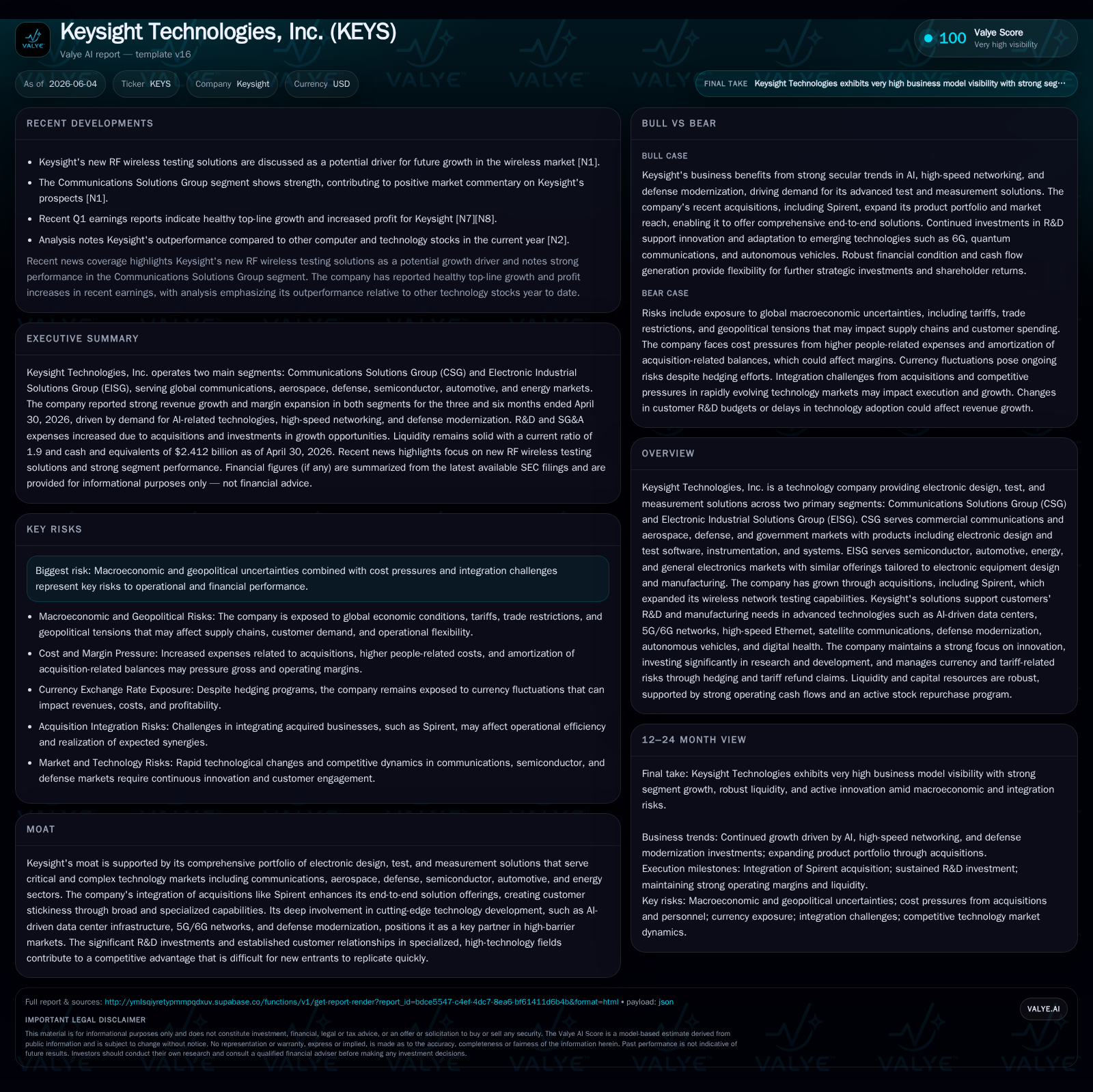
In its June 2026 quarterly report, Keysight Technologies delivered robust margin expansion fueled by tariff refunds, strong revenue volume, and favorable product mix alongside ongoing integration of recent acquisitions. The company sustained heightened R&D and SG&A spending reflective of strategic investments in AI-driven data centers, 5G/6G networks, and automotive electronics validation. Operating leverage improved substantially despite cost pressures from amortization and personnel expenses. Keysight's dual-segment business model serves diverse high-technology sectors, leveraging a broad portfolio that underpins resilient demand and customer stickiness. Risks remain around macroeconomic uncertainties and integration complexities, but the firm’s strong liquidity and balanced leverage support its aggressive innovation cycle and growth initiatives.
Recent Quarterly Operating Highlights: Margin Expansion and Income Gains
Keysight Technologies’ Q2 fiscal 2026 results released on June 4 report substantial gross margin improvement to 67.8% from 59.4% a year earlier [S2]. This represents an 8-point uplift primarily attributed to successful IEEPA tariff refund claims along with growing revenue volumes and more favorable product mix. Incremental contributions from recent acquisitions also bolstered gross margins despite headwinds from ongoing tariffs. Operating margins benefited accordingly, rising to 33.1%, up sharply from 23.4% the prior year quarter [S2]. The margin gains reflect effective operating leverage from scale combined with disciplined cost management.
Non-cash adjustments notably increased net income by $204 million over the six-month period ended April 30, driven primarily by elevated acquisition amortization ($65 million increase) as well as share-based compensation ($36 million), depreciation ($13 million), partially offset by investment sale gains [S2]. Personnel-related costs rose amid higher headcount—approximately +1,100 employees compared to prior year reflecting principally acquired businesses—and increased variable compensation components [S2]. While these expense categories added pressure on operating income, they represent investments supporting longer-term growth platforms.
Business Model Overview: Dual-Segment Innovation and Market Diversity
Keysight operates two principal segments: Communications Solutions Group (CSG) serving commercial communications alongside aerospace/defense/government markets; and Electronic Industrial Solutions Group (EISG) targeting semiconductor equipment manufacturers, automotive systems validation including software-defined vehicles/autonomous driving segments, energy solutions, and general electronics OEMs.[S19][S20]
Each segment offers a comprehensive suite of electronic design automation tools, test instruments including hardware/software platforms for validation/simulation/measurement tasks essential across R&D to manufacturing cycles. This positioning builds deep customer integration into complex technology workflows that are not easily substitutable.
The diversified end-market exposure buffers cyclicality risks inherent in semiconductors or aerospace defense individually while enabling cross-pollination of innovative offerings—for instance, AI-driven datacenter infrastructure testing developed in CSG finds applications in automotive chip validation within EISG. This breadth supports stable revenue streams tied to customers' multiphase innovation roadmaps.
Competitive Position and Industry Structure: Strength Through Acquisition Integration
Keysight's competitive moat derives from its comprehensive portfolio covering cutting-edge electronic test domains complemented by strategic acquisitions like Spirent that enhanced network testing capabilities for wireless standards including emerging 5G/6G protocols.
The industry shows consolidation tendencies where scale is critical to invest in high-spec instrumentation development while meeting price-performance expectations amid escalating technology complexity.
Amortization costs related to acquisitions have risen markedly ($65 million increase year over year), indicating ongoing investment in integrating these complementary assets into cohesive offerings that fortify Keysight’s pricing power versus standalone peers largely focused on narrower niches [S2][N8]. This short-term earnings impact is typical but suggests management prioritizes sustained long-term differentiation through bolstering end-to-end solution depth.
Sector-Specific KPIs Driving Sustainable Profitability
R&D expense has surged nearly 28% in Q2 alone ($77 million versus $63 million prior year), reflecting accelerated innovation activity aligned with addressing advanced semiconductor performance testing challenges, autonomous vehicle sensor validation demands, and next-generation wireless network verification requirements [S2]. This spend as a percentage of revenue underscores Keysight’s commitment to maintaining technology leadership critical for customer retention amidst rapid market evolution.
In parallel, selling general & administrative expenses rose commensurately due to expanded field resources required to support new product introductions and integration initiatives plus increased marketing investments aligned with expanding enterprise footprints post-acquisition [S2]. Despite these cost increases, operating leverage improvements demonstrate efficiency enhancements likely stemming from mix shifts toward higher-margin software subscriptions embedded within hardware setups—a trend consistent with sector peers focusing on recurring revenue streams.
Growth Drivers: Innovation in Emerging Technologies and Market Penetration
Key tailwinds stem from robust demand growth in AI-driven data centers requiring extensive high-frequency testing solutions; evolving semiconductor fabrication processes necessitating precision measurement instruments; the booming segment for validation tools in software-defined/autonomous vehicles; as well as expanded needs in satellite communications integral to aerospace/defense modernization efforts [N2][N8].
The EISG segment’s reported 19%-24% revenue growth year-over-year evidences strong traction across Asia Pacific and Europe amid continued innovation investments by semiconductor fabs and PCB manufacturers focusing on next-gen interconnect technologies critical for performance scaling [S2]
Meanwhile CSG maintains steady progress servicing commercial telecom upgrades underpinning global wireless standard transitions that expand the total addressable market for network emulation/testing solutions against increasingly complex RF environments [N2][N8].
This environment fosters scalable opportunities especially when paired with software-driven recurring revenue models integral to automated test procedures—a key metric for tracking sustainable business development within the capital-intensive electronic equipment sector.
Risks and Constraints: Cost Pressures and Geopolitical Uncertainty
Macroeconomic uncertainties could influence customer capex cycles impacting near-term demand visibility — semiconductor fabs might pause capacity expansions amid inventory swings whereas defense budgets often fluctuate with geopolitical shifts. Tariff-related headwinds remain relevant outside periods covered by refund claims which improved margins temporarily.
Personnel inflation especially within R&D engineering talent pools contributes to rising variable compensation expenses challenging margin expansion if revenue scaling slows relative to fixed cost bases [S2]. Integration complexities of acquired entities may extend amortization burdens affecting reported EPS clarity despite their strategic rationale.
Additionally, currency volatility impacts both top-line translations as well as procurement costs given the globalized supply chains involved with instrumentation manufacturing requiring precise components sourcing across multiple jurisdictions [S14].
Outlook: Milestones to Monitor for Execution Success
Investors should track forthcoming quarterly updates highlighting margins sustaining post-integration phases alongside updated management commentary on R&D spending trajectories particularly how accelerated investments translate into product pipeline advancements targeting AI/5G/autonomous car segments [S2][S3].
Monitoring bookings momentum within newly launched RF wireless testing suites or semiconductor production tools will provide insights into demand durability amid evolving market dynamics [N2][N8]. The pace at which recurring revenue contributions grow via embedded software subscriptions or automated test frameworks will be an indicator of structural business quality improvements.
Acquisition assimilation progress encompassing cost synergy realization versus incremental sales lift also remains critical for validating medium-term profitability targets.
Financial Summary: Liquidity, Leverage, and Operational Efficiency
At April 30, 2026, Keysight held $2.4 billion in cash equivalents against total debt approximating $2.53 billion producing a net debt position near $119 million with a strong current ratio around 1.9 reflecting solid working capital management [F1][S2]. Operating cash flow generation improved notably versus prior periods supporting sustained investment activity including capex commitments for facility expansions plus acquisition outlays [$80 million investing cash outflows reported].
This strong liquidity foundation enables Keysight to pursue growth projects confidently amidst external industry volatility.
This analysis focuses solely on publicly disclosed information from Keysight Technologies’ SEC filings through June 4, 2026 ([S2], [S3]) combined with recent news commentary () without offering investment research views or forecasts beyond factual interpretation of operational data. All financial figures are cited directly per regulatory filings or verified corporate disclosures.
Disclaimer: This is research-only, informational analysis and not investment advice. It may include AI-generated interpretation and general industry context. Always verify important details using primary sources.

Comments