
Cohen & Steers: Real Assets Expertise Powers Consistent Growth Amid Market Volatility
The firm’s niche focus on real assets and alternative income underpins steady financial performance despite a turbulent macroeconomic backdrop.
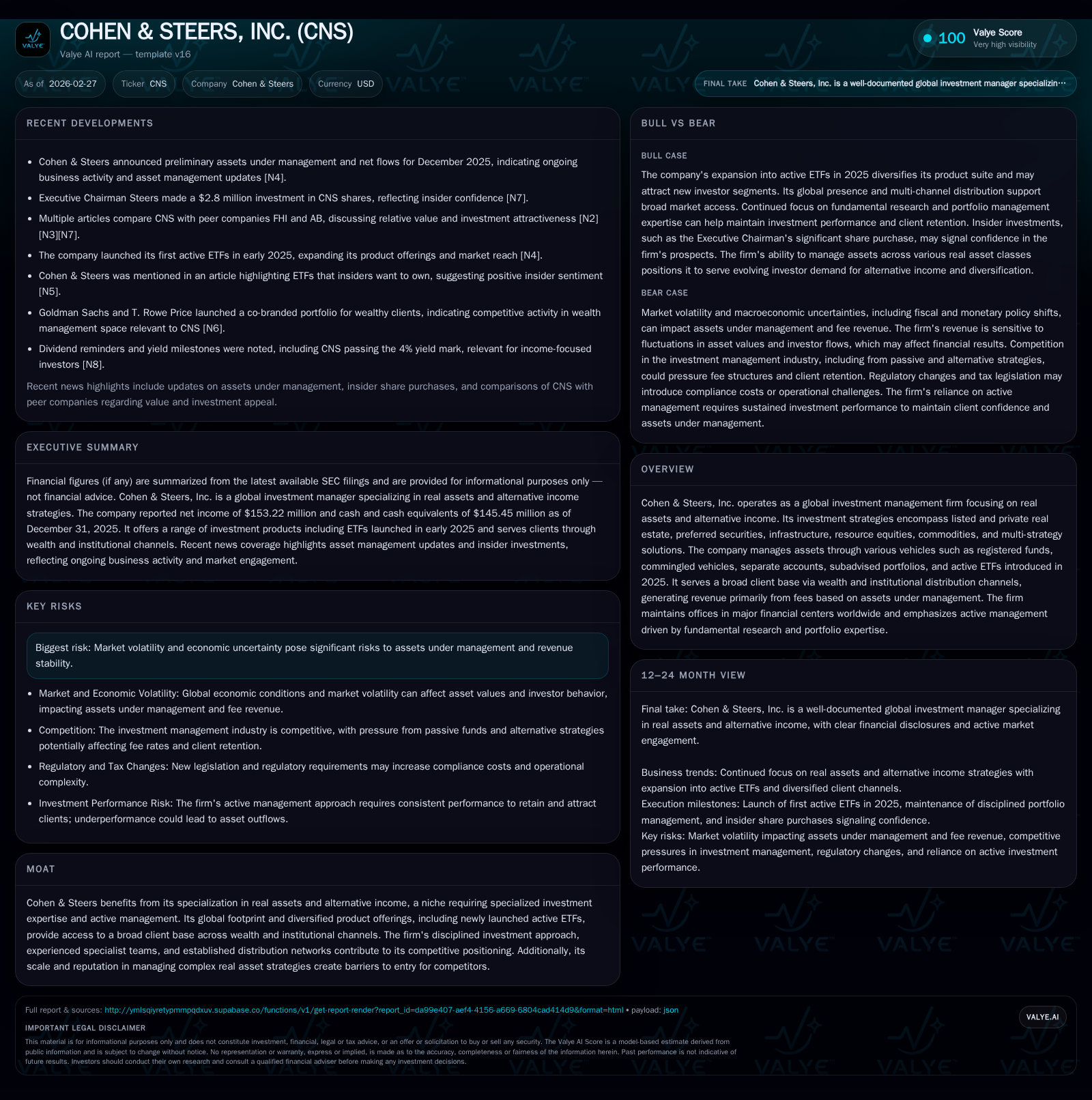
Cohen & Steers has demonstrated reliable revenue and income growth driven by its specialization in real assets and alternative income strategies, supported by an expanding product range including active ETFs launched in 2025. The company maintains disciplined capital allocation with consistent dividend increases and modest buybacks, alongside prudent leverage management evidenced by a $100 million revolving credit facility extended to 2029. However, a sharp decline in operating cash flow in the latest fiscal year signals operational challenges warranting close monitoring. Robust cybersecurity governance and a broad global distribution footprint further solidify the firm’s competitive moat heading into 2026.
Evolution of Growth: Tracking Revenue and Income Trajectories
Cohen & Steers has exhibited consistent expansion since FY2017, with revenue growing approximately 17% over four years from about $99.3 million to $116.5 million by FY2020 [F1]. While more recent specific annual revenues beyond 2020 are not explicitly disclosed, operating income and net income data through FY2025 provide insight into ongoing earnings momentum.
Operating income peaked notably at $215.9 million in FY2022 then moderated to $177.7 million by FY2025 — a decline of roughly 17.6% over three years — hinting at margin compression or shifting portfolio mix during evolving market conditions [F1]. Net income reflects relative resilience, edging up slightly to $153.2 million in FY2025 compared with $151.3 million in FY2024 (+1.3% YoY) [F1]. This suggests Cohen & Steers has managed to preserve profitability even as operating conditions fluctuate.
Historical performance (annual)
| FY | Net ($mm) | CFO ($mm) | OpInc ($mm) | Capex ($mm) | Net YoY |
|---|---|---|---|---|---|
| 2025 | 153 | -120 | 178 | 6 | +1.3% |
| 2024 | 151 | 97 | 173 | 12 | +17.2% |
| 2023 | 129 | 172 | 164 | 57 | -24.6% |
| 2022 | 171 | 62 | 216 | 4 |
Source: SEC companyfacts cache [F1].
Capital returns and efficiency (annual)
| FY | Div ($mm) | Buybacks ($mm) | FCF ($mm) |
|---|---|---|---|
| 2025 | 127 | 28 | -126 |
| 2024 | 119 | 21 | 85 |
| 2023 | 112 | 22 | 115 |
| 2022 | 107 | 27 | 57 |
Source: SEC companyfacts cache [F1].
Data for some years not explicitly available; table focuses on disclosed key figures [F1]
Drivers Behind Historical Performance: Portfolio Specialization and Market Conditions
Cohen & Steers’ growth has been anchored in its specialization within the real assets and alternative income niches — sectors requiring specialized investment acumen and tailored portfolio management approaches [S1]. This includes strategies across listed/private real estate, preferred securities (notably low duration), infrastructure, resource equities, commodities, and multi-strategy solutions.
Market dynamics have influenced results variably: the firm's assets under management (AUM) react directly to fluctuating valuations driven by interest rate cycles and trade tensions documented through late-2025 [S1]. Monetary policy developments such as the Federal Reserve's interest rate cut cycle introduced early last year shifted investor sentiment toward yield-oriented alternatives, benefiting strategically positioned managers like Cohen & Steers.
The active management style supported by fundamental research teams allows nimble positioning within these volatile asset classes but exposes revenue streams to market swings impacting fee base [S1]. For example, preference for real assets offsets some downside during equity pullbacks but high correlation during risk-off episodes remains a constraint.
Current Macroeconomic Impact and Operational Adaptations
Throughout the turbulent economic environment of late 2024 and most of 2025—marked by fiscal policy shifts, government shutdowns, and persistent policy uncertainty—Cohen & Steers emphasized disciplined cost control alongside portfolio diversification to sustain risk-adjusted returns [S1][S2][N2].
Their management commentary within MD&A sections alludes to stringent operational efficiency programs which cushioned profitability margins amidst subdued asset inflows and elevated cost pressures [S2]. The firm’s robust risk management framework ensures minimal disruptive volatility across funds they manage.
Furthermore, their balanced client exposure between wealth institutions (registered investment advisers, broker dealers) and sovereign/public funds provides diversification advantages among distribution channels that can sometimes offset sector-specific headwinds [S3].
Expanding Horizons: New Product Launches and Future Market Opportunities
Strategic innovation has seen Cohen & Steers launch its first active exchange traded funds (ETFs) during Q1 of calendar year 2025—a marked entry into a fast-growing segment of investment vehicles that cater both to retail investors via wealth channels and institutional participants seeking transparency plus liquidity [N2][S1].
These ETFs complement their established suite of strategies encompassing registered funds, separate accounts, commingled vehicles, and subadvised portfolios [S19]. The firm’s active ETF initiative broadens access while providing opportunity for incremental fee-based revenue generation — critical as fee pressures rise industry-wide.
Further expansions into multi-strategy solutions underscore efforts to capture cross-asset opportunities within real assets categories — a progressive approach considering increasing investor appetite for yield-dense diversified products [N2]. Growth constraints will stem principally from macroeconomic uncertainty’s impact on AUM valuation trajectories and competitive pressures for scale.
Capital Structure Stability and Liquidity Enhancements
Cohen & Steers maintains financial flexibility via a revolving credit facility originally set to mature January 20, 2026 but amended mid-2025 to extend maturity through August 15, 2029 under similar senior unsecured terms [S4][S5][S6][S10][S25]. This agreement allows variable-rate borrowings tied either to Term SOFR or Base Rate plus applicable spreads per performance pricing grids.
As of mid-2025 filings through Q3 year-end reporting dates, Cohen & Steers remained compliant across leverage ratios—an indication of measured use of debt facilities without undue overextension [S4][S6]. Commitment fees on unused balances help maintain cost efficiency while preserving quick access for working capital or strategic deployment needs.
Additionally, the Company has made funded commitments exceeding $110 million into certain proprietary investment vehicles with remaining uncertain timing on other contributions totaling up to roughly $175 million—another factor underscoring liquidity management imperatives for capital efficiency [S11][S16].
Analyzing Capital Allocation: Dividends, Buybacks, and Return on Equity
Cohen & Steers demonstrates consistent capital return policies emphasizing dividends complemented by targeted share repurchases [F1][S14][S18]. Dividend distributions increased steadily each fiscal year through FY2025 reaching approximately $126.9 million last reported — reflecting confidence in recurring earnings power.
Repurchase activity remains more measured yet steady with buyback amounts circa $28.4 million in FY2025 after modest fluctuations previously—underscoring a preference towards balancing shareholder returns without excessive equity reduction program scale [F1].
Calculating approximate return on equity for FY2025 yields a robust ~27%, consistent with strong profitability metrics aligned with comparable specialty asset managers using active fee models built on AUM values rather than transaction volume alone [F1]. This indicates effective utilization of shareholder capital towards generating above-average earnings.
Navigating Cash Flow Challenges: Insights from Recent Operating Cash Trends
A notable area warranting scrutiny is the significant plunge in operating cash flow recorded for FY2025 (-$120M) contrasting starkly against positive cash generation exceeding $96M just one year prior [F1]. This sharp reversal signals either timing anomalies related to working capital adjustments or heightened outflows linked possibly to incentives or operational investments detailed partially within SEC notes.[S1][S2]
Capital expenditure halved relative to prior years (~$6M versus over $11M), yet overall free cash flow remains negative around -$126M—this underscores heightened operational cash demands not offset sufficiently by renewed inflows during disrupted market conditions [F1].
Though caution is warranted before extrapolating permanent trends without clearer disclosures, this metric will be crucial for ongoing monitoring especially regarding sustainable funding of growth initiatives versus balance sheet health.
Strategic Risk Management: Cybersecurity and Compliance Posture
Despite tangential focus for investors primarily interested in financial returns, Cohen & Steers presents a mature cybersecurity governance framework overseen by veteran executives including a CISO credentialed with CISAs/CRISC certifications plus CTO leadership boasting near three decades’ experience within financial services [S1].
The integrated cybersecurity incident response plan involves roles clearly defined across executive teams with escalation policies assuring prompt notification up to board audit committee levels when incidents arise.[S1] Notably no material cyber events have impacted business operations or strategy through December 31, 2025.
Regular audits combined with ERM integration highlight adherence toward emerging risk standards protecting sensitive client data amid accelerating cyber threats prevalent across global investment firms — an increasingly competitive differentiator assuring institutional client confidence.
Key Milestones to Monitor in 2026 and Beyond
Looking forward, attention should focus on sustainability of new product launches notably the active ETF lineup's asset gathering pace relative to established vehicles as reported in press releases throughout early-2026 [N2][N3], underpinning potential incremental fee revenue streams.
Tracking net flows into core strategies amid macroeconomic headwinds will indicate whether Cohen & Steers leverages its niche expertise effectively during volatility—with particular regard toward global infrastructure and private real estate segments showing relative resilience during inflationary economies.[S3]
Updates related to usage patterns under the amended revolving credit facility may also provide insights into capital deployment strategies or opportunistic acquisitions expanding portfolio breadth.[S4][S10]
Dividend policy announcements timed quarterly ought also signal management’s confidence aligned with prevailing earnings trajectories while any adjustment could reflect shifting priorities.
In sum, Cohen & Steers combines specialized know-how cultivated over decades with tangible product evolution aimed at capturing alternative income growth opportunities—all while deploying prudent financial stewardship positioning them well amid multifaceted market forces heading into 2026.
This analysis synthesizes information solely from provided SEC filings ([S#]), company numerical data ([F1]), and recent news articles ([N#]). It does not constitute investment advice or recommendations but rather aims to objectively assess company financials, strategies, risks, and outlook based on disclosed evidence.
Disclaimer: This is research-only, informational analysis and not investment advice. It may include AI-generated interpretation and general industry context. Always verify important details using primary sources.

Comments