
Constellation Acquisition’s SPAC Model Faces Execution and Governance Challenges Ahead of Deadline
As Constellation Acquisition nears its May 29 deadline, its pursuit of a lithium industry business combination with US Elemental exposes critical execution and governance risks intrinsic to the SPAC structure.
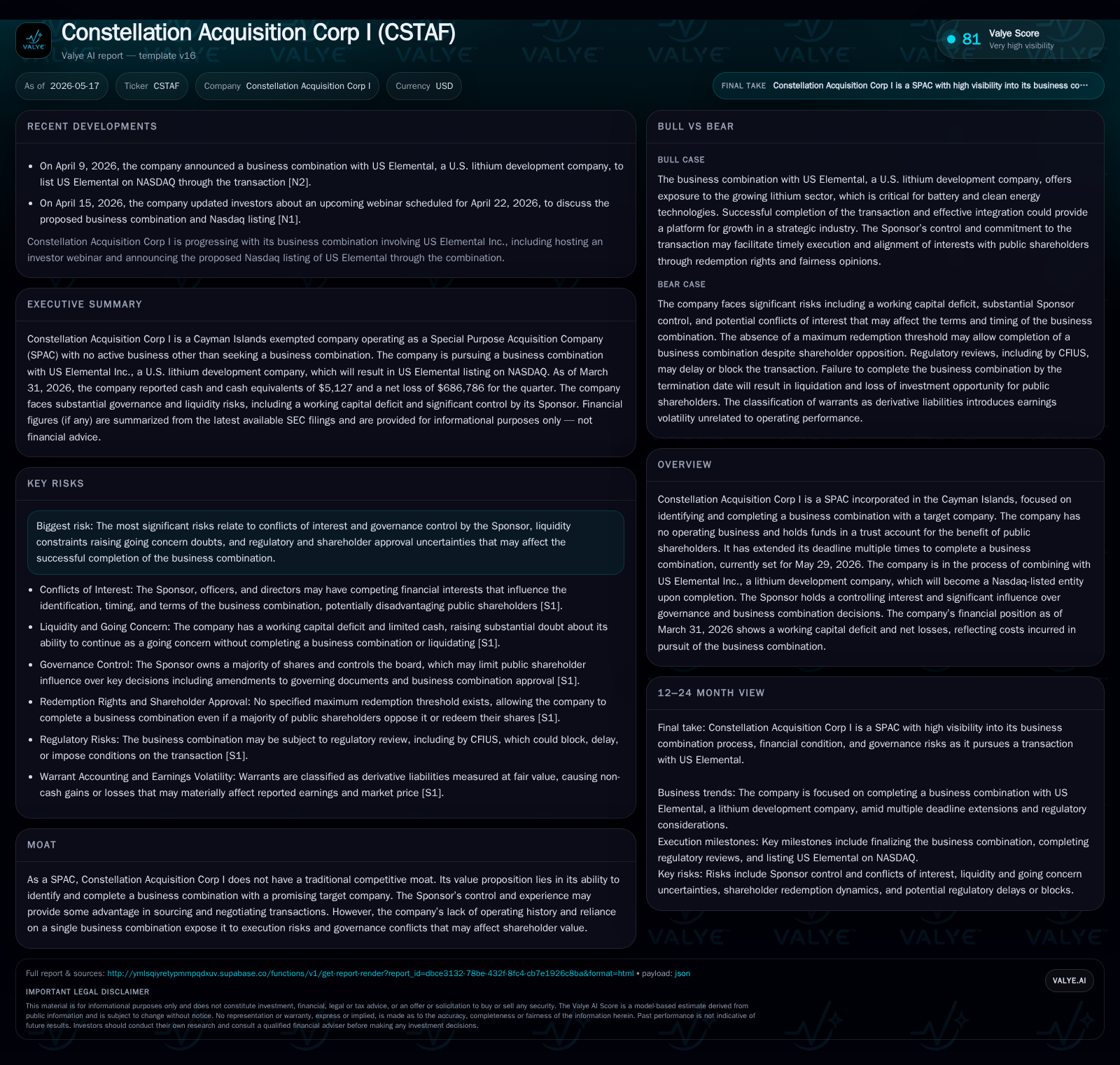
Constellation Acquisition Corp I is approaching a pivotal deadline to complete a business combination with US Elemental, a lithium development company slated for Nasdaq listing. The latest quarterly filing reveals a strained liquidity position marked by a significant working capital deficit and minimal cash balance, underscoring financial pressures. As a Cayman Islands-based SPAC, its value hinges entirely on successful merger execution amid sponsor-controlled governance that presents potential conflicts of interest. Market dynamics around lithium demand offer a promising growth pathway, but risks related to funding, regulatory approval, and deal completion remain material concerns in this limited operating business model.
Latest Quarterly Update and Business Combination Progress
The May 15, 2026 Form 10-Q [S2] positions Constellation Acquisition Corp I at a critical juncture: with its mandatory deadline to complete a business combination looming on May 29, 2026. The filing confirms that the company remains actively engaged in finalizing its merger with US Elemental Inc., a lithium development enterprise targeting Nasdaq listing [N1]. However, the financial disclosures paint a stark picture of operational stress—current liabilities stand near $11.9 million vastly overshadowing current assets near $40,000 and cash & equivalents amounting to only approximately $5,127 as of March 31, 2026 [F1]. This stark disparity results in a negative working capital stance indicating that Constellation Acquisition faces meaningful execution risk unless transaction closure occurs imminently.
This filing reaffirms prior commitments to consummate the business combination before forced liquidation would occur [S1], underscoring pressure on leadership to expedite final approvals and financing arrangements. The company’s net losses through the last reported period further highlight an absence of core operations generating revenue—typical of SPACs structured solely as acquisition vehicles [F1]. Thus, this quarterly update starkly illuminates how Constellation’s near-term viability rests exclusively on the successful closing of the US Elemental transaction.
Business Model Anchored in SPAC Structure and Lithium Sector Exposure
Constellation Acquisition operates as a Cayman Islands-incorporated special purpose acquisition company (SPAC), designed without intrinsic operating assets or revenue streams [S1]. Its core business model revolves around raising investor capital upfront which is held in trust while management searches for an appealing private company target to merge with—a process colloquially known as ‘de-SPACing.’ In this instance, the target is US Elemental Inc., positioned within the strategically relevant lithium development sector [N1]. The combined entity post-merger will become publicly listed on Nasdaq.
Revenue mechanistically depends entirely on closing this singular transformative merger; absent completion no revenue or operational cash flow arises [N1][S6]. Pricing power or customer mix dynamics are thus not applicable pre-merger. Success derives instead from targeting companies whose markets exhibit strong structural demand drivers—in this case lithium’s role in electric vehicle batteries and renewable infrastructure offers growth tailwinds supportive of long-term share appreciation
However, Constellation’s governance structure consolidates substantial influence within its Sponsor entity (Constellation Sponsor LP), which controls key decisions including transaction timing [S1]. This creates complex agency dynamics between public shareholders—who bear economic risk—and Sponsor interests who benefit differently from deal terms and potential control positions post-merger.
Competitive Dynamics and Governance Complexities in SPAC Transactions
The landscape for SPACs has grown notably competitive since their rise earlier in the decade. Sponsors must identify compelling acquisition targets amid fluctuating capital market sentiment and regulatory scrutiny. Given Constellation’s controlling Sponsor interest coupled with off-balance sheet obligations such as amended promissory notes increasing to over $5 million [S3][S26], governance complexity heightens.
Conflicts may emanate from Sponsor incentives favoring deal completion over optimal terms for public investors. Amendments to founder agreements executed without shareholder consent further accentuate misalignment potentials [S1]. Unlike traditional operating firms competing on product differentiation or scale efficiencies, SPACs compete predominantly on transaction execution capabilities and Sponsor reputational capital.
Investors face opaque disclosure regimes relative to target valuations plus uncertainty over event timing—introducing execution risk that can materially impact shareholder returns if milestones are missed or renegotiated under duress.
Growth Catalysts Linked to Lithium Industry Entry and Listing Milestone
If consummated successfully, the merger transports Constellation from a non-operating shell into an active participant in the lithium resources market—a sector underpinned by intensifying global demand for clean energy metals [N1][S6]. This transition could unlock growth through expanded resource development capacity at US Elemental’s operations potentially supported by partnerships such as with Jindalee Lithium Limited announced during proxy-related disclosures [S16].
Key measurable catalysts include release and SEC clearance of definitive proxy statements for shareholder voting scheduled imminently [S5][S16], Nasdaq listing approvals expected post-merger completion [N1], alongside investor engagement events highlighting economic prospects like projected Net Present Value (NPV) enhancements and production targets cited in recent webinars [N2].
While structural demand for lithium suggests enduring tailwinds beyond typical cyclicality seen in resource sectors, actual growth realization strongly depends on timely capital deployment post-merger which remains contingent on deal closure.
Key Risks: Liquidity, Sponsor Control, and Event Completion Uncertainty
Material risks permeate Constellation’s path forward given its extreme liquidity pressure—a reported current ratio effectively at zero due to liabilities eclipsing assets nearly 300-fold as per Q1 balance sheet data [F1][S2]. The possibility that costs exceed budgeted levels for due diligence or merger execution introduces funded continuation doubts [S1]. Additional financing requirements may compel new security issuances or debt incurrence potentially dilutive or restrictive.
Sponsor control poses conflict-of-interest challenges where managerial discretion over timing or selection could diverge from public shareholder preferences—especially since amendments may occur without shareholder approval under letter agreements underpinning Sponsor privileges [S1]
Regulatory uncertainties loom large: foreign investment reviews (e.g., CFIUS) add layers of approval complexity implying potential delays or prohibitions impacting deal viability [S1][S23]. External geopolitical instability—such as tensions involving Russia-Ukraine or China-Taiwan—further exacerbate market volatility directly influencing financing availability or valuation backstops.
Failure to consummate before the date triggers wound-down liquidation scenarios erasing premium value propositions embedded within deal expectations.
Near-Term Milestones and What Investors Should Monitor Next
Several imminent events will critically test Constellation’s trajectory:
- The May 29 deadline marks the last allowable completion date for the business combination before mandatory liquidation enforced by SPAC rules [S2][S23].
- Proxy/Registration Statement filings (Form S-4), expected briefings via clearly laid out investor webinars have been scheduled recently for late April explaining deal details to shareholders ahead of voting rounds [S5][N2][S16].
- Shareholder voting outcomes on approval of the merger will be pivotal; rejection could precipitate liquidation unless extensions are granted within regulatory frameworks.
- Required regulatory clearances including NASDAQ listing acceptance and governmental foreign investment reviews must be secured. Any denial materially curtails prospects.
- Additional financing arrangements might be announced addressing shortfalls identified post-quarter end; these would reveal Sponsor commitment level amid stretched liquidity. Monitoring these milestones provides crucial insights into both contractual execution feasibility and evolving governance dynamics around public investor protections.
Financial Profile Reflecting Liquidity Strain and Operational Burn
Reflecting its status as a pre-combination SPAC executing merger pursuit activities exclusively, Constellation exhibits negligible revenue generation alongside ongoing net losses attributable primarily to transactional advisory fees, legal costs, and administrative overhead concentrically focused on closing the planned business combination [F1][S2]
At March quarter-end: cash & equivalents stood at approximately $5,127 with current assets totaling roughly $40,402 compared against current liabilities approaching $11.9 million resulting in an effectively zero current ratio highlighting intensive liquidity stress [F1]. Total debt was about $227k though net leverage considerations are secondary given imminent corporate transformation expected following transaction closure [F1].
These figures reflect high operational burn relative to financial resource availability requiring successful merger completion or substantial additional financing imminently to bridge near-term gaps. Failure would likely compel asset liquidation releasing only pro rata trust account proceeds minus liabilities impacting warrant holders disproportionately [S1][S2]
This analysis integrates public filings up through May 15, 2026 including Form 10-Q disclosures coupled with related SEC amendments and recent press releases detailing Constellation Acquisition Corp I's pursuit of business combination completion. Given inherent uncertainties associated with SPAC operations—particularly those controlled by dominant Sponsors targeting volatile sectors such as lithium resource development—the outcome hinges delicately upon successful navigation of financial liquidity constraints alongside governance tensions before contractual deadlines expire.
Readers should consider this analysis descriptive rather than prescriptive given policy constraints restricting investment research views.
Disclaimer: This is research-only, informational analysis and not investment advice. It may include AI-generated interpretation and general industry context. Always verify important details using primary sources.

Comments