
Cytosorbents’ Critical Care Ambitions Collide with Liquidity Strain and Listing Risk
The company’s future now hinges on regulatory progress, market adoption, and its ability to secure additional capital before compliance windows close.
The company’s ability to sustain operations and achieve broader adoption of its blood purification technologies will depend on progress with regulatory approvals, market acceptance, and near-term financing solutions. Investors should watch for capital raises, regulatory milestones, and signals of commercial traction as the most important thesis tests over the next year. [S2] [N1] [N2]
Cytosorbents Corp sits at a pivotal crossroads: its blood purification devices, led by the CytoSorb platform, serve high-stakes critical care needs and are supported by ongoing regulatory filings. With a December 2026 Nasdaq delisting deadline looming and regulatory progress for new products far from assured, Cytosorbents’ next moves will determine whether it can bridge the gap between scientific promise and commercial viability.
Liquidity Crunch and Nasdaq Listing Risk Dominate Near-Term Outlook
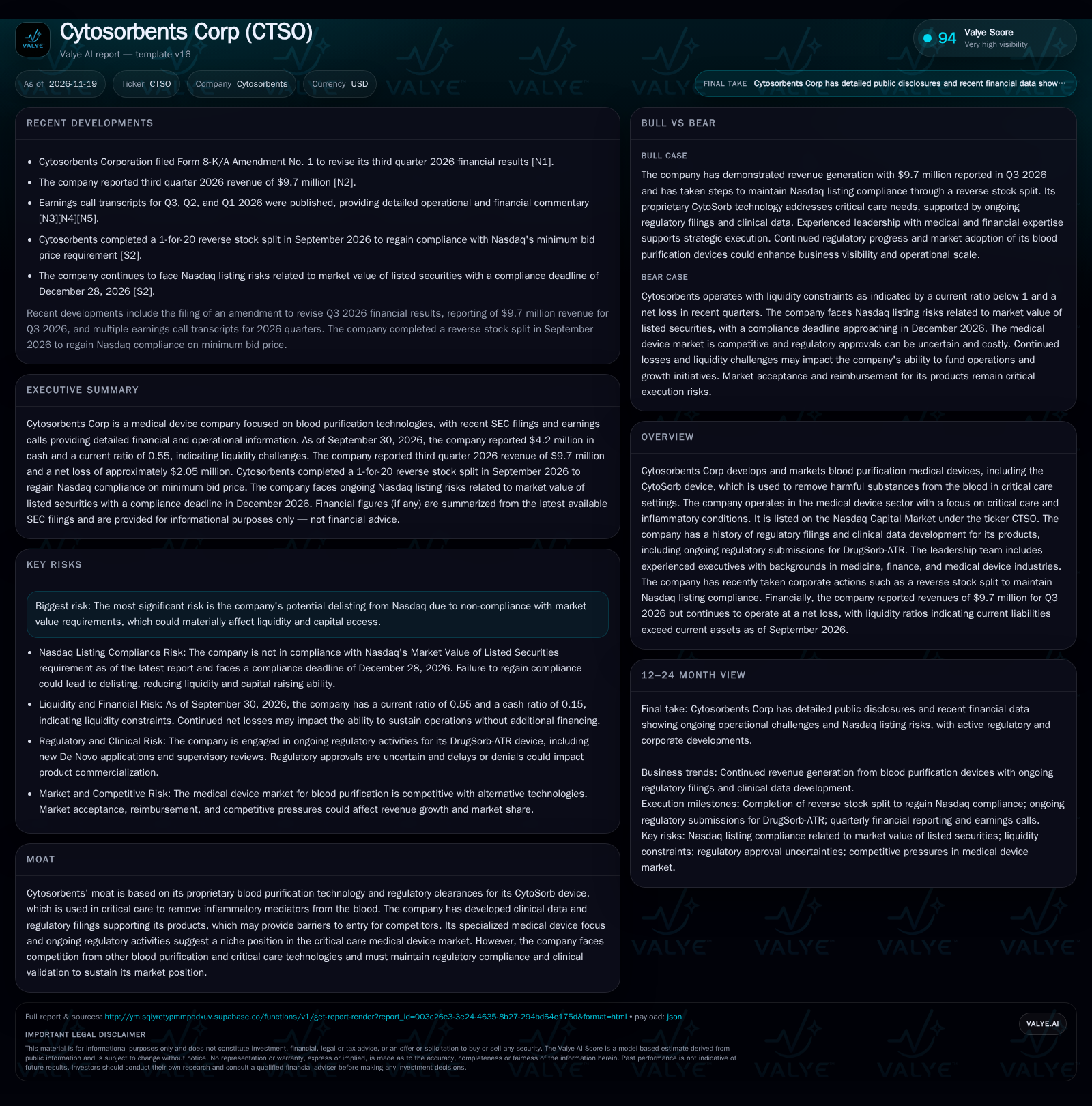
As of September 30, 2026, Cytosorbents reported $4.2 million in cash and cash equivalents, current assets of $15.44 million, and current liabilities of $28.03 million—yielding a current ratio of 0.55 and a cash ratio of 0.15. These figures highlight acute liquidity constraints, with current liabilities substantially exceeding liquid assets. The company posted third quarter 2026 revenue of $9.7 million but continued to operate at a net loss of $2.05 million, translating to a basic and diluted EPS of -$0.65 per share. To address minimum bid price requirements, Cytosorbents executed a 1-for-20 reverse stock split in September 2026. However, the company remains out of compliance with Nasdaq’s market value of listed securities requirement, facing a delisting deadline of December 28, 2026. Ongoing regulatory submissions for its DrugSorb-ATR device and continued clinical data development are crucial operational milestones. The intersection of persistent losses, urgent liquidity needs, and listing risk now defines the company’s strategic landscape. [S2] [N1] [N2]
The liquidity crunch not only impacts day-to-day operations but also constrains strategic flexibility. In capital-intensive medical device sectors, the ability to invest in clinical trials, regulatory submissions, and commercial infrastructure is critical to sustaining momentum. When cash resources are limited, management must make difficult trade-offs between advancing product development and maintaining sales efforts. This dynamic can lengthen timelines for regulatory approvals and slow market penetration, creating a feedback loop that exacerbates financial strain. Furthermore, the pressure to meet Nasdaq listing requirements adds a layer of urgency that may force near-term decisions prioritizing compliance over long-term value creation.
Revenue Model, Cash Burn, and the Economics of Blood Purification Devices
Cytosorbents’ core revenue stream stems from sales of its CytoSorb blood purification device, which is marketed for use in critical care to remove inflammatory mediators from the blood. In medical device businesses like this, economics typically hinge on a mix of up-front device sales and recurring consumable or cartridge revenues, with gross margins influenced by manufacturing scale, regulatory compliance costs, and channel mix. However, the company’s current financials—marked by ongoing net losses—suggest that fixed operating expenses, including R&D, regulatory, and commercial overhead, are not yet covered by gross profit from device sales.
Operating leverage could improve if revenue growth accelerates, particularly if higher-margin consumables become a larger share of the mix. However, persistent cash burn creates pressure to either raise additional capital or dramatically reduce costs. The capital intensity of ongoing clinical trials and regulatory submissions for new products like DrugSorb-ATR compounds this challenge. Without additional financing or a step-change in revenue, the company’s economics remain precarious—leaving little margin for execution error.
The recurring revenue potential from consumables is a key lever for improving the unit economics of blood purification devices. If Cytosorbents can increase the attach rate of disposable cartridges per device, it could generate more predictable and scalable cash flow. However, this depends on clinical acceptance and integration into hospital protocols, which often require robust evidence of cost-effectiveness and patient outcome benefits. Additionally, reimbursement policies play a pivotal role: favorable reimbursement codes and pricing can accelerate adoption and improve margins, while unfavorable or uncertain reimbursement environments can hinder utilization and revenue growth. Therefore, the interplay between clinical validation, reimbursement landscape, and consumable sales dynamics is central to the company’s path to profitability.
Barriers and Counterforces in a Crowded Critical Care Landscape
Cytosorbents’ competitive position rests on its proprietary blood purification technology and regulatory clearances for the CytoSorb device. In theory, clinical evidence and regulatory approvals can create substantial barriers to entry in critical care medical devices, especially when supported by peer-reviewed data and real-world adoption. However, the market for extracorporeal blood purification is competitive, featuring both established medical device conglomerates and specialized device manufacturers, as well as alternative therapies for managing sepsis and inflammatory syndromes.
The company’s ability to secure favorable reimbursement, demonstrate clear clinical superiority, and maintain regulatory momentum are all essential to defend and expand market share. Switching costs for hospitals can be meaningful if devices are embedded in protocols and supported by training and evidence, but new entrants with improved efficacy, ease of use, or pricing may erode any temporary advantage. Ultimately, Cytosorbents’ moat depends on sustained innovation, regulatory progress, and the ability to convert clinical efficacy into commercial traction.
The critical care market is characterized by rapid innovation and evolving standards of care, which can both create opportunities and threats for Cytosorbents. Competitors may introduce novel blood purification technologies with differentiated mechanisms or enhanced ease of use, potentially shifting clinician preferences. Moreover, shifts in clinical guidelines driven by emerging evidence can alter the perceived value proposition of existing devices. Therefore, sustaining a competitive advantage requires continuous investment in clinical research to demonstrate superior outcomes and cost benefits. Additionally, building strong relationships with key opinion leaders and integrating into hospital decision-making processes can raise switching costs and support durable market share. However, these efforts demand resources that may be constrained by current financial pressures.
How Regulatory Wins and Capital Infusions Could Transform the Trajectory
A favorable scenario for Cytosorbents would be driven by successful regulatory approvals for DrugSorb-ATR and expanded indications for CytoSorb, coupled with a capital raise that alleviates near-term liquidity pressure. If the company secures a positive regulatory decision—particularly a De Novo clearance in a major market—it could unlock new addressable segments and catalyze adoption among critical care centers. Simultaneously, a meaningful equity or strategic investment would provide operating runway, allowing management to accelerate salesforce expansion, hospital onboarding, and post-market clinical studies.
Evidence that would confirm this scenario includes: announced regulatory wins, a significant capital raise or partnership, and sequential revenue acceleration driven by new accounts or expanded usage. Conversely, if regulatory timelines slip or financing is only available on punitive terms, this upside path would be undermined.
Sustaining Operations Amid Uncertainty and Incremental Progress
The most plausible near-term outcome is that Cytosorbents continues to generate modest revenue growth from its existing CytoSorb platform, while pursuing regulatory submissions for DrugSorb-ATR and seeking additional financing under increasingly constrained conditions. Operational cost control becomes more prominent as cash balances dwindle, with management potentially forced to prioritize certain development programs or geographies over others.
Confirmation of this scenario would come from incremental regulatory progress (such as acceptance of new filings), modest sequential revenue increases, and bridge financing that delays—but does not resolve—the underlying liquidity challenge. If the company fails to raise capital or loses key regulatory momentum, the risk of operational disruption or delisting becomes acute.
Liquidity Exhaustion and Delisting Drive Strategic Options to the Brink
In an adverse scenario, Cytosorbents is unable to raise sufficient capital before its cash reserves are depleted, forcing dramatic cuts to R&D and commercial operations. If Nasdaq delisting proceeds due to failure to meet market value requirements, the company could lose access to public capital markets, further constraining its ability to fund operations and eroding investor confidence. Regulatory setbacks—such as rejection or prolonged review of DrugSorb-ATR—would compound these pressures, potentially triggering restructuring, asset sales, or even insolvency.
Evidence supporting this scenario would include missed regulatory milestones, inability to secure bridge financing, sharp reductions in workforce or pipeline activity, and formal Nasdaq delisting notices. Conversely, a timely capital raise or unexpected regulatory win could mitigate these risks.
What Will Determine Cytosorbents’ Next Chapter?
Updates on capital raising activities—including public or private financings, strategic investments, or non-dilutive funding—will be critical for assessing operational runway.
Progress reports or disclosures on regulatory filings, particularly for DrugSorb-ATR, such as acceptance, review status, or clearance decisions, would help validate or challenge the growth thesis.
Quarterly revenue trends, especially sequential growth, new hospital account wins, or expanded usage within existing accounts, would indicate commercial traction.
If disclosed, gross margin trends and cost structure evolution would help test the potential for operating leverage as sales scale.
Formal communications regarding Nasdaq listing compliance or delisting proceedings will directly affect public market access and investor sentiment.
Any changes to reimbursement status, clinical guidelines, or published outcomes data could materially influence adoption and competitive positioning.
Disclosures on R&D prioritization, pipeline adjustments, or restructuring efforts would signal management’s response to financial pressures.
Disclaimer: This is research-only, informational analysis and not investment advice. It may include AI-generated interpretation and general industry context. Always verify important details using primary sources.

Comments