
Emmaus Life Sciences: Navigating Severe Liquidity Constraints and Strategic Uncertainty
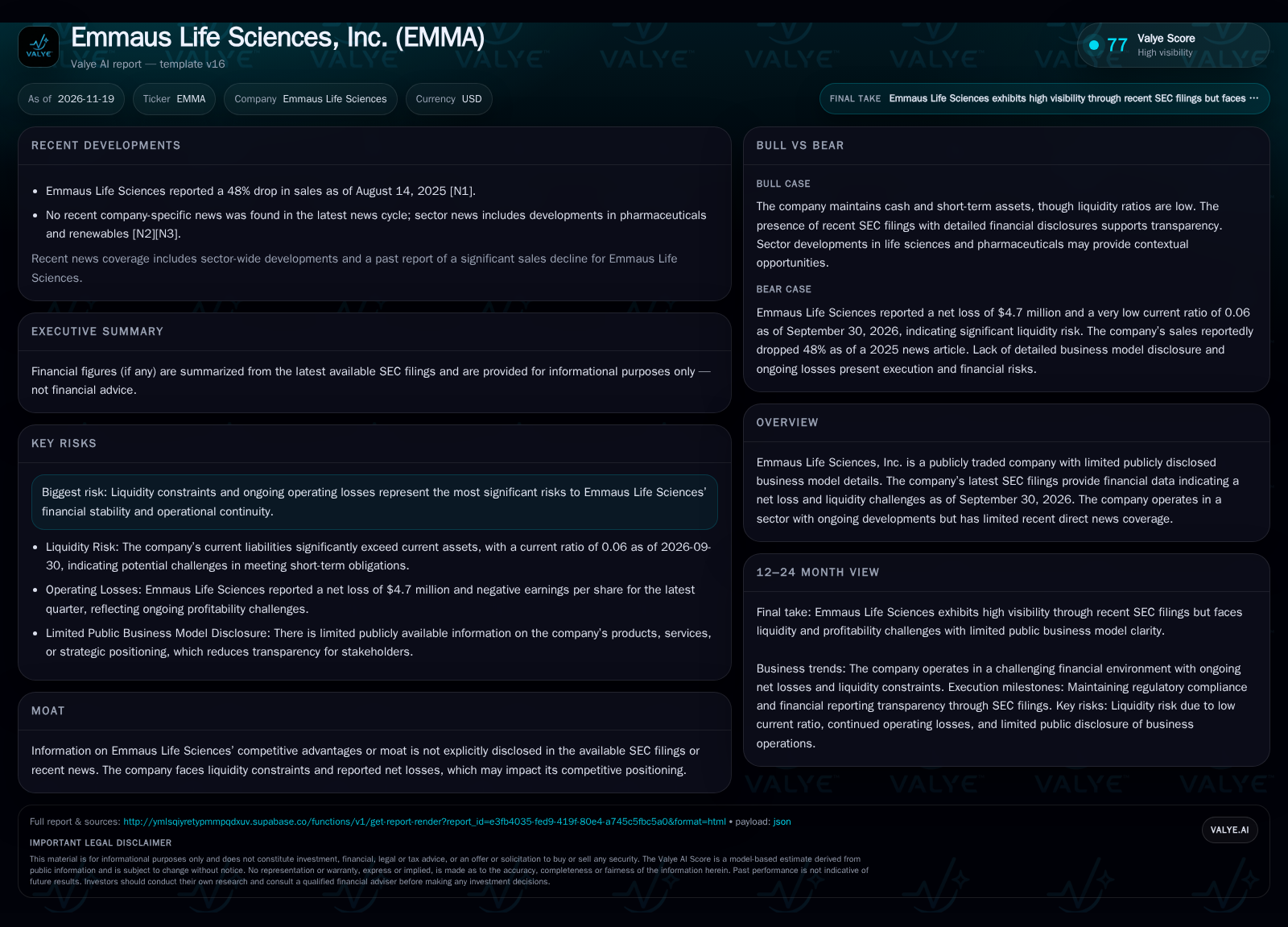
Emmaus Life Sciences faces acute liquidity pressure and continued operating losses, with limited public disclosure on its business model or competitive positioning. The company’s ability to secure funding or pivot strategically will determine its prospects amid mounting short-term obligations.
The company’s limited public disclosure on its core offerings and a prior 48% sales drop further cloud its outlook. Survival likely hinges on new capital, cost restructuring, or a major strategic shift in a sector where capital access and execution are critical.
Emmaus Life Sciences, Inc. is in a precarious financial position, reporting a severe liquidity squeeze and ongoing net losses as of its most recent filings. With only $971,000 in cash against $72.9 million in current liabilities, the company’s short-term obligations far exceed its available resources. Compounding these challenges are a lack of public detail on its business strategy and a significant prior sales decline, leaving Emmaus’s future highly contingent on its ability to secure funding or execute a dramatic operational turnaround.
Acute Liquidity Shortfall and Operating Losses Define Emmaus’s Present
Emmaus Life Sciences ended Q3 2026 with $971,000 in cash and $4.7 million in current assets, dwarfed by $72.9 million in current liabilities. The company reported cash and liquidity metrics for the period; these figures do not by themselves establish operating runway, investment capacity, financial flexibility, or financing capacity. [S2] The company reported a net loss of $4.7 million for the period, with negative EPS of -$0.07 [S2]. Notably, a 2025 news item referenced a 48% drop in sales, underscoring a sharp contraction in the revenue base. No legal proceedings were disclosed in the most recent annual filing [S1]. These facts collectively frame a business at risk of insolvency and in urgent need of capital or strategic realignment.
Understanding the liquidity shortfall's implications requires examining the company's cash conversion cycle and working capital management. If Emmaus has extended payment terms to customers or holds significant inventory, these factors could exacerbate cash flow pressures despite reported current assets. Conversely, if liabilities primarily consist of short-term debt or payables with stringent deadlines, the immediacy of funding needs intensifies. Additionally, the absence of disclosed contingent liabilities or off-balance-sheet obligations leaves uncertainty regarding potential hidden cash demands. A detailed breakdown of these components would help clarify the timeline and severity of the liquidity crisis, informing the urgency and scale of any required capital interventions.
Funding Gaps and Unclear Revenue Model Challenge Economic Sustainability
The company’s ability to generate cash from operations appears severely impaired, as evidenced by ongoing net losses and a dramatic decline in reported sales [S2]. The lack of detailed public disclosure on business lines, pricing structure, or customer concentration makes it difficult to assess the underlying unit economics. If Emmaus is in the pharmaceutical or life sciences sector, as sector context suggests, typical business models rely on either proprietary therapeutics or specialty products, often requiring significant upfront R&D investment and long sales cycles, with reimbursement and regulatory hurdles impacting both pricing and volume. Without evidence of recurring revenue streams or high-margin specialty products, Emmaus’s cost structure likely includes substantial fixed costs (R&D, compliance, overhead) and variable costs tied to manufacturing or service delivery. The current cash shortfall suggests that operating leverage is working against the company, amplifying losses as sales contract.
The company's revenue model ambiguity complicates forecasting future cash flows and assessing operational scalability. If Emmaus relies heavily on milestone-driven payments or one-time licensing fees, revenue may be irregular and insufficient to cover fixed costs consistently. Alternatively, recurring revenue streams, such as subscription-based service models or long-term supply contracts, could provide more predictable cash inflows, albeit at potentially lower margins. The cost structure's fixed-to-variable cost ratio critically influences financial resilience; a higher fixed cost base necessitates sustained revenue levels to avoid losses, while a more variable cost profile allows for expense flexibility in downturns. Insight into these dynamics would enable better evaluation of the company's capacity to adjust operations in response to market conditions.
Competitive Disadvantages Amplified by Transparency and Scale Limitations
Emmaus’s competitive positioning is difficult to evaluate due to the lack of disclosed details on products, pipeline, or differentiation strategies. In the life sciences and specialty pharma sectors, scale, regulatory compliance, and capital access are critical for sustaining operations and investing in innovation. Larger competitors often benefit from diversified revenue streams, established distribution, and stronger balance sheets, enabling them to weather periods of volatility. By contrast, Emmaus’s acute liquidity constraints and shrinking sales base may limit its ability to invest in product development, regulatory submissions, or commercial infrastructure. The absence of information on patents, exclusivity, or unique technology further suggests that any existing moat is either weak or unproven. If Emmaus is dependent on a single product or a concentrated customer set, as is common for smaller life sciences firms, its vulnerability to competitive or regulatory shocks is heightened.
Scale disadvantages may also impact Emmaus's bargaining power with suppliers and payers, potentially leading to less favorable terms that further strain margins. Larger competitors often negotiate volume discounts, extended payment terms, or preferred formulary placements, enhancing their cost efficiency and market access. Emmaus's limited scale could hinder its ability to secure such advantages, increasing per-unit costs or restricting market penetration. Moreover, regulatory compliance costs tend to be disproportionately burdensome for smaller entities due to fixed overheads and less diversified product portfolios. Without a clear competitive moat, the company may face pricing pressures and market share erosion, especially if competitors introduce innovative or lower-cost alternatives.
Pathways to Recovery: Capital Infusion or Strategic Pivot Could Reset Trajectory
Alternatively, a successful pivot to a higher-margin or more defensible product line, or the out-licensing of intellectual property, could stabilize revenues and improve margins. Evidence that would support this scenario includes new financing announcements, strategic collaboration agreements with larger sector players, or regulatory approvals that unlock new revenue streams. Rapid improvement in sales trends, disclosure of a robust product pipeline, or cost containment leading to reduced losses would also bolster the upside case. However, these developments would need to materialize quickly given the current balance-sheet strain.
Stabilization Hinges on Near-Term Financing and Cost Discipline
The most plausible near-term scenario is one in which Emmaus seeks emergency financing or bridge funding to meet pressing liabilities while attempting to stabilize operations. Cost-cutting measures—such as workforce reduction, R&D deferrals, or renegotiation of supplier terms—could slow cash burn but may also impede future growth prospects. Modest improvement in working capital or a one-off asset sale might provide temporary relief but would not address underlying structural challenges. Confirmation of this scenario would include announcements of small-scale financings, layoffs, or operational restructurings. Conversely, failure to secure funding or maintain vendor and creditor relationships would quickly undermine even this modest stabilization path.
Cost discipline measures, while necessary, carry inherent risks that could undermine long-term viability. For instance, reducing R&D expenditure might preserve short-term liquidity but delay product development cycles, diminishing future revenue potential and competitive positioning. Workforce reductions can lower operational costs but may also lead to loss of institutional knowledge and reduced capacity for innovation or customer engagement. Renegotiating supplier contracts might improve cash flow temporarily but could damage relationships critical for supply chain stability. Therefore, the effectiveness of these measures depends on their strategic calibration to balance immediate financial relief with the preservation of core capabilities essential for eventual recovery.
Liquidity Exhaustion Triggers Insolvency or Forced Asset Sales
If Emmaus is unable to secure additional capital or meaningfully reduce its liabilities, it faces a high risk of insolvency, creditor actions, or forced liquidation of assets. In the absence of external support, Emmaus may be compelled to file for bankruptcy protection or sell core assets at distressed valuations. Signs confirming this adverse scenario would include missed debt payments, default notices, delisting warnings, or abrupt management departures. A rapid deterioration in supplier or customer relationships, as reflected in further sales declines or disclosure of material contract losses, would also signal escalation toward insolvency.
Company-Specific Developments That Will Determine Emmaus’s Fate
Announcements of new equity or debt financing rounds, including terms and investor participation.
Disclosure of strategic partnerships, licensing deals, or collaborations with larger industry players.
Updates on sales trends, customer concentration, or product pipeline developments—if disclosed.
Evidence of cost-containment actions, such as layoffs, R&D cuts, or facility closures.
Regulatory milestones or approvals that could unlock new revenue streams or markets.
Changes in creditor relationships, including debt restructuring or payment deferrals.
Management turnover or changes in board composition, especially if linked to restructuring.
Delisting notices or warnings from exchanges, which would indicate acute financial distress.
Disclaimer: This is research-only, informational analysis and not investment advice. It may include AI-generated interpretation and general industry context. Always verify important details using primary sources.

Comments