
Northern Technologies: Margin Volatility, Strategic Realignment, and the Stakes of Specialty Materials Expansion
NTIC’s growth in corrosion control and biodegradable plastics is offset by rising input costs and external shocks—forcing a strategic emphasis on debt reduction and operational resilience as the company navigates complex end markets and joint venture dependencies.
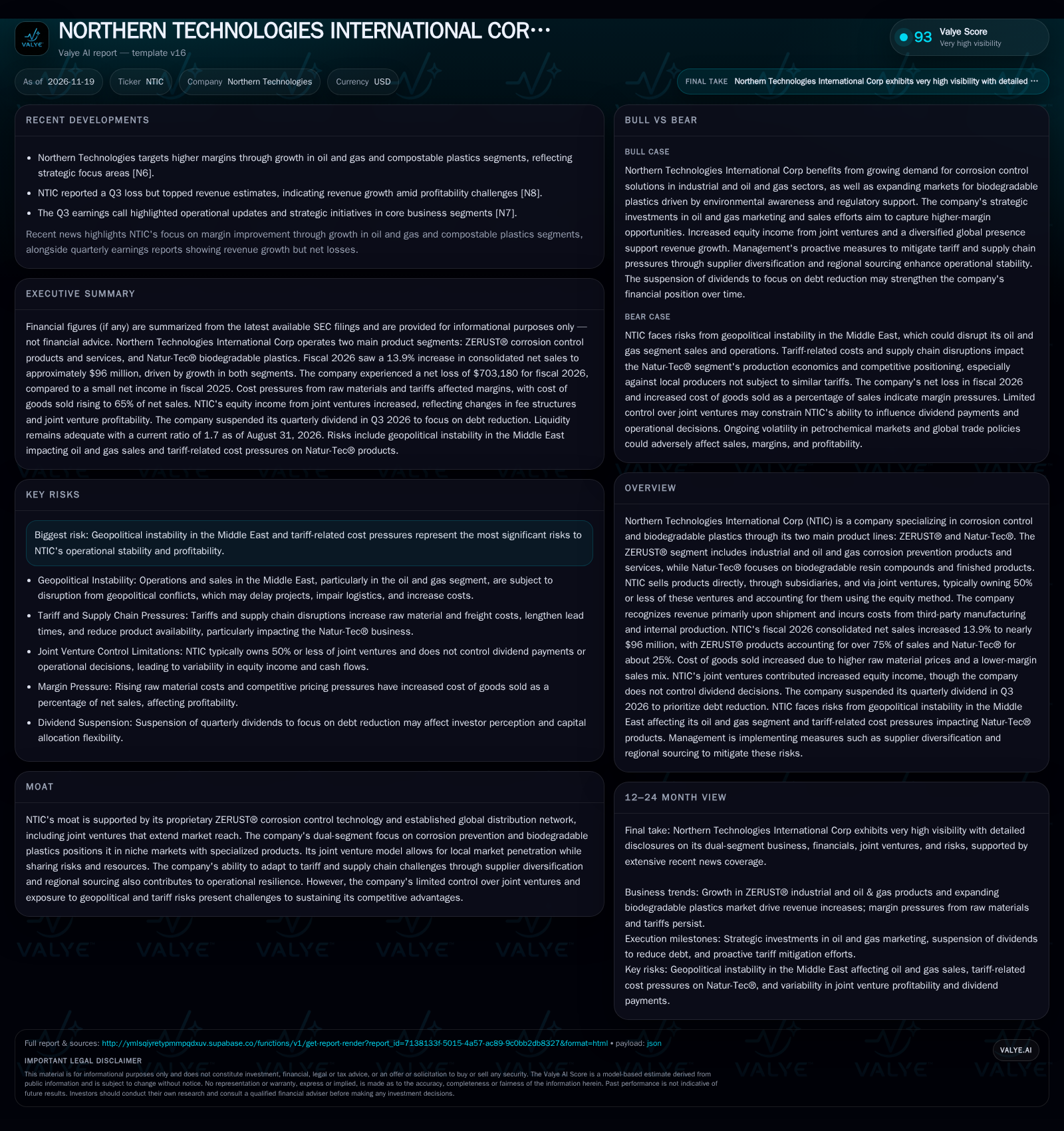
Northern Technologies International Corp (NTIC) grew sales 13.9% in fiscal 2026, driven by both ZERUST® corrosion control and Natur-Tec® biodegradable plastics, but margin pressures from higher input costs and a less favorable mix led to a net loss and a dividend suspension. While investments in oil and gas marketing and supply chain diversification target higher-margin growth, the company remains exposed to geopolitical and tariff risks, with limited control over joint venture cash flows. Strategic execution and stabilization of profitability will be critical as NTIC seeks to balance specialty market opportunities with cost headwinds and capital allocation constraints. [S1] [N6] [N8]
Northern Technologies International Corp faces a paradox familiar to specialty materials firms: robust top-line growth in its ZERUST® corrosion control and Natur-Tec® biodegradable plastics segments is undermined by rising input costs, margin compression, and external shocks. Fiscal 2026 saw a double-digit sales increase, but also a swing to net loss and the suspension of its dividend in favor of debt reduction. With joint venture income on the rise but not fully within management’s control, and persistent risks from geopolitics and tariffs, NTIC’s ability to convert niche demand into sustainable profitability will hinge on cost discipline, supply chain adaptation, and strategic capital allocation. [S1] [N6] [N8]
Margin Compression and Capital Discipline Define 2026’s Operating Reality
Northern Technologies International Corp reported a 13.9% increase in consolidated net sales to $96.0 million for fiscal 2026, with the ZERUST® segment (primarily industrial and oil & gas corrosion prevention) accounting for 75.3% of sales and Natur-Tec® biodegradable plastics the remaining 24.7%. ZERUST® oil and gas sales surged 33.3%, outpacing the 13.2% growth in industrial applications, while Natur-Tec® grew 9.2% overall, led by India and North America. However, gross margin pressure was acute: cost of goods sold grew 18.6% and rose to 65.0% of net sales (from 62.4% prior year), reflecting both higher raw material costs and a less favorable sales mix. NTIC posted a net loss for the year and suspended its quarterly dividend in Q3 2026 to prioritize debt reduction. Liquidity as of August 31, 2026, stood at $7.0 million in cash and equivalents, a current ratio of 1.7, and a cash ratio of 0.43. [S1] [N8]
Increased equity income from joint ventures (up 22.8% to $4.35M) provided some offset, but NTIC’s lack of control over JV dividends and operational decisions means this income stream is variable and not fully discretionary. Externally, management highlighted risks from Middle East instability affecting oil and gas sales, and tariffs impacting Natur-Tec® economics, with mitigation efforts underway via supplier diversification and regional sourcing. [S1] [N6]
How Product Mix, Input Costs, and JV Structure Shape Earnings Power
NTIC’s business model is built on two differentiated specialty platforms: ZERUST® (corrosion control, serving industrial and oil & gas) and Natur-Tec® (biodegradable plastics). Revenue is recognized primarily on shipment, and costs stem from a mix of third-party manufacturing and internal production. The ZERUST® segment, with its proprietary technology and established industrial/O&G customer base, historically offers higher gross margins—especially in oil and gas, where technical requirements and switching costs can be higher. Natur-Tec®, by contrast, faces greater commodity and competitive pressures, particularly in regions where tariffs or local producers undermine pricing power.
The company’s joint venture model enables market access and risk-sharing in global markets, but limits NTIC’s control over cash flows and operating decisions—meaning realized JV income can be volatile and not always available for immediate reinvestment or debt service. Operating leverage exists, but is currently blunted by raw material inflation (notably petrochemicals for both plastics and corrosion inhibitors), tariff pass-through limitations, and a sales mix shift toward lower-margin products or geographies. Capital needs are moderate, but the recent dividend suspension and focus on debt reduction signal a shift toward internal funding and balance-sheet repair rather than aggressive expansion or shareholder returns. [S1]
Specialty Positioning Versus Commodity Pressures and Geopolitical Uncertainty
NTIC’s core competitive advantage lies in the technical differentiation of its ZERUST® corrosion control solutions and a global distribution network enabled by joint ventures. In oil and gas, the company’s proprietary formulations and tailored service approach can increase switching costs and customer stickiness, especially for mission-critical asset protection. In biodegradable plastics, Natur-Tec® benefits from regulatory tailwinds and growing environmental awareness, but faces significant pricing pressure from local and global competitors, especially in price-sensitive markets like China.
The joint venture model allows NTIC to penetrate otherwise difficult markets and share risk, but also means the company has less direct control over operations, pricing, and capital allocation in those regions. Geopolitical instability, particularly in the Middle East, exposes the oil and gas segment to project delays, logistics disruptions, and cost volatility. Tariff regimes and trade barriers represent a persistent headwind for Natur-Tec®, where local competitors may be structurally advantaged. The dual-segment approach offers some diversification, but each business faces distinct competitive and macroeconomic threats.
If Margin Recapture and Specialty Demand Outpace External Headwinds
A bullish scenario for NTIC would see robust demand for ZERUST® oil and gas solutions continue, fueled by infrastructure investment, asset integrity mandates, and recovery in Middle East projects. If management’s investments in oil and gas marketing translate into higher sales of premium, higher-margin products, the company could see a meaningful recovery in gross margins. Natur-Tec® could benefit from accelerating regulatory bans on single-use plastics and increasing adoption of compostable materials in North America and India.
Successful execution of supplier diversification and regional sourcing could blunt the impact of raw material inflation and tariffs, restoring margin stability. If joint ventures generate both higher profits and regular, sizable dividend distributions, NTIC’s cash flow could improve, allowing for a resumption of shareholder distributions or targeted reinvestment. Confirmation would come from a sustained reduction in cost of goods sold as a percentage of sales, sequential gross margin expansion, and evidence of premium product mix within both segments. A return to net profitability with positive operating and free cash flow would further validate this scenario. [S1] [N6]
Balancing Specialty Growth with Persistent Margin Pressures
The most plausible near-term outcome is continued top-line growth in both ZERUST® and Natur-Tec®, driven by secular trends in corrosion prevention and sustainability, but with margins remaining under pressure from elevated input costs, tariffs, and an unfavorable sales mix. Management’s mitigation efforts—supplier diversification, regional sourcing, and targeted investments in higher-margin oil and gas applications—may prevent further deterioration, but are unlikely to fully restore historical margin levels in the absence of input cost relief or a more favorable sales mix.
Joint venture income will remain a positive contributor, but its variability and NTIC’s lack of control over distributions limit its ability to serve as a financial shock absorber. The company will likely maintain a conservative capital allocation posture, with any excess cash directed toward debt reduction rather than dividends or large-scale expansion. Evidence for this scenario would include stable or modestly improving sales, cost of goods sold remaining elevated as a percentage of revenue, and continued but uneven joint venture contributions. [S1] [N7] [N8]
When Macroeconomic and Geopolitical Shocks Overwhelm Specialty Niche Defenses
The principal risk for NTIC is that external shocks—such as a significant escalation in Middle East conflict or further tariff escalation—cause a sharp contraction in oil and gas segment sales or further erode Natur-Tec® profitability. Prolonged raw material inflation, combined with the inability to pass through costs, could further compress gross margins, potentially leading to sustained net losses and negative operating cash flow. If joint ventures underperform or withhold dividends, NTIC’s ability to service debt and fund operations could be strained.
In this scenario, liquidity could become a pressing concern, forcing further cuts to capital spending or even consideration of asset sales. Loss of market share in Natur-Tec® to local or lower-cost producers, or customer defections in core ZERUST® markets, would validate this outcome. Concrete evidence would include a further rise in cost of goods sold as a percentage of sales, sequential declines in revenue, negative cash flow, and material reductions in joint venture income or distributions. [S1]
What Will Reveal Whether NTIC Can Convert Growth into Sustainable Profitability
Quarterly gross margin trends, especially the cost of goods sold as a percentage of net sales, will provide a real-time gauge of input cost management and product mix.
Segment-level revenue growth—particularly in ZERUST® oil and gas and Natur-Tec® in North America and India—will indicate the success of strategic focus areas and end-market health.
The frequency and size of joint venture dividend distributions (if disclosed) would help test the company’s ability to convert equity income into usable cash.
Updates on supplier diversification and regional sourcing initiatives, including progress in reducing tariff and freight cost exposure, would clarify the effectiveness of risk mitigation.
Operating cash flow and net profitability, especially in the wake of the dividend suspension, will be critical for assessing financial resilience and flexibility.
Any return to or further suspension of shareholder distributions (dividends or buybacks) would signal management’s outlook on near-term stability and capital needs.
Disclosure of customer concentration or contract wins/losses in the oil and gas and biodegradable plastics segments would help evaluate market position durability.
If disclosed, segment-level gross margins or pricing trends for premium versus commodity Natur-Tec® products would provide insight into competitive dynamics and margin recapture potential.
Disclaimer: This is research-only, informational analysis and not investment advice. It may include AI-generated interpretation and general industry context. Always verify important details using primary sources.

Comments