
Warner Music Group: Restructuring and Revenue Shifts in the Digital Music Era
A $200 million restructuring, rising digital integration, and ongoing rights diversification shape Warner Music Group’s post-2025 outlook.
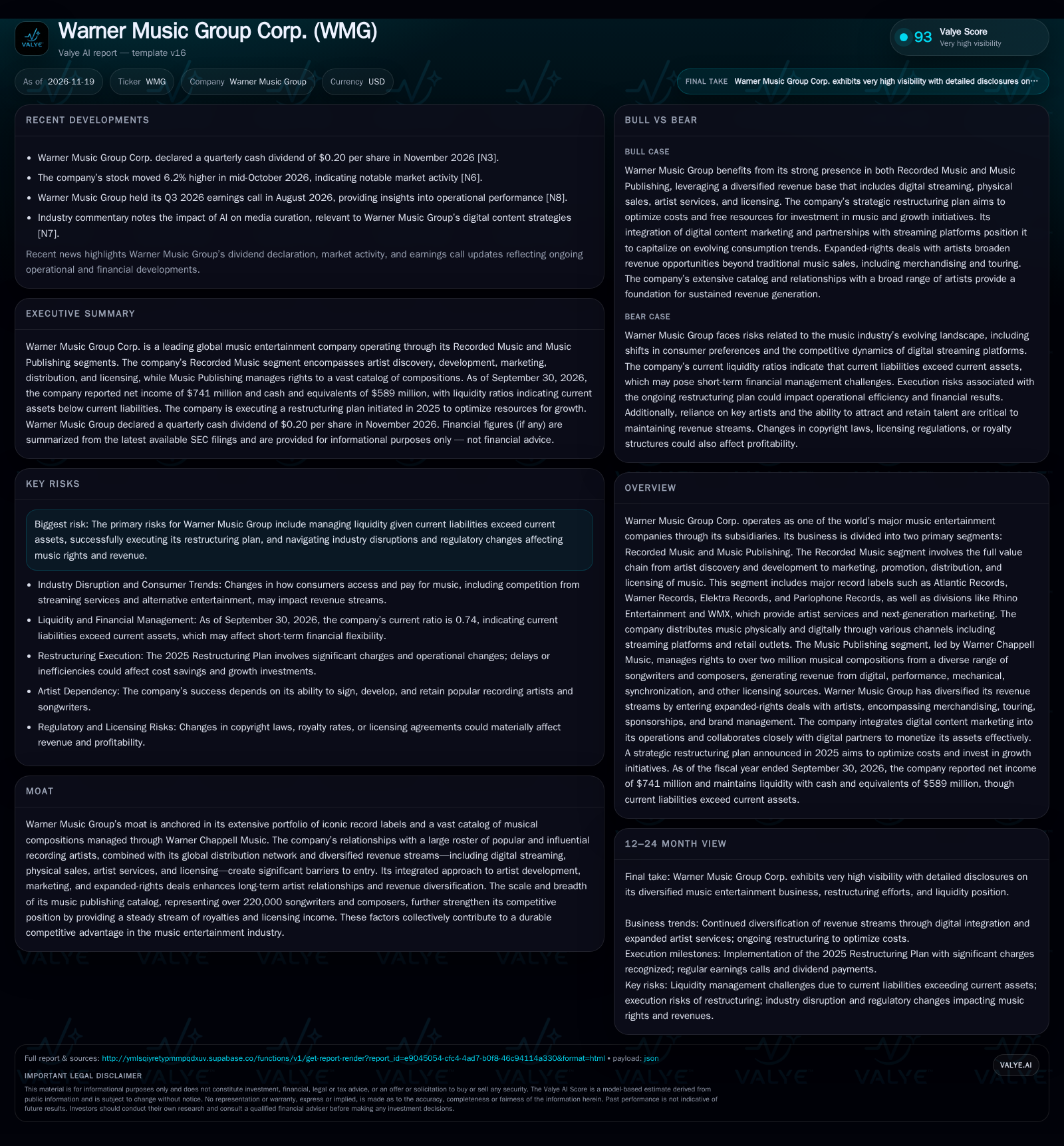
Revenue diversity and digital content partnerships are key to its long-term positioning, yet liquidity management and restructuring execution will be central watchpoints in the coming year. [S1] [N3]
Warner Music Group, one of the global music industry’s three major players, enters 2027 at a strategic inflection point. The company has largely completed a $200 million restructuring aimed at sharpening its cost base and freeing funds for growth, while maintaining robust net income and cash dividends. The evolution of digital streaming, expanded artist services, and the economics of music publishing remain central to its future, as the company’s ability to execute on multi-channel monetization and adapt to shifting industry structures will determine whether its competitive advantages endure or erode.
Warner Music Group’s Recent Changes in Profitability and Capital Structure
As of September 30, 2026, Warner Music Group reported net income of $741 million and held $589 million in cash and cash equivalents. Despite this profitability, the company’s balance sheet reveals current assets of $3.277 billion versus current liabilities of $4.405 billion, yielding a current ratio of 0.74 and a cash ratio of 0.13. This points to a short-term liquidity position where near-term obligations outpace liquid assets, raising questions about ongoing potential financial flexibility. The company has also completed the bulk of a $200 million pre-tax restructuring plan, initiated in July 2025, with the intent of freeing funds for future investment and growth. In November 2026, Warner declared a $0.20 per share quarterly dividend, reaffirming its commitment to shareholder returns even amid these operational transitions. [S1] [N3]
How Digital Revenue and Expanded Rights Reshape Music Economics
Warner Music Group’s business economics hinge on two primary segments: Recorded Music and Music Publishing. Recorded Music generates revenue from digital streaming, downloads, physical sales, and licensing, while also capturing value from artist services such as merchandising, touring, and sponsorships. Music Publishing, through Warner Chappell, monetizes a vast catalog via digital, performance, mechanical, and synchronization royalties. The rise of streaming has shifted revenue mix towards recurring digital income, but also compressed per-unit margins compared to traditional physical sales.
The company’s expanded-rights deals—encompassing merchandising, VIP ticketing, and brand management—allow Warner to capture a larger share of artist-related economics beyond recordings. This model can provide operating leverage as digital distribution reduces physical logistics costs, but also exposes Warner to the volatility of artist demand and the dynamics of revenue-sharing with talent. Capital requirements for new artist development and catalog acquisition remain significant, and the restructuring aims to optimize cost structures for reinvestment. The company’s ability to scale digital content marketing and leverage its catalog across multiple channels is central to maintaining profitability in a rapidly evolving marketplace. [S1]
The shift toward digital revenue streams also introduces new cost considerations, particularly in technology infrastructure and data analytics capabilities. Investment in advanced algorithms for audience segmentation, predictive consumer behavior modeling, and royalty tracking systems can enhance Warner Music Group’s ability to optimize content placement and licensing strategies. However, these technological investments require upfront capital and ongoing maintenance, which must be balanced against immediate profitability goals. Moreover, the reliance on third-party streaming platforms for distribution means that Warner faces inherent risks related to platform fee structures, data transparency, and potential changes in streaming policies, which could impact revenue predictability and margin stability.
The Role of Catalog Depth and Artist Ties in a Competitive Market
Warner’s competitive position is anchored in its portfolio of iconic record labels, deep artist roster, and a publishing catalog that spans over two million compositions from more than 220,000 songwriters. This breadth provides negotiating power with digital platforms and creates barriers to entry for new competitors. However, the music industry’s landscape is marked by intense rivalry among major label peers and rising alternative competitors, including independent distributors, direct-to-consumer platforms, and digital-first music services.
The rise of streaming giants has shifted some bargaining power away from labels toward platforms, pressuring margin structures and raising the stakes for successful artist development and retention. At the same time, Warner’s integration of digital content marketing and expanded-rights models may help offset some of this pressure by creating proprietary artist-fan ecosystems. The long-term value of the music publishing catalog—providing recurring licensing and royalty income—remains a strategic moat, though regulatory shifts or changes in royalty structures could alter this advantage.
Catalog depth and artist relationships also have implications for Warner’s negotiating leverage in an environment where platform dominance continues to grow. While a broad catalog provides bargaining power, it also demands continuous management to ensure that rights are effectively monetized across emerging channels such as social media, short-form video, and virtual reality experiences. The company’s ability to innovate in licensing models and create exclusive content offerings could differentiate it from competitors. However, this requires agility and responsiveness to shifting consumer preferences, which may be constrained by legacy contracts or slower decision-making processes within a large organization.
Furthermore, the competitive landscape is increasingly influenced by the rise of artist empowerment and direct-to-fan platforms, which can circumvent traditional label roles. Warner’s expanded-rights deals attempt to capture value beyond recordings, but the company must carefully navigate artist expectations for revenue sharing and creative control. If artists perceive that these deals limit their autonomy or financial upside, Warner risks higher attrition or reputational challenges. Conversely, successfully structuring flexible agreements that align incentives could strengthen long-term partnerships and create a more resilient revenue base amid evolving industry dynamics.
Potential Gains from Digital Integration and Rights Expansion
A favorable trajectory for Warner Music Group would see the restructuring program successfully lowering the company’s fixed cost base, freeing up capital to invest in new talent and technology. Enhanced digital integration—such as data-driven A&R, direct-to-fan marketing, and global streaming partnerships—could accelerate revenue growth and improve margins, especially if expanded-rights deals deepen artist relationships and unlock new monetization channels.
If digital streaming continues to grow globally, and Warner’s catalog and artist services see strong demand, the company could achieve higher operating leverage and more predictable cash flows. Confirmation would come from rising adjusted EBITDA margins, an reported liquidity-ratio trends as cost savings materialize, and evidence of increased artist signings or catalog acquisitions driving incremental recurring revenue.
Stability Achieved but Challenges in Digital and Artist Management Remain
The most plausible scenario is that Warner Music Group stabilizes its financial footing through the completed restructuring, with moderate improvements in cost efficiency and operating margins. Revenue growth is likely to track broader industry trends in digital streaming and global music consumption, while expanded-rights and publishing provide diversification but not dramatic upside.
While the company maintains profitability and pays out dividends, short-term liquidity remains a management focus, with the current ratio gradually improving if working capital is managed tightly. Competitive pressures from both major peers and digital-first platforms persist, and Warner’s ability to retain top artists and adapt to evolving royalty structures will be tested. Evidence for this scenario would include steady revenue growth, no material deterioration in liquidity metrics, and regular updates on restructuring implementation.
Risks from Execution Issues, Liquidity, and Regulatory Changes
An adverse scenario could emerge if Warner’s restructuring fails to achieve targeted cost savings or disrupts operational capabilities, leading to flat or declining profitability. If digital streaming growth slows, or if major streaming platforms further compress royalty rates, revenue and margins could come under acute pressure. Liquidity could become a binding constraint if the company is unable to rebalance its current asset-liability mismatch, potentially forcing asset sales, debt refinancing under unfavorable terms, or dividend cuts.
Additional downside risks include significant artist departures, regulatory changes that alter music licensing economics, or an inability to secure new hit talent. Warning signs would be a worsening current ratio, negative free cash flow, missed restructuring milestones, or rising artist churn without offsetting catalog growth.
Key Developments Influencing Warner Music Group’s Future
Progress on restructuring execution—timing, realized cost savings, and any operational disruptions.
Quarterly trends in current ratio and cash ratio, to assess whether liquidity management is stabilizing or deteriorating.
Growth rate and margin evolution in digital streaming and expanded-rights revenue segments (if disclosed).
New artist signings, catalog acquisitions, or major expanded-rights deals announced by the company.
Retention and development of top-performing artists and songwriters, or evidence of material attrition.
Changes in royalty rates or licensing structures driven by regulatory or industry negotiations.
Competitive developments among streaming platforms or major label peers that could alter revenue sharing or artist bargaining dynamics.
Disclaimer: This is research-only, informational analysis and not investment advice. It may include AI-generated interpretation and general industry context. Always verify important details using primary sources.

Comments