
Palo Alto Networks: Platformization, AI Security Stakes, and the Economics of Cyber Defense Consolidation
Palo Alto Networks is leveraging AI-driven platform integration to address an expanding threat landscape and the complexity of enterprise security, but competitive intensity, customer consolidation, and growth management present real tests to its recurring revenue model and long-term margin potential.
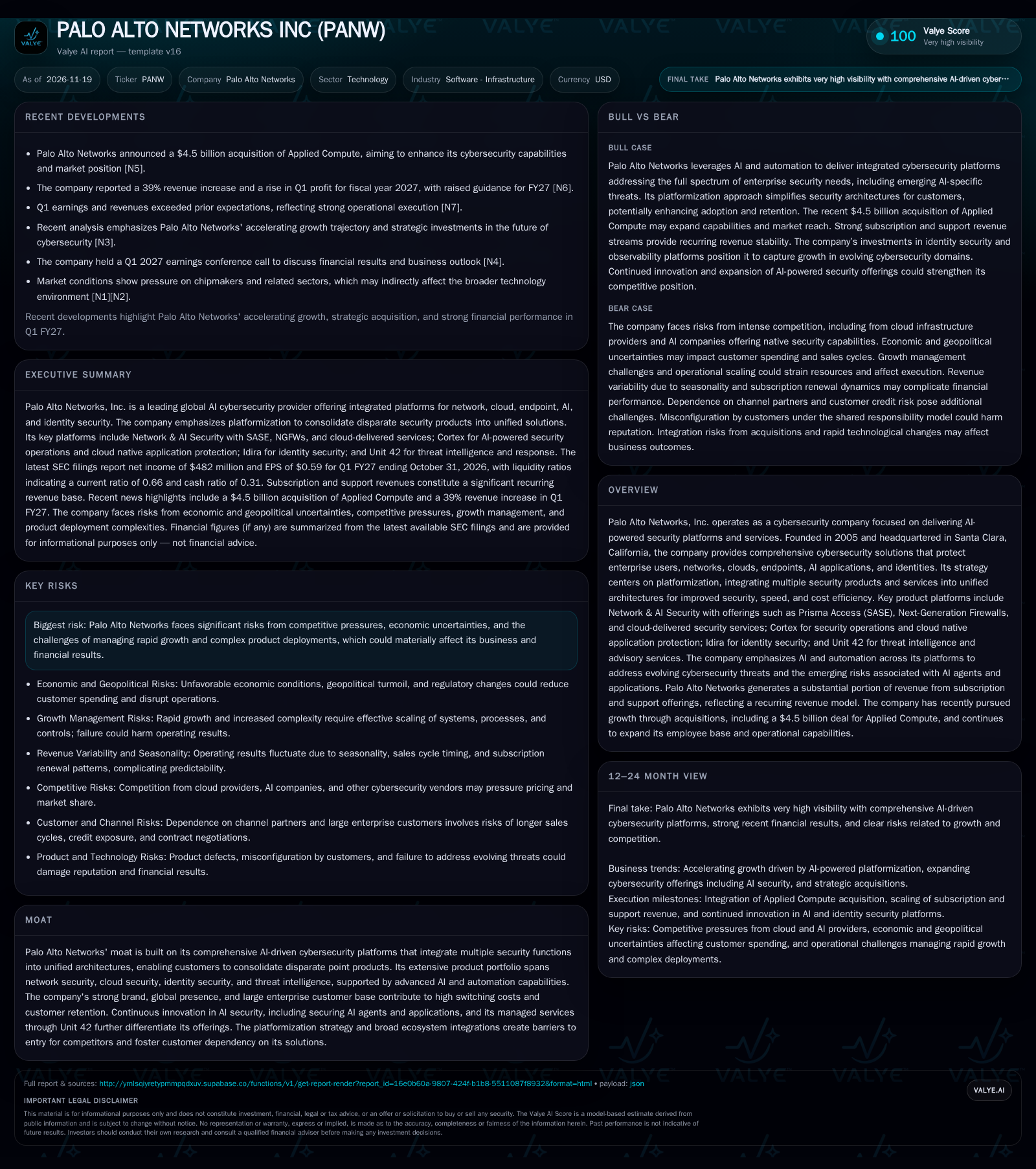
Palo Alto Networks reported strong Q1 results, with net income of $482 million and 82.7% of revenue from subscription and support offerings, highlighting its shift toward a recurring, platform-based model. The $4.5 billion Applied Compute acquisition signals a strategic push into AI and cloud security, but liquidity ratios (current: 0.66, cash: 0.31) underscore the need for disciplined growth management. Competition from cloud providers and integration risks remain top concerns as the company scales its workforce and expands its portfolio. The thesis hinges on whether platformization and AI-driven security can sustain differentiation and retention amid industry consolidation and evolving threats. [S2] [N3] [N5] [N7]
Palo Alto Networks is navigating a pivotal phase, marked by robust financial performance, a deepening commitment to AI-driven platform security, and the strategic acquisition of Applied Compute. As cybersecurity complexity and customer expectations escalate, the company’s push to consolidate disparate security tools into unified, AI-enabled platforms is both its differentiator and its greatest test. The durability of its recurring revenue model, ability to manage operational scaling, and resilience against competitive and macroeconomic headwinds will determine whether it remains a consolidator—or becomes consolidated itself—in a rapidly evolving market.
Recent Results, Recurring Revenue, and Strategic Expansion
Palo Alto Networks reported net income of $482 million and basic EPS of $0.59 for the quarter ended October 31, 2026, reflecting strong operational execution and profitability. Subscription and support offerings accounted for 82.7% of total revenue, underscoring the company’s ongoing shift toward a recurring revenue model centered on platform-based security solutions. The company reported a current ratio of 0.66 for the period. Notably, Palo Alto Networks announced a $4.5 billion acquisition of Applied Compute, signaling a strategic push into AI and cloud security, and increased its headcount from 21,921 to 22,339 over the recent quarter, suggesting continued investment in talent and operational capacity. [S2] [N3] [N5] [N7]
How Platformization Reshapes Cybersecurity Revenue and Margins
Palo Alto Networks’ business model revolves around consolidating point security products into integrated platforms, driving a high mix of recurring subscription and support revenue. This approach creates more predictable cash flows and may yield favorable unit economics as customers migrate from fragmented spend to bundled, multi-year contracts. The shift to SaaS and managed services reduces hardware cyclicality and can improve gross margins if software and cloud-delivered services scale efficiently.
Pricing power depends on the demonstrated value of platformization, integration, and AI-powered automation—customers may pay a premium for simplified management, reduced vendor sprawl, and proactive threat prevention. However, as large customers consolidate spend and demand volume discounts, average revenue per user could come under pressure unless offset by upselling higher-value modules or AI security layers.
The $4.5 billion Applied Compute acquisition represents a significant capital deployment, with success hinging on integration and cross-selling synergies. Operating leverage is plausible as more revenue is driven through existing platforms and cloud infrastructure, but rising R&D and go-to-market costs—alongside a growing workforce—could compress margins if top-line growth slows.
Defending the Moat: AI, Cloud, and Customer Consolidation Risks
Palo Alto Networks’ competitive edge is built on breadth: unified platform offerings spanning network, cloud, endpoint, identity, and AI security, all underpinned by automation and threat intelligence. This comprehensive product suite can increase switching frictions for enterprise customers, especially those seeking to consolidate vendors for cost and operational efficiency.
However, the competitive landscape is intensifying. Cloud hyperscalers (such as AWS, Microsoft Azure, and Google Cloud) are embedding native security features, eroding the standalone value proposition of third-party platforms. Specialized AI security startups and legacy cybersecurity vendors are also innovating rapidly, narrowing differentiation. As customers increasingly prefer fewer, more strategic partners, the risk is that Palo Alto Networks becomes one of several providers forced into pricing or integration battles, especially in large accounts.
Channel partners drive a substantial portion of sales, which can accelerate market reach but exposes Palo Alto Networks to risks of channel conflict, margin compression, and delayed feedback loops on customer needs. Execution in AI-specific security and successful integration of new platforms like Applied Compute will be critical to defending the company’s moat.
If Platformization and AI Security Drive Share Gains
The favorable scenario sees Palo Alto Networks capitalizing on enterprise demand for integrated, AI-driven security platforms that address both traditional and emerging threats. Successful integration of Applied Compute could extend the company’s reach into cloud-native and AI workload protection, unlocking new cross-sell and upsell opportunities within its existing customer base.
If the company demonstrates continued double-digit subscription growth, rising attach rates for AI security modules, and stable or improving gross margins, it would suggest that platformization is resonating and creating pricing power. Evidence of increasing multi-year contract wins, high retention rates, and successful expansion into identity and observability markets would further confirm the thesis.
Falsification would come from stagnating subscription growth, weak customer adoption of new AI modules, or inability to integrate Applied Compute, signaling that the platformization promise is not translating to economic advantage.
Sustaining Growth Amid Integration and Margin Pressures
The most plausible outcome is that Palo Alto Networks sustains above-industry growth, but faces intermittent pressure on margins and execution as it integrates acquisitions and manages a larger, more complex organization. The recurring revenue model continues to provide stability, but average contract values may plateau as large customers demand discounts or consolidate their vendor relationships.
Success will likely depend on the company’s ability to maintain innovation velocity in AI-driven security, minimize integration friction from Applied Compute, and defend share against both cloud providers and agile cybersecurity peers. Modest margin expansion could occur if operating leverage from platform adoption outweighs incremental R&D and go-to-market expenses.
Confirmation would come from continued growth in subscription and support revenue, stable customer retention if disclosed, and evidence of cross-platform adoption. Falsification would appear as missed integration milestones, rising churn, or declining gross margins amid competitive pricing.
When Integration, Competition, or Customer Retention Falter
An adverse scenario could unfold if integration of Applied Compute proves disruptive—leading to product overlap, cultural misalignment, or customer confusion. If cloud hyperscalers accelerate their in-house security offerings or large enterprises consolidate spend with competing platforms, Palo Alto Networks could see slower growth, increased churn, or downward pricing pressure.
Liquidity concerns may emerge if working capital needs or acquisition-related expenses outstrip cash generation, forcing the company to seek external funding under less favorable terms. Execution missteps in AI security—such as product delays, misconfigurations, or high-profile breaches—could erode trust and damage the brand.
This scenario would be confirmed by a decline in subscription revenue growth, deteriorating gross margins, missed integration or product roadmap targets, or rising customer attrition if disclosed.
Metrics and Developments That Could Reshape the Platformization Thesis
Quarterly subscription and support revenue growth rates, which indicate whether the recurring revenue model is sustaining momentum or slowing.
Gross margin trends, particularly as AI modules and cloud-delivered services scale—margin expansion would support the economic case for platformization.
Integration progress and realized synergies from the Applied Compute acquisition, including revenue contribution and cross-sell rates if disclosed.
Customer retention, renewal, and churn rates—if disclosed—to gauge whether platform consolidation is driving deeper enterprise relationships or facing attrition.
Average contract value and attach rates for new AI security and identity modules, which would demonstrate upsell success.
Net new large enterprise customer wins or losses, especially in competitive bid situations against cloud hyperscalers or legacy peers.
R&D and go-to-market expense trajectories relative to revenue growth, to assess whether operating leverage is materializing.
Any developments in regulatory or macroeconomic conditions that could impact customer cybersecurity budgets or project timing.
Disclaimer: This is research-only, informational analysis and not investment advice. It may include AI-generated interpretation and general industry context. Always verify important details using primary sources.

Comments