
Dror Ortho-Design's ZSmile Platform Faces Liquidity Challenges Amid Early-Stage Commercialization
Dror Ortho-Design pursues growth through its innovative AI-driven orthodontic platform while navigating financial and regulatory headwinds.
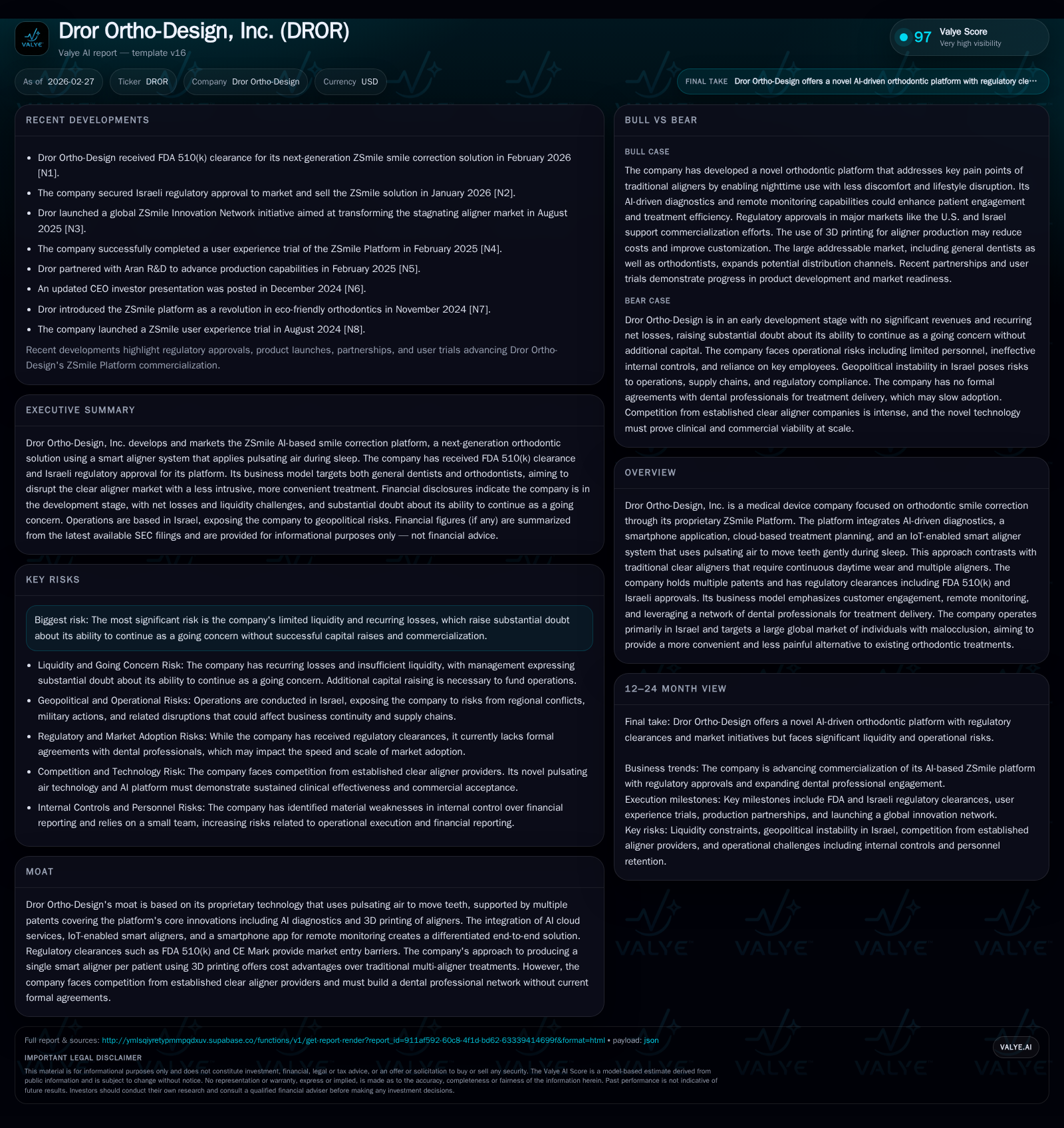
Dror Ortho-Design, Inc. develops the ZSmile Platform, an AI-enabled orthodontic solution designed for overnight smile correction using a smart aligner. Despite recent FDA 510(k) clearance, the company remains in early commercialization stages with minimal revenue and sustained operating losses as of FY2025. Liquidity constraints and absence of established dental professional partnerships pose significant challenges to scaling operations. Future growth depends on successful capital raises, market adoption, and regulatory compliance in multiple jurisdictions.
Company Overview
Originally incorporated as Novint Technologies in 1999, Dror Ortho-Design rebranded after a share exchange in mid-2023 to focus exclusively on orthodontic solutions leveraging AI and IoT technologies [S1][S23]. Its flagship ZSmile Platform is designed to offer an alternative to traditional clear aligners by enabling teeth movement during sleep via a single smart aligner activated by pulsating air technology—a departure from conventional methods requiring multiple daytime-worn aligners.
The platform combines AI-driven diagnostics with cloud-based treatment planning accessible via smartphone applications, aiming to enhance patient convenience and reduce treatment discomfort. Intellectual property protections cover core innovations including AI algorithms, 3D printed aligners, and the smart air pulsation system [S23][N1]. Regulatory validation includes FDA 510(k) clearance obtained in February 2026 alongside Israeli approvals, positioning the company for entry into key markets such as the United States [N1].
Historical Performance
Financial results reflect an early-stage company yet to achieve meaningful commercial traction. Revenue has remained stagnant at $2,568 for fiscal years ending 2021 and 2022 with no additional reported growth thereafter [F1]. Operating losses escalated from approximately -$178 thousand in FY2022 to nearly -$5.22 million in FY2024 before improving to -$2.22 million in FY2025 [F1]. Net losses followed a similar trajectory totaling roughly -$2.54 million in FY2025 [F1].
Operating cash flows have been consistently negative—registering around -$2.06 million in FY2025—indicating continued investment without offsetting income generation [F1]. Capital expenditures remain nominal (under $1,000 in FY2025), consistent with a business model oriented toward software development rather than heavy manufacturing [F1]. Equity levels turned negative by approximately -$2.87 million at the end of FY2025 due to accumulated deficits exceeding invested capital [F1].
Historical performance (annual)
| FY | Net ($mm) | CFO ($mm) | OpInc ($mm) | Capex ($) | Net YoY |
|---|---|---|---|---|---|
| 2025 | -3 | -2 | -2 | 966 | +55.9% |
| 2024 | -6 | -3 | -5 | 25849 | -61.9% |
| 2023 | -4 | -2 | -4 | -1896.0% | |
| 2022 | 0 | 0 | 0 |
Source: SEC companyfacts cache [F1].
Capital returns and efficiency (annual)
| FY | FCF ($mm) | ROE% |
|---|---|---|
| 2025 | -2 | 88.6 |
| 2024 | -3 | 1569.6 |
| 2023 | -112.8 | |
| 2022 | 24.7 |
Source: SEC companyfacts cache [F1].
Note: Revenue figures only available through FY2022.
Liquidity is highly constrained: current assets were approximately $239 thousand against current liabilities exceeding $2.95 million at year-end 2025 resulting in a current ratio near 0.08 [F1]. Cash declined sharply to roughly $228 thousand by December 31, 2025 with auditors expressing "substantial doubt" about the company's ability to continue as a going concern absent new capital infusions [S1][S15].
Growth Outlook and Milestones
The company aims to commercialize the ZSmile Platform across multiple regulated markets including Israel (home base), the United States, European Union member states, United Kingdom and Canada with digital marketing efforts focused on social media engagement [S23][N1]. The patented overnight aligner technology differentiates it from incumbents like Invisalign that require daytime continuous wear of sequential aligners causing patient discomfort.
Key growth drivers include:
- Expansion of regulatory clearances facilitating broader market launches.
- Establishment of formal agreements or partnerships with dental professionals who conduct intraoral scanning and treatment planning remotely via the ZSmile AI cloud platform—currently absent but critical for scale [S23].
- Increasing patient adoption through smartphone app diagnostics and remote monitoring.
- Positive clinical outcomes demonstrating efficacy compared to traditional aligner treatments.
- Accessing sizable global malocclusion patient populations seeking convenient alternatives.
Growth challenges encompass:
- Competition from established clear aligner providers commanding extensive professional networks.
- Regulatory compliance risks including evolving FDA oversight and international medical device regulations such as EU MDR potentially increasing costs or causing delays [S7][S19][S21].
- Geopolitical risks given all operations are concentrated in Israel amid regional conflicts impacting continuity and stability [S4][S15].
- Legal and regulatory scrutiny under healthcare laws including anti-kickback statutes and false claims acts posing operational complexities and litigation risks [S4–S11][S16][S20][S25].
- Financial limitations due to restricted working capital impeding marketing investments or R&D advancement absent successful fundraising rounds.
Capital Allocation & Returns
The company has not generated positive returns historically; approximate ROE calculated from latest net income over equity is negative given net losses alongside negative equity reflecting accumulated deficits [F1]. Capital expenditures remain minimal aligning with software/cloud service emphasis rather than fixed asset investments ($966 reported for FY2025) [F1]. No dividends or share repurchases have been undertaken consistent with early-stage status prioritizing cash conservation.
Operating cash flows are persistently negative (~-$2.06 million in FY2025), underscoring ongoing burn driven by R&D and commercialization efforts without offsetting operating profits [F1]. Free cash flow remains deeply negative due to negligible capex relative to cash outflows.
Capital structure shows stressed solvency metrics with liabilities substantially exceeding short-term assets placing pressure on management to secure additional equity or debt financing promptly to sustain operations or face restructuring scenarios [S15]. This funding imperative remains a key execution risk.
Risks Summary
Per company SEC filings ([S1], [S4]–[S29]), principal risks include:
- Substantial doubt regarding going concern status owing to recurring losses and liquidity shortages;
- Geopolitical instability affecting Israel-based operations;
- Complex healthcare regulatory environment involving anti-kickback laws, false claims statutes and data privacy obligations imposing compliance burdens;
- Intellectual property litigation risks common within medical device sectors;
- Dependence on building professional dental networks lacking formal contracts currently;
- Potential adverse legal exposure from consumer protection claims or off-label use allegations;
- Challenges complying simultaneously with diverse international regulatory regimes;
- Fragile cash position limiting operational flexibility absent successful financing events.
Conclusion
Dror Ortho-Design's ZSmile Platform offers innovative orthodontic technology integrating AI diagnostics and smart IoT-enabled overnight treatment aligned with emerging digital dentistry trends. Despite possessing valuable intellectual property rights and recent FDA clearance supporting U.S. market access, the company faces significant hurdles including limited commercialization progress evidenced by minimal revenue and sustained operating losses.
Liquidity constraints coupled with absence of formalized dental professional partnerships constrain near-term growth prospects. Navigating complex regulatory frameworks internationally while establishing market acceptance requires substantial capital infusions alongside execution discipline.
Investors should monitor upcoming milestones such as clinical validation data releases, establishment of professional networks for treatment delivery partnerships, initial user adoption indicators following FDA clearance announcements ([N1]), and quarterly liquidity updates addressing going concern uncertainties ([S15]). Competitive positioning relative to entrenched incumbents will also be critical as Dror Ortho-Design seeks scalable commercialization pathways.
Disclaimer: This is research-only, informational analysis and not investment advice. It may include AI-generated interpretation and general industry context. Always verify important details using primary sources.

Comments