
Leonardo DRS Strengthens Defense Technology Position with Robust 2025 Growth and Strategic Investments
Leonardo DRS’s fiscal 2025 marked a meaningful rebound in operating income supported by innovation in sensing and naval propulsion technologies aligned with U.S. defense priorities.
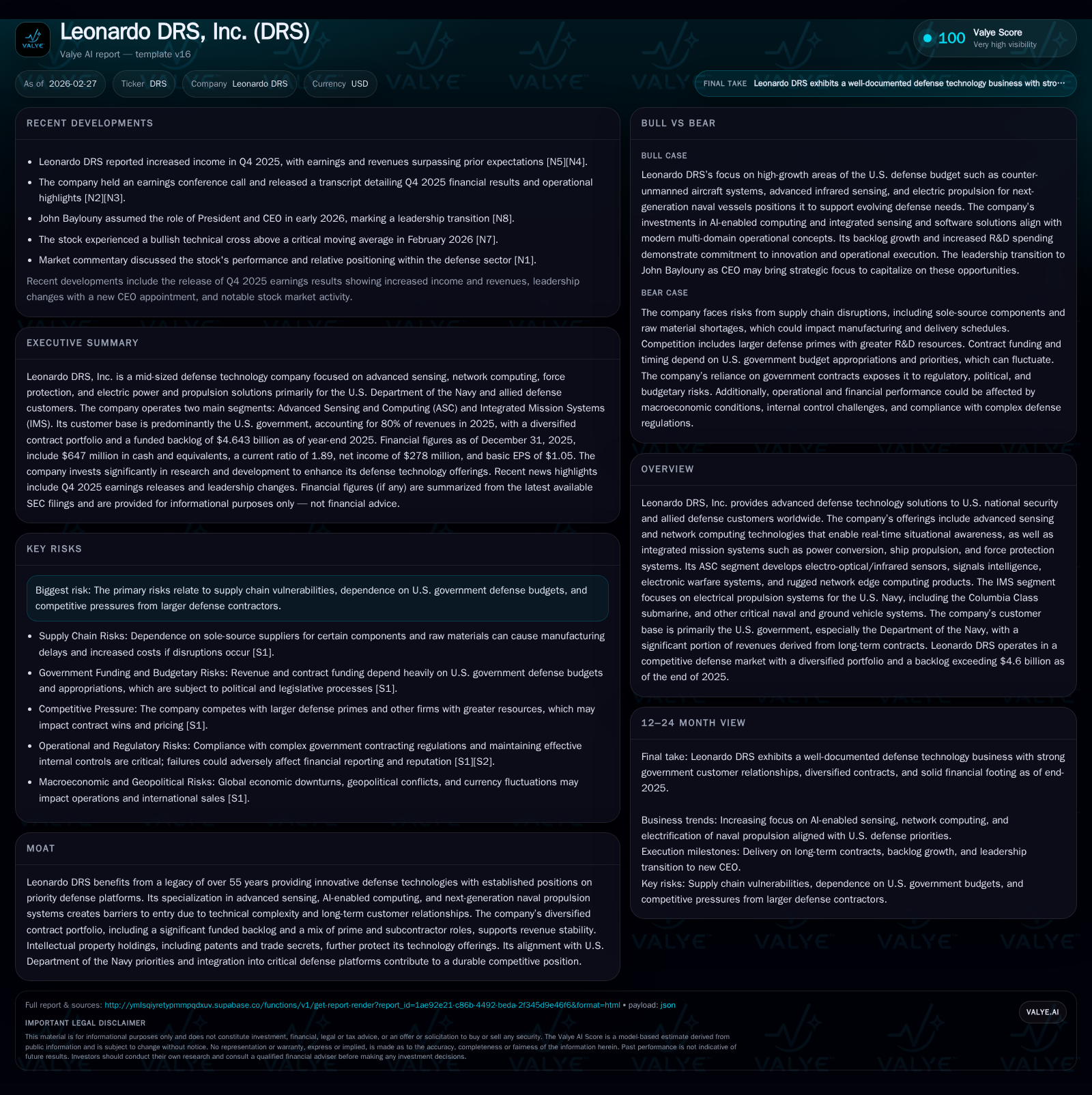
After two years of uneven performance, Leonardo DRS achieved notable financial momentum in 2025, driven primarily by its Advanced Sensing and Computing (ASC) and Integrated Mission Systems (IMS) segments. Operating income increased 18.8%, while net income rose 30.5%, underscoring improving operational execution amid favorable contract awards. The company’s cash flow generation strengthened materially, enabling significant capital investments aimed at expanding technology capabilities and capacity. Risks remain tied to supply chain vulnerabilities, government budget dependencies, and intense competitive dynamics. Going forward, backlog growth and defense industry tailwinds in autonomous systems and naval electrification suggest continued opportunities for growth.
Financial Momentum: Unpacking FY2025’s Growth Drivers
Leonardo DRS’s financial trajectory through fiscal year 2025 illustrates a marked recovery following volatile prior years. Operating income reached $348 million, an increase of 18.8% compared to $293 million in FY2024 [F1]. This surge reflects operational improvements across both core segments alongside beneficial contract awards and renewals documented in recent earnings commentary [N1][S1]. Net income also saw a notable advance, rising 30.5% year-over-year to $278 million, illustrating enhanced profitability amid stable revenue performance [F1]. Cash flow from operations expanded sharply by 35.1% to $366 million, underpinning a strategic increase in capital expenditure spending elevated by nearly two-thirds to $139 million—largely allocated to accelerating research & development initiatives and facility enhancement [F1]. This capex uptick signals management’s commitment to investing in innovation pipelines and production capabilities essential for winning next-generation platform contracts.
Despite a prior FY2022 peak operating income ($561 million) followed by declines in the subsequent two years reflecting program transitions and macro uncertainties [F1], the FY2025 rebound indicates restored momentum tied to contractual ramp-up in high-priority areas such as naval propulsion systems and advanced sensing technologies periodically impacted by cycle timing [N1][S4]. The company’s current ratio at 1.89 points to resilient liquidity supporting these investments [F1].
Historical performance (annual)
| FY | Net ($mm) | CFO ($mm) | OpInc ($mm) | Capex ($mm) | Net YoY |
|---|---|---|---|---|---|
| 2025 | 278 | 366 | 348 | 139 | +30.5% |
| 2024 | 213 | 271 | 293 | 85 | +26.8% |
| 2023 | 168 | 205 | 231 | 60 | -58.5% |
| 2022 | 405 | 33 | 561 | 65 |
Source: SEC companyfacts cache [F1].
Capital returns and efficiency (annual)
| FY | Div ($mm) | FCF ($mm) | ROE% |
|---|---|---|---|
| 2025 | 227 | 10.2 | |
| 2024 | 0 | 186 | 8.3 |
| 2023 | 0 | 145 | 7.2 |
| 2022 | 396 | -32 | 19.0 |
Source: SEC companyfacts cache [F1].
Table: Leonardo DRS Historical Key Financial Metrics (FY2022-2025) derived from [F1].
Advanced Sensing & Computing: Core Technology Foundations
The ASC segment anchors Leonardo DRS’s technical differentiation through cutting-edge sensing and AI-augmented network computing offerings vital to contemporary defense operations [S1][S4][S16]. This business unit develops a spectrum of sensors including electro-optical/infrared (EO/IR), signals intelligence (SIGINT), electronic warfare (EW) systems, and ruggedized edge computing platforms that enable real-time situational awareness critical for layered air defense, counter-unmanned aircraft system (C-UAS) missions, precision targeting, and ISR (intelligence, surveillance, reconnaissance) applications.
Leonardo DRS leverages decades of intellectual property encompassing patents on focal plane arrays and semiconductor devices that enhance sensor resolution, spectral coverage, and environmental resilience—a technical moat that constrains market entry [[S22]]. Through integration of AI-optimized open architecture software packages like SAGEcore™, ASC’s offerings meet Department of the Navy (DoN) imperatives for reduced latency data processing at distributed tactical nodes advancing multi-domain command and control capabilities [S18]. The segment’s focus on power-constrained mobile platforms reflects an acute understanding of defense customer demand patterns prioritizing size-weight-power-cost (SWaP-C) optimization.
This technology suite positions ASC favorably amid DoN priorities targeting autonomy-enhanced networked operations — where seamless fusion of sensor data enables accelerated threat identification against proliferating airborne threats such as drones—a domain gaining increasing budget emphasis [N1]. Sector-specific expert analysis suggests ASC could capture outsized growth via modular subsystem deliveries feeding into broader shipboard radar upgrades and electronic warfare suites.
Integrated Mission Systems: Naval Propulsion as a Strategic Growth Engine
IMS comprises the other pillar of Leonardo DRS’s competitive strength concentrating on power conversion, control systems, electrical propulsion motors, force protection technologies, and logistics support primarily for U.S. Navy platforms including the Columbia Class ballistic missile submarine—the first modern electric drive submarine program offering substantial funded backlog coverage [S1][S4][N1][S16].
Ship propulsion modernization is a core thrust of U.S. naval force renewal emphasizing electrification to enhance stealth, power density, efficiency, and thermal management within constrained vessel envelopes [S19]. IMS products span permanent magnet motors with high torque density as well as energy storage units complementing DC power distribution networks critical for next-gen navy vessels whose combat systems demand unprecedented energy profiles.
With a portfolio protected by advanced technology patents relating to power conversion architecture and motor design coupled with incumbent supplier status on long-term shipbuilding contracts valued collectively in billions [S16], IMS faces high barriers for competitors given technical complexity and stringent qualification cycles typical for nuclear submarine classes.
This segment contributes significantly to Leonardo DRS’s steady funded backlog expansion ($4.64 billion at end-2025 versus $4.18 billion at end-2024), exhibiting confidence from DoN stakeholders amid fleet modernization programs continuing unhindered by short-term fiscal pressures [S16].
Contract Mix & Customer Profile: Navigating Prime and Subcontract Dynamics
Leonardo DRS operates with a pragmatic contract structure reflecting its positioning as both prime contractor (39%) and subcontractor (61%) based on marketplace competitiveness assessment per opportunity [S5]. Prime contractor roles offer direct government contracting relationships but entail higher administrative overheads; subcontracting typically means supplying subsystems or components integral to platform integrators’ efforts.
This mix shapes margins — fixed-price firm contracts ($3.2 billion revenue in FY25) expose the firm to cost overrun risks whereas flexibly priced cost-plus/time-and-materials contracts ($443 million in FY25) provide more reimbursement certainty but less upside on efficiencies [S5]. Revenue concentration resides predominantly within the U.S. Department of the Navy across long-tenured programs exhibiting incumbent advantages that mitigate pricing pressure but require continual technical relevance.
Customer evaluations weigh factors like past performance reliability, delivery timeliness amidst supply chain headwinds, product innovation cadence especially integrating AI functionalities into sensing systems, cost competitiveness relative to larger peers who may leverage economies of scale yet face bureaucratic inertia ([S25]) .
Balancing Risks: Supply Chain, Budget Dependence and Competitive Pressures
Operational risks permeate Leonardo DRS’s business model reflecting perennial defense sector constraints involving supplier dependencies where sole or limited sources exist (e.g., germanium-based components essential for infrared sensors), causing potential manufacturing delays or cost inflation [S9]. Despite active mitigation via long-term agreements promoting economies of scale plus flexible contract billing terms with customers layers risk management but does not eliminate it.
The company remains heavily reliant on the continuity of U.S. government defense appropriations which are subject to political risk including potential shutdowns delaying payment or authorizations impacting order flows directly ([S1],[S6]). Contractual exposure splits between fixed-price contracts vulnerable to inflation-induced cost overruns versus cost-reimbursable arrangements requiring careful project management controls.
Cybersecurity compliance is critical given classified nature of many contracts mandating strict adherence to National Industrial Security Program requirements — failure here could result in suspension or loss of privileged access thwarting business continuity ([S1]). Moreover, intensifying competition from larger defense contractors who benefit from broader resource bases as well as agile smaller innovators delivering disruptive technologies necessitates ongoing investment in innovation ([S25]).
Capital Allocation Analysis: Cash Flow Strength Supports Expansion
Leonardo DRS generated robust operating cash flow totaling $366 million in FY2025 representing a healthy increase that fuels reinvestment capacity without external capital dependence ([F1],[S13]). After accounting for elevated capital expenditures of $139 million—up sharply year-on-year by about two-thirds mainly dedicated towards scaling R&D capacity—the company still realized free cash flow approximating $227 million.
Equity base expansion concurrent with profitable earnings delivery yields an approximate return on equity (ROE) near 10.2%, which aligns favorably within benchmarks for mid-sized defense contractors operating under tight government acceptance regimes ([F1]). Absence of dividend payments signals board preference towards reinvestment though share repurchases remain a tool that could be employed subject to cash flow availability and shareholder approval conditions.
Looking Ahead: Backlog, Order Trends, and Industry Tailwinds
Although explicit guidance remains limited beyond qualitative outlook statements ([N1],[S16]), the company disclosed substantial backlog worth approximately $4.64 billion funded at year-end—up nearly $470 million from prior year—indicating sustained demand visibility amidst evolving DoN strategic priorities centered on autonomous system integration, enhanced electronic warfare suites, layered missile defense architectures, and naval fleet electrification programs.
The increasing trend toward modular open-systems architecture fosters opportunities for Leonardo DRS’s integrated sensing-computing platforms well positioned within multi-domain operations regimes requiring rapid data assimilation at the tactical edge (). Emerging investments surrounding AI-driven decision-support systems combined with persistent demand for quiet propulsion equipment further suggest favorable medium-term market conditions despite macroeconomic headwinds.
Investors should monitor new contract awards announcements especially around Columbia Class submarine propulsion milestones or C-UAS program participations as indicators that order intake sustains growth rates.
Key Milestones and Metrics to Watch in 2026
Upcoming fiscal quarters will be instructive regarding revenue trajectories relative to consensus expectations as the company finalizes deliveries under both prime contracts involving platform integrators and subcontractor components fulfilling incremental milestones ([N2],[N3]). Profitability benchmarks are expected to reflect margin shifts attributable to evolving contract mix between fixed-price engagements demanding cost discipline versus flexibly priced arrangements allowing scope adjustments.
Execution fidelity on Advanced Sensing innovations—particularly deployment success against C-UAS threats—and timely fulfillment of Integrated Mission Systems propulsion units destined for priority shipbuilding programs comprise actionable markers underpinning valuation sensitivity ([N6]). Close attention should also be paid to supply chain resilience updates amid ongoing global material shortages which may influence delivery schedules.
While Leonardo DRS shows strengths grounded in legacy relationships combined with technical acumen fostering incumbent status across core Navy programs, vigilance remains warranted given overarching defense budget uncertainties coupled with intensified competitive stakes both from large consolidated primes attempting market share gains as well as nimble technologically specialized entrants reshaping certain niche domains.
Disclaimer: This document presents an analytical review based solely on provided company filings [F1], SEC reports [S#], and recent news transcripts [N#]. It does not constitute investment advice or recommendations.
Disclaimer: This is research-only, informational analysis and not investment advice. It may include AI-generated interpretation and general industry context. Always verify important details using primary sources.

Comments