
Emergent BioSolutions’ Revenue Decline and Strategic Restructuring Shape 2025 Financial Profile
Emergent BioSolutions delivers operating profit turnaround in 2025 despite significant revenue contraction driven by portfolio rationalization.
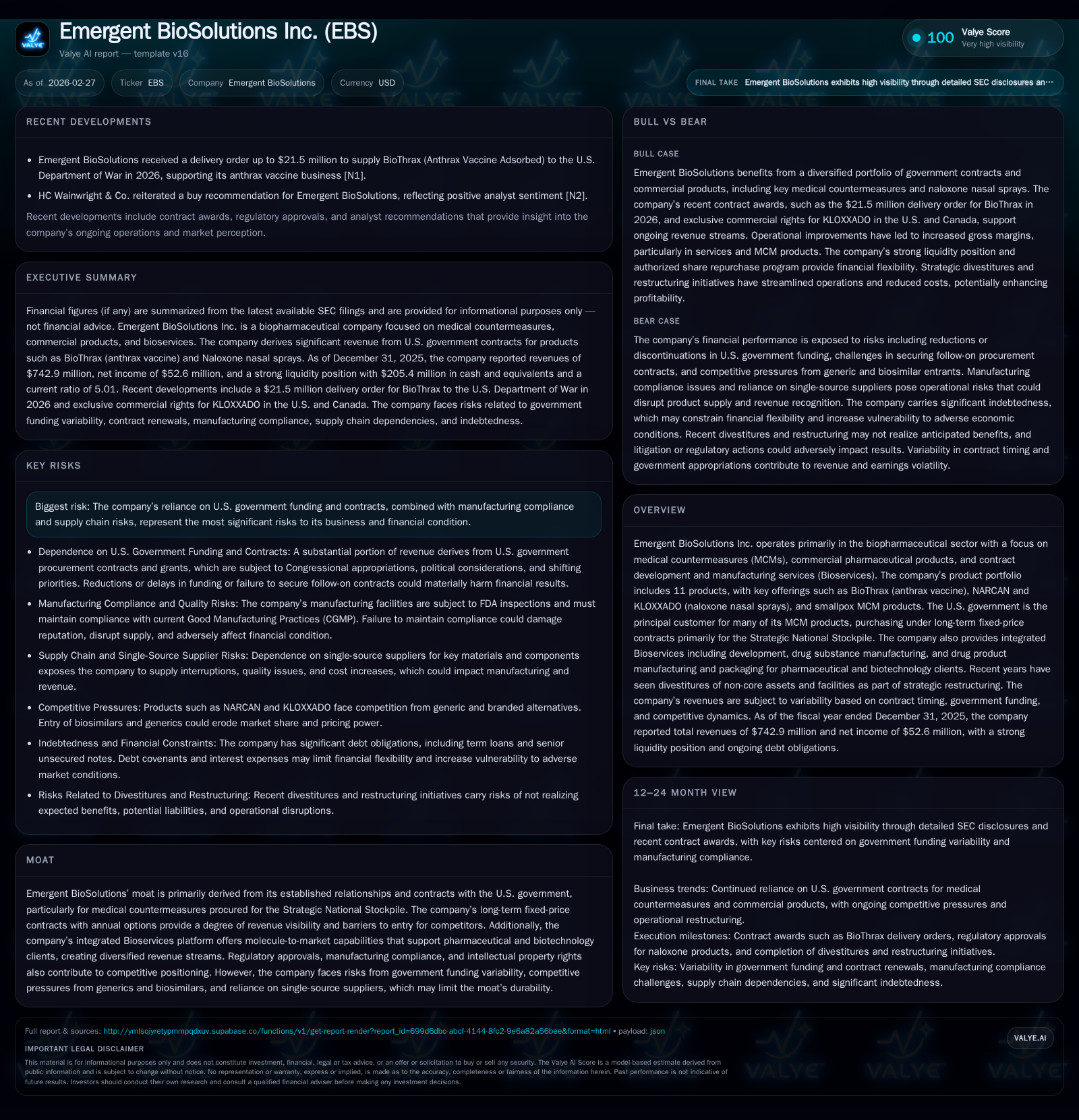
Emergent BioSolutions Inc. experienced a pronounced decline in revenue in fiscal year 2025, primarily due to divestitures of non-core assets and decreased bioservices revenue following asset sales. Nevertheless, the company returned to operating profitability and positive net income after multi-year losses, supported by cost control and favorable product mix. The business remains heavily dependent on U.S. government contracts for medical countermeasures with long-term fixed-price agreements providing revenue visibility but also exposing it to funding risks. With ongoing portfolio refinement, steady cash generation, and a reauthorized share repurchase program, Emergent is navigating a transitional phase as it emphasizes core pharma products and contract manufacturing services.
Company Overview
Emergent BioSolutions Inc. operates at the intersection of biopharmaceuticals focused on Public Health Threats (PHTs) including chemical, biological, radiological, nuclear and explosive threats (CBRNE), emerging infectious diseases (EID), and acute emergency care. The company’s portfolio comprises medical countermeasures (MCMs) such as anthrax vaccines (BioThrax®, CYFENDUS®), smallpox vaccines (ACAM2000®), commercial opioid overdose treatments (NARCAN® and KLOXXADO® naloxone nasal sprays), alongside contract development and manufacturing services (CDMO) branded as Bioservices.
Historically, Emergent has leveraged enduring contracts with the U.S. government principally for strategic stockpile procurement under fixed-price agreements offering revenue stability but also tying its fortunes closely to government budget cycles and priorities [S1]. Recently completed divestitures of non-core assets including its travel health business and certain manufacturing facilities underpin an ongoing strategic reset designed to sharpen the company’s operational focus and improve financial returns [S2].
Historical Performance
Emergent’s financial trajectory illustrates recent volatility driven by restructuring activities and portfolio evolution. Total revenue for fiscal year 2025 fell sharply to approximately $743 million—a nearly 29% decrease compared to roughly $1.04 billion in both 2023 and 2024—reflecting the impact of divesting businesses such as the travel health segment sold to Bavarian Nordic for $270 million cash plus contingent milestones [F1][S2]. Bioservices revenues dropped markedly after asset sales including the Baltimore-Camden drug product facility disposal finalized in Q3 2024 [F1][S2]. Conversely, contract and grants revenues increased modestly by around 26% driven largely by work under the Ebanga™ program [S24].
Operating results show a marked turnaround: operating income swung from a substantial loss of $109 million in 2024 to positive operating earnings of about $100 million in 2025. Net income improved correspondingly from a hefty negative $191 million loss in 2024 to a profitable $53 million net gain in 2025, underscoring effective cost management amid reduced top-line scale [F1]. This reversal was aided by improved product mix favoring higher-margin MCM products including anthrax vaccines, coupled with lower restructuring costs year-over-year [S24].
Cash flows reflect strengthening fundamentals: operating cash flow surged nearly twofold from $59 million in 2024 to $171 million in 2025 while capital expenditures more than halved from $22.9 million down to about $13.8 million. Resultingly, free cash flow approximated $157 million—providing substantial liquidity for debt servicing or capital deployment activities [F1].
A summary of key annual consolidated financials is below:
Historical performance (annual)
| FY | Rev ($mm) | Net ($mm) | CFO ($mm) | OpInc ($mm) | Rev YoY | Net YoY |
|---|---|---|---|---|---|---|
| 2025 | 743 | 53 | 171 | 100 | -28.8% | +127.6% |
| 2024 | 1044 | -191 | 59 | -109 | -0.5% | +74.9% |
| 2023 | 1049 | -760 | -206 | -726 | +217.8% | -1035.1% |
| 2022 | 330 | -67 | -34 | -55 |
Source: SEC companyfacts cache [F1].
Capital returns and efficiency (annual)
| FY | Buybacks ($mm) | FCF ($mm) | ROE% |
|---|---|---|---|
| 2025 | 25 | 157 | 10.1 |
| 2024 | 0 | 36 | -39.5 |
| 2023 | 0 | -258 | -117.1 |
| 2022 | 82 | -150 | -4.8 |
Source: SEC companyfacts cache [F1].
*Note: Revenue YoY % calculated from available annual data; negative YoY metrics indicate improvement from loss.
Future Growth Prospects
Emergent's growth potential hinges on several complementary vectors aligned with its PHT mandate:
Medical Countermeasures: Demand for anthrax (BioThrax®, CYFENDUS®), smallpox vaccines (ACAM2000®), and related products is largely driven by U.S government stockpile needs under long-term commitments, providing a modicum of revenue visibility; however, uncertain government appropriations and contract renewals create upside/downside risk [S1][S4].
Naloxone Commercial Segment: Ownership of NARCAN® nasal spray plus exclusive U.S./Canada rights acquired for KLOXXADO® bolster commercial opioid overdose treatment offerings that carry growth potential through expanded indication approvals—as exemplified by FDA’s recent SNDA approval for a NARCAN carrying case enhancing user convenience—but are tempered by escalating generic competition risk domestically [N1][S1][S25].
Bioservices Contract Manufacturing: The company's integrated CDMO platform provides molecule-to-market development through clinical stage manufacturing and packaging services leveraging capacity across multiple sites including Winnipeg; growth is contingent on securing new client contracts while navigating challenges like capacity utilization and regulatory compliance that require sustained investment [S1][S24].
Product Pipeline: Developing candidates spanning pre-clinical through clinical stages present longer horizon opportunities; external funding support via government grants or collaborations materially influence R&D spend priorities amid competitive landscape pressures [S19][S21].
Conversely, constraints include reliance on volatile government budgets especially post-pandemic drawdowns; attrition of non-core business lines limits diversification; pricing pressures emanating from ongoing healthcare reforms including Medicaid rebate complexities; patent cliffs; regulatory scrutiny around compliance with anti-kickback laws; litigation exposure notably linked to vaccine manufacturing quality control issues; supply chain concentration risks notably single-source suppliers which may hamper production agility; plus evolving biosimilar threats across biologics franchises temper upside prospects substantially [S4],[S14],[S16],[S20],[S25].[F1]
Forecasts & Milestones
The company has not publicly issued explicit guidance encapsulating revenue or earnings targets for upcoming fiscal periods within provided sources; accordingly market watchers should keenly observe:
- Renewal progressions on U.S government procurements especially anthrax vaccine contracts given their outsized impact;
- Volume ramp-up or new awards within Bioservices contracts,
- Uptake trends for naloxone products amid competitive generics,
- Clinical progress milestones achieved by pipeline candidates,
- Potential capital allocation moves including further share buybacks flagship Redeployment / reinvestment strategies following recent restructuring.
Success or slippage along these vectors will materially shape emergent financial trajectory near term.
Capital Allocation & Returns
Emergent delivered approximate return on equity (ROE) near 10% for fiscal year ended December 31, 2025 calculated as net income divided by shareholders’ equity reflecting modest profitability restoration following consecutive large losses previously reported (net losses exceeding $190 million in prior year) [F1]. The restoration corresponds with robust free cash flow generation (~$157 million) afforded by strong operating cash flow expansion juxtaposed with reduced capital expenditure intensity as the company rationalizes manufacturing footprint [F1][S19].
Capital deployment during calendar year included approximately $25 million utilized for share repurchases authorized under the reissued program extending through March 2027 targeting up to $50 million total buybacks offering shareholder value return potential albeit limited scale relative to market cap size [F1][S8]. The balance sheet shows substantial liquidity cushions with unrestricted cash exceeding $205 million coupled with undrawn revolving credit capacity at $100 million—facilitating operational flexibility amid debt leverage totaling roughly $573 million distributed between secured loans ($150 million term loan) and unsecured notes (~$440 million outstanding) presenting legacy financing costs considerations requiring diligent management amid macroeconomic rate/credit risks [F1][S6][S8][S13].
Industry Context & Competitive Positioning
Analysis: Emergent operates within a specialized niche intersecting biodefense-oriented pharma products procured predominantly by governments along with commercial opioid reversal treatments facing traditional biopharma competitive dynamics including branded/generic substitutions plus contract manufacturing which competes intensely for partnerships demanding quality regulatory track records combined with cost efficiency.
The company’s moat notably derives from entrenched U.S government relationships secured through long-term contractual arrangements forming barriers against entrant competitors lacking requisite regulatory approvals or manufacturing credentials for MCM products targeted at strategic stockpiles—a critical national security priority that underpins stable demand even amidst broader commercial pharmaceutical cyclicality.
However, this margin of safety contends simultaneously with downsides intrinsic to dependence upon politically influenced funding flows susceptible to annual Congressional appropriations debates potentially undermining procurement continuity over medium term horizons.
Intellectual property protections around key biologic drugs confer some insulation yet must be vigilantly defended against biosimilar competition steadily expanding global footprints alongside generic naloxone products increasingly commoditizing the commercially oriented segment.
Persistent regulatory complexity encompassing FDA approvals as well as extensive anti-fraud/anti-kickback laws impose overhead compliance burdens while litigation history—including settled shareholder lawsuits linked to prior vaccine manufacturing disruptions—highlights reputational risk exposures materializing alongside cybersecurity vigilance needs tightened post-COVID operations amplified digital attack surface exposures.
Moreover, supply chain concentration in certain active pharmaceutical ingredients or intermediates heightens vulnerability amid global logistics uncertainties—demanding strategic supplier diversification initiatives going forward.
Risks Summary
Detailed exposition across multiple SEC filings highlights pervasive risks including:
- Funding unpredictability concerning USG MCM procurement programs;
- Regulatory compliance demands enveloping health care fraud/abuse statutes;
- Litigation outcomes capable of imposing material financial penalties or injunctive restrictions;
- Pricing pressures mediated by Medicaid rebate programs plus anticipated healthcare reforms constraining revenue potential;
- Generic/biosimilar entry eroding patent-protected product franchises;
- Manufacturing disruptions stemming from facility incidents or quality control failures;
- Supply chain single points of failure increasing operational risk profile;
- Cybersecurity threats affecting proprietary information integrity;
- Challenges relating to integration or deleveraging efforts tied to acquisitions/divestitures completed last three years reflecting restructuring undertakings described earlier. These factors together elevate execution risk particularly during this transitional strategic phase where operational discipline must coexist with innovative pipeline progression capabilities[S4],[S14],[S16],[S20],[S25],[S28].
Conclusion
Emergent BioSolutions enters calendar year 2026 having accomplished a pivotal return to profitability after successive years burdened by intense restructuring costs headwinds amplified by past pandemic-related contract fulfillment challenges.[F1] The company’s deliberate portfolio pruning actions culminating in divestiture proceeds recapitalized liquidity enabling enhanced balance sheet positioning complemented by ongoing share repurchase authorizations signaling confidence in underlying business fundamentals.[S2],[S8]
However, this progress coexists with broad headwinds arising from intrinsic dependence on uncertain public-sector budgets governing medical countermeasure purchases coupled with stiffening generic competition dynamics undermining key commercial products.[S25] Verifiable growth catalysts hinge principally on sustaining long-range U.S Government relationships while incrementally expanding participation across Bioservices clientele via unparalleled integrated molecule-to-market capabilities at controlled costs.[S1]
From an investment analysis standpoint—notwithstanding implicit valuation discounts likely priced into shares considering historical volatility—the firm represents a player reconciling legacy biodefense obligations with ambitions toward sustainable commercial biopharma returns framed within politically sensitive defense spending environments.[F1] Close monitoring of contract awards cadence alongside regulatory compliance developments forms focal points for assessing future fundamental health.
This report is for informational purposes only and does not constitute investment advice or recommendations.
Disclaimer: This is research-only, informational analysis and not investment advice. It may include AI-generated interpretation and general industry context. Always verify important details using primary sources.

Comments