
e.l.f. Beauty’s Innovation and Acquisition Strategy in the Competitive Clean Beauty Landscape
e.l.f. Beauty leverages accessible premium clean products, strategic acquisitions, and digital marketing to drive growth amid supply chain and market pressures.
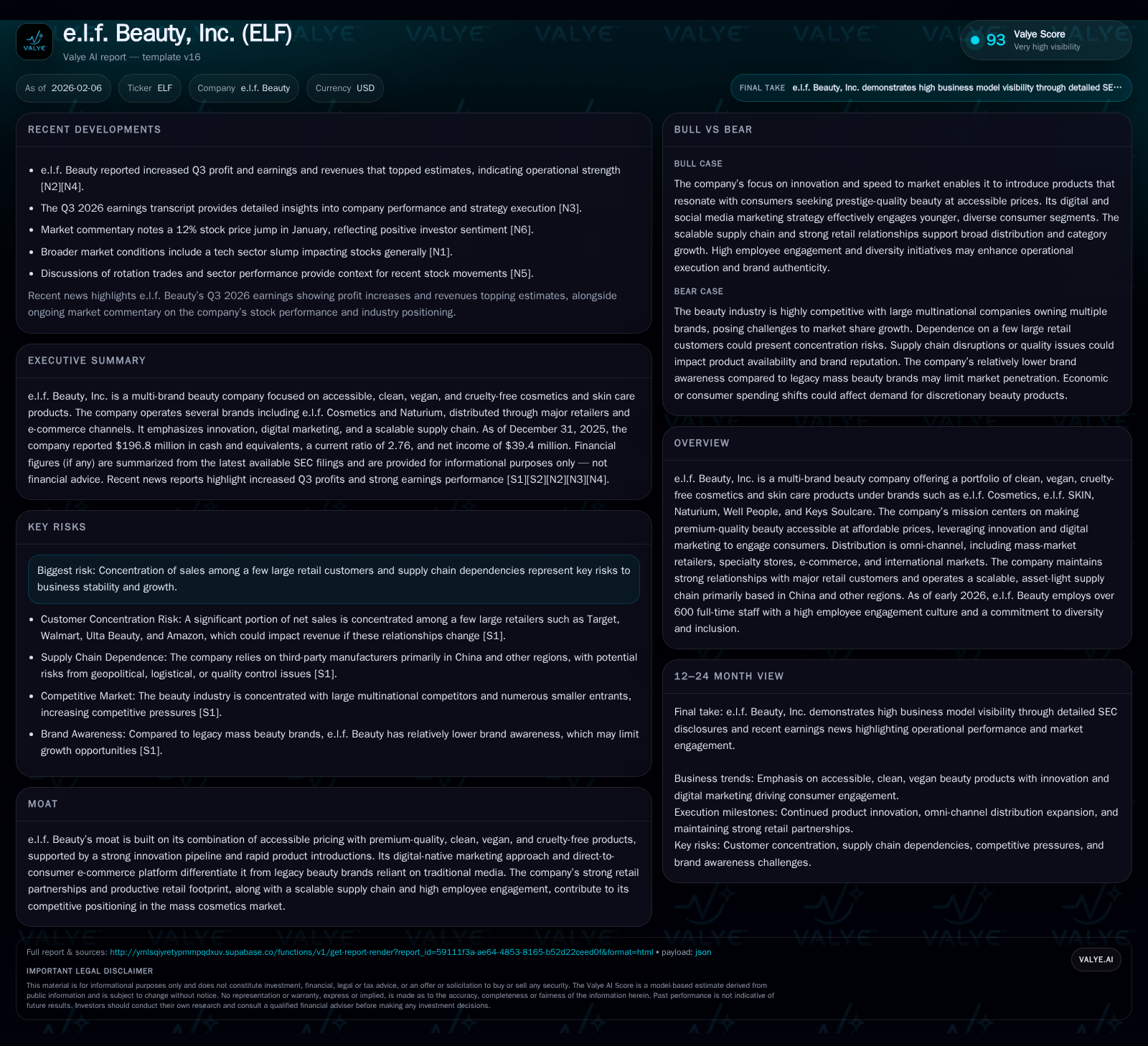
e.l.f. Beauty, Inc. has carved a differentiated niche by offering clean, vegan, cruelty-free cosmetics at accessible price points through a multi-brand portfolio including e.l.f. Cosmetics, Naturium, and Well People. Recent quarterly results surpassed expectations, fueled by product innovation and expanded retail distribution. The company’s acquisitions of Naturium and the pending Rhode deal bolster its skincare footprint and growth potential but bring integration and supply chain complexities. A digitally native marketing approach coupled with an omni-channel presence supports consumer engagement in an increasingly competitive beauty market. While strong retail relationships underpin sales, customer concentration and reliance on third-party Asian manufacturers represent operational risks. A highly engaged workforce fosters rapid innovation needed to sustain momentum.
Disrupting Traditional Beauty: e.l.f.’s Inclusive, Clean, and Affordable Edge
e.l.f. Beauty has fundamentally reshaped the mass cosmetics landscape since its inception by centering a value proposition around accessibility without compromising on product integrity. The company’s portfolio comprises a diversified set of brands—e.l.f. Cosmetics, e.l.f. SKIN, Naturium, Well People, and Keys Soulcare—all unified under principles of clean formulations that are vegan and cruelty-free [S1]. This multi-brand architecture allows e.l.f. to address different consumer segments while upholding a consistent ethos focused on transparency, sustainability, and inclusivity.
At the core is e.l.f. Cosmetics which pioneered affordable prestige-inspired makeup products available through national mass retailers as well as online platforms. Supplementing this is e.l.f. SKIN’s dermatologist-developed skincare offerings with targeted actives designed for broad consumer access at “get-real” prices [S1]. Meanwhile, Naturium expands the company’s reach into efficacious botanical formulations melding natural ingredients with technology—a powerful foil against premium but often less transparent competitors.
Beyond product formulation, e.l.f.’s commitment to manufacturing standards such as Fair Trade Certified™ production underscores its mission to disrupt traditional beauty paradigms by democratizing quality clean beauty.
Recent Q3 Results & Market Reaction: Momentum Beyond Estimates
In Q3 FY26, e.l.f. Beauty reported financial results that robustly exceeded analyst expectations: net income climbed to $39 million alongside top-line growth outpacing consensus forecasts [N1][N2][N7]. This earnings beat was attributed primarily to strength in new product launches propelled by the latest multi-brand innovation pipeline coupled with expanded retailer shelf space.
Investor reaction was notably positive with ELF stock surging over 12% in January in response to these developments amidst a weakening broader equity environment triggered by technology sector headwinds [N9][N6]. Management commentary highlighted success in leveraging digital channels for rapid innovation cycles—the ability to enter new subcategories swiftly has been credited with sustaining consumer interest despite intensifying category competition [N1].
This momentum indicates resilience in both brand equity and operational execution at a time when many beauty peers face slowing demand or margin pressures.
Strategic Expansion through Naturium and Rhode Acquisitions: Synergies and Growth Potential
e.l.f.’s strategic acquisition activity points to a deliberate build-out of its skincare segment—a fast-growing category within beauty driven by consumer preference shifts toward health-conscious routines.
The October 2023 acquisition of Naturium for approximately $333 million (paid via cash plus shares) integrated a well-regarded skin-compatible brand known for ingredient transparency [S1]. This deal provided immediate scale and enhanced product pipeline depth that complements e.l.f.’s existing e.l.f. SKIN offerings.
Looking ahead, the pending acquisition of Rhode—a lifestyle beauty brand founded by influencer Hailey Bieber—for $800 million represents an ambitious step into adjacent lifestyle categories with elevated brand cachet [S1]. This transaction is expected to close in Q2 FY26 subject to customary approvals.
Potential synergies include cross-brand marketing efficiencies leveraging Rhode’s celebrity association alongside expanded distribution through established retail channels such as Target and Ulta where e.l.f. already maintains strong footholds [S1]. Nonetheless, integration challenges are notable given Rhode's distinct positioning requiring careful alignment while preserving its aspirational appeal.
Supply Chain Dynamics and Customer Concentration Risks: Underpinning Resilience?
Operationally, e.l.f.’s supply chain remains predominantly reliant on third-party manufacturers located primarily in China and other Asian markets where cost-effective production can be scaled efficiently [S1]. While this asset-light model affords flexibility and mitigates capital intensity relative to owning manufacturing assets outright, it also exposes the company to geopolitical tensions, tariffs (as referenced in SEC filings), logistics disruptions, and raw material inflation risks.
Customer concentration presents another critical risk vector. Four customers—Target (23%), Walmart (16%), Ulta Beauty (12%), and Amazon (12%)—collectively accounted for over 60% of net sales in fiscal 2025 [S1]. Although these relationships enhance distribution reach substantially across brick-and-mortar plus digital channels domestically and internationally (UK/Canada being notable markets), any adverse changes in retail partnerships or reductions in shelf space could materially impact revenue visibility.
Mitigation efforts include expanding into newer retail doors coupled with increasing sales per linear foot within existing accounts via marketing investment and product innovation [S1]. However, concentration remains an omnipresent structural vulnerability amid evolving retailer strategies.
Digital-Native Marketing and Omni-Channel Distribution: The Engine of Consumer Connection
e.l.f. stands out among mass cosmetics companies due to its early adopter status as a digital-native marketer leveraging social platforms for authentic community building—a strategy that continues to define its brand identity [S1]. Rapid prototyping of campaigns coupled with influencer collaborations enables fast rollout cycles when paired with data-driven consumer insights gleaned from direct-to-consumer e-commerce channels.
These efforts amplify reach beyond traditional mass retail environments into specialty stores plus international territories where localized digital content adapts seamlessly [S1]. As a result, the company's omni-channel distribution ecosystem enhances accessibility while maintaining high awareness levels across diverse audiences.
Such connectivity strengthens repeat purchase behavior in younger digital-affluent cohorts vital for sustained category relevance amid shifting consumption patterns away from legacy department store dominance.
Financial Health Snapshot: Profitability, Liquidity, and Capital Deployment
e.l.f.’s most recent financial disclosures underscore solid fundamentals enabling continued investment into growth initiatives including acquisitions [F1]. Reported net income stood at $39 million at year-end 2025 bolstered by lucrative gross margins derived from optimized product mix management within scalable manufacturing agreements.
Liquidity remains robust with approximately $197 million held in cash/equivalents against current liabilities near $254 million yielding a current ratio of roughly 2.76—indicative of ample short-term solvency [F1]. Such a healthy balance sheet facilitated financing the Naturium acquisition partially via shares while reserving capacity for the larger Rhode transaction slated shortly.
Capital efficiency gains derive from asset-light operations focusing expenditure on marketing innovation instead of fixed manufacturing infrastructure which could constrain responsiveness otherwise.
Competitive Positioning Among Mass and Prestige Peers: Who Holds the Advantage?
e.l.f.’s hybrid positioning straddles mass affordability yet incorporates prestige-inspired product attributes—a blend not commonly matched in either pure-play luxury or conventional drugstore brands [N10][N11]. Compared side-by-side with heritage luxury houses such as Estee Lauder (EL), e.l.f. offers youthfulness in brand voice combined with swift innovation velocity against EL’s breadth but slower cycle times [N4][N11].
This dynamic introduces tension between accessibility versus aspiration; however, it grants e.l.f. unique leverage over consumers transitioning from value-oriented purchases into higher-end skincare experimentation encouraged by Naturium's acquisition.
Analysts acknowledge that while prestige brands maintain strong global scale advantages encompassing fragrance/cosmetics duopolies elsewhere in portfolios, mass-market leaders like e.l.f.—with digitally native agility—remain best positioned to capture evolving generation Z/millennial preferences grounded in transparency values [N10][N11].
Organizational Culture as a Strategic Asset: Employee Engagement and Innovation
A standout feature driving execution capacity is e.l.f.’s remarkably high employee engagement metric hitting approximately 90%, significantly above consumer goods industry norms [S1]. This data point signals a motivated workforce aligned tightly with corporate purpose emphasizing inclusivity (“every eye, lip & face”) alongside innovation freedoms enabling rapid ideation-to-market pathways.
Employees’ enthusiastic endorsement (>97% recommendation rate internally) fosters cross-functional collaboration instrumental for maintaining pace amidst fast-moving beauty category trends requiring relentless freshness of SKU offerings paired with efficacy claims validation standards [S1].
Such cultural strength acts not merely as internal morale booster but as tangible competitive moat enhancing talent retention critical during periods of expansion especially when absorbing acquired entities’ teams under common vision frameworks.
Looking Ahead: Catalysts, Challenges, and Investment Considerations
Looking forward, key catalysts include successful integration milestones with Rhode expected post-Q2 FY26 closure potentially unlocking incremental cross-category revenue streams supported by elevated branding synergies linked directly to influencer marketing clout [S1][N6]. Continued innovation particularly within clean skincare formulas will be essential given category saturation forces exerted by emerging indie players plus incumbent conglomerates increasing functional claims competitiveness alike.
Conversely, macroeconomic uncertainties such as sustained tariff regimes affecting input costs or disrupted global logistics chains present tangible headwinds documented explicitly in recent SEC filings highlighting potential impairment on profitability margins if cost pass-through limitations arise or inventory obsolescence accelerates [S2]. Moreover, concentrated retailer customer bases require careful management of channel conflicts or shifting assortment priorities threatening sales momentum abruptly.
Market conditions also pose notable volatility; recent tech stock sell-offs spreading uncertainty highlight vulnerability even among fast-growth discretionary names including beauty stocks dependent on consumer spending confidence fluctuations [N6]. Scenarios demanding operational agility reinforce why e.l.f.’s decentralized manufacturing model combined with fluid digital ecosystem engagement remain vital pillars underpinning resilience.
In sum, e.l.f. Beauty presents a compelling case study blending disruptive brand-building within conventional retail infrastructures backed by astute capital allocation into complementary acquisitions deepening its clean beauty footprint while deliberately managing inherent risks embedded within competitive dynamics and supply networks.
Disclaimer: This analysis is for informational purposes only based on publicly available information as of early February 2026. It does not constitute investment advice or recommendations.
Disclaimer: This is research-only, informational analysis and not investment advice. It may include AI-generated interpretation and general industry context. Always verify important details using primary sources.

Comments