
Elutia After Divestiture: Can NXT-41x Anchor a Focused Biologics Model Amid Litigation and Capital Uncertainty?
Elutia’s post-divestiture strategy centers on the NXT-41x biomatrix, aiming to address complications in implantable medical devices—but with litigation liabilities, no remaining insurance for key claims, and uncertain future capital needs, the company’s ability to achieve sustainable growth now hinges on regulatory progress and market acceptance for a single, high-stakes product.
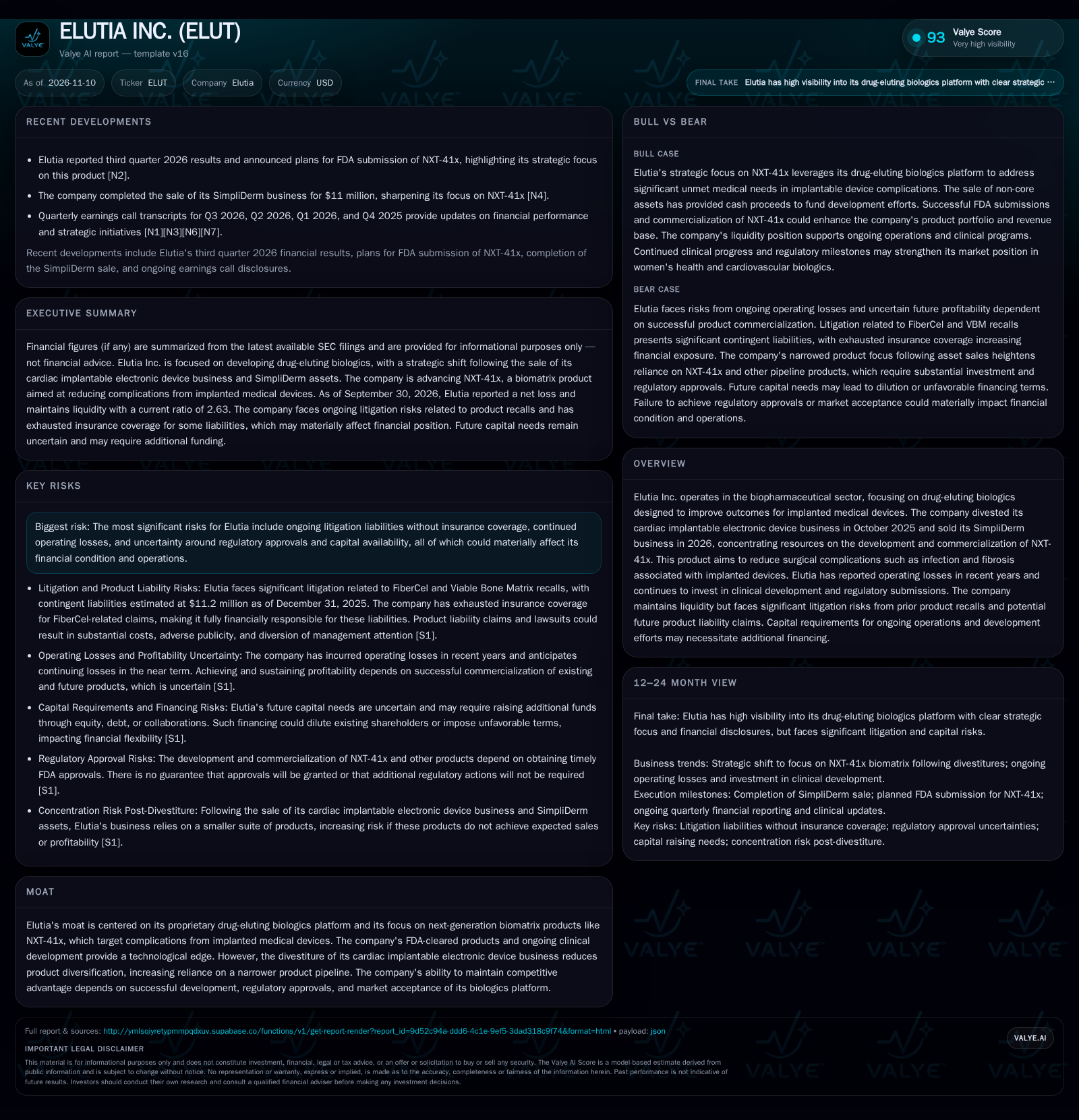
Elutia has sold off major legacy businesses to focus on developing and commercializing NXT-41x, a drug-eluting biomatrix targeting surgical complications from implants. The company retains a $29.1 million reported cash balance but faces ongoing operating losses, significant litigation liabilities from past recalls (with exhausted insurance coverage), and must secure both regulatory approval and market traction for NXT-41x to reach profitability. Future funding may be needed, with dilution or unfavorable terms possible if NXT-41x progress stalls or litigation costs escalate. [S1] [S2] [N2]
Elutia Inc. has undergone a dramatic transformation, divesting its cardiac device and SimpliDerm businesses to focus exclusively on the development and commercialization of NXT-41x, a drug-eluting biomatrix designed to tackle complications associated with medical implants. With no remaining insurance for key litigation and uncertain timelines for FDA approval, Elutia’s investment case now rests on its ability to execute clinical, regulatory, and commercial milestones for NXT-41x before financial pressures escalate.
Strategic Refocusing, Litigation Overhang, and the NXT-41x Bet
Elutia’s recent business transformation is marked by two major divestitures: the sale of its cardiac implantable electronic device (CIED) business in October 2025 and the 2026 sale of SimpliDerm. These moves have narrowed the company’s focus almost entirely to the development and commercialization of NXT-41x, a biomatrix intended to reduce surgical complications such as infection, migration, and fibrosis for implanted devices. As of September 30, 2026, Elutia reported $29.1 million in cash and cash equivalents, a current ratio of 2.63, and a net loss of $1.285 million for the recent quarter. However, the company faces $11.2 million in contingent litigation liabilities from prior product recalls, with no remaining insurance coverage for FiberCel-related claims, leaving it fully exposed to these risks. The company continues to operate at a loss and expects further losses until (and unless) NXT-41x achieves regulatory and commercial success. [S1] [S2] [N2] [N4]
The concentration of Elutia’s business model around a single product, NXT-41x, introduces significant operational risk that extends beyond clinical and regulatory challenges. Without diversification, the company’s financial health becomes tightly coupled to the timing and success of this one asset, increasing vulnerability to external shocks such as shifts in reimbursement policy or competitor innovations. The company reported cash and liquidity metrics for the period; these figures do not by themselves establish operating runway, investment capacity, financial flexibility, or financing capacity. This risk profile necessitates meticulous capital management and contingency planning to balance investment in growth against potential liabilities.
How Elutia’s Focused Model Could (or Might Not) Generate Returns
Elutia’s path to profitability now relies almost exclusively on NXT-41x. The core economic proposition is that a proprietary drug-eluting biomatrix, if proven to reduce complications with implanted medical devices, could command premium pricing in a market where surgical complications are costly for providers and patients alike. Volume potential depends on securing regulatory approval, driving adoption among surgeons and hospitals, and possibly winning inclusion in reimbursement pathways. The cost structure of biologics development is typically front-loaded, with high R&D and regulatory costs but the potential for substantial gross margins if successful. However, Elutia’s narrowed product scope amplifies operational leverage—success could quickly improve margins, but any delay or setback in NXT-41x’s clinical or regulatory journey would leave fixed costs (including G&A and ongoing litigation) unsupported. Future capital raises—whether via equity, debt, or partnerships—may be required, and could dilute shareholders or impose restrictive terms if NXT-41x progress stalls. [S1] [S2]
From a capital efficiency standpoint, Elutia’s focused biologics model hinges on achieving economies of scale in manufacturing and distribution for NXT-41x, which could be challenging given the specialized nature of biomatrix products. The upfront R&D investment, including clinical trials and regulatory submissions, represents a sunk cost that must be amortized over product sales volume. If market adoption is slower than anticipated, fixed costs could weigh heavily on margins and cash flow. Conversely, successful penetration into multiple implantable device categories could drive volume growth and improve unit economics. Strategic partnerships or licensing arrangements might also provide alternative pathways to scale while mitigating capital intensity and operational risk.
NXT-41x in the Broader Landscape: Differentiation, Substitution, and Barriers
Elutia’s competitive moat hinges on the proprietary nature of its drug-eluting biomatrix platform. If clinical data support meaningful reductions in infection, fibrosis, or other complications, NXT-41x could differentiate itself from standard biomaterials and non-drug-eluting alternatives. However, the medical device and biologics market is highly competitive, with large incumbents offering a range of biomaterials, coatings, and adjunctive therapies aimed at similar complications. Substitution risk is significant: hospitals may prefer established products with proven safety records, especially given Elutia’s litigation history. Switching costs for providers are typically low unless the new product demonstrates clear clinical and economic advantages. Regulatory hurdles and the need for strong clinical evidence represent both a barrier to entry for new competitors and a challenge for Elutia’s own adoption curve. Success will likely depend on the company’s ability to build robust clinical evidence, secure FDA approval, and demonstrate health-economic value to payers and providers.
The competitive landscape for implantable device adjuncts is shaped not only by product efficacy but also by the strength of clinical evidence and payer acceptance. Even if NXT-41x demonstrates superior outcomes, Elutia must navigate complex hospital procurement processes and demonstrate compelling health economic benefits to justify premium pricing. Additionally, the company’s litigation history may influence provider and payer perceptions, potentially increasing the burden of proof required to gain trust. In this environment, building a robust real-world evidence base and engaging key opinion leaders could be critical to overcoming substitution risk and accelerating adoption. Regulatory exclusivity periods and patent protection will also play a key role in sustaining competitive advantage against generic or biosimilar entrants.
What a Successful NXT-41x Launch Could Unlock
If Elutia successfully navigates the FDA submission and approval process for NXT-41x, and if clinical data validate its ability to reduce surgical complications, the company could see rapid adoption in targeted implant markets. Early hospital uptake—especially if supported by favorable reimbursement decisions—could drive revenue growth and operating leverage, improving margins as fixed costs are spread over higher sales. Positive clinical outcomes could also facilitate expansion into adjacent indications or partnerships with larger device manufacturers. The upside scenario would be confirmed by timely FDA approval, robust clinical data publications, announced hospital or group purchasing organization (GPO) contracts, and clear evidence of recurring orders. If litigation costs remain contained and capital needs are met on reasonable terms, Elutia could transition from cash burn to positive cash flow, restoring optionality for pipeline expansion or future acquisitions.
A Plausible Trajectory: Incremental Progress, Measured Adoption, and Ongoing Capital Needs
The most plausible path for Elutia is one of incremental progress: advancing NXT-41x through regulatory milestones, generating initial clinical evidence, and securing early but limited commercial traction. Revenue growth would likely be modest at first, with ongoing operating losses as the company invests in market education, additional clinical studies, and reimbursement efforts. This scenario would be confirmed by a steady cadence of clinical and regulatory updates, slow but positive revenue growth, and periodic capital raises. Signs of delayed FDA approval, clinical setbacks, or slow market uptake would tilt the scenario toward downside risk.
Where the Model Breaks: Delays, Litigation Shocks, and Funding Strain
The adverse scenario for Elutia is characterized by a combination of regulatory delays, underwhelming clinical data, or market reluctance to adopt NXT-41x—leaving the company without a viable growth engine. Simultaneously, litigation settlements or judgments could significantly erode the company’s cash position, especially in the absence of insurance coverage. If capital markets become less receptive or if the company is forced to raise funds on punitive terms, existing shareholders could face significant dilution or even risk of insolvency. This scenario would be confirmed by negative regulatory or clinical announcements, rapidly declining cash balances, larger-than-expected litigation payouts, and distressed financing activity.
Milestones and External Pressures That Will Shape Elutia’s NXT-41x-Centric Future
FDA submission and review timeline for NXT-41x, including any requests for additional data or delays in the regulatory process.
Initial clinical and real-world evidence demonstrating reduction in surgical complications compared to standard of care—if disclosed.
First announced hospital contracts, GPO agreements, or commercial partnerships for NXT-41x.
Quarterly revenue trends attributable to NXT-41x sales, if broken out in financial reports.
Updates on the status and magnitude of litigation settlements or judgments, especially for FiberCel and VBM claims.
Disclosure of additional capital raises, including terms and dilution impact for existing shareholders.
Disclaimer: This is research-only, informational analysis and not investment advice. It may include AI-generated interpretation and general industry context. Always verify important details using primary sources.

Comments