
Enterprise Products Partners L.P.: Capital-Intensive Growth Amid Market Volatility and Regulatory Challenges
EPD’s vast midstream assets underpin solid cash flows, but commodity swings, regulatory costs, and leverage pose key constraints.
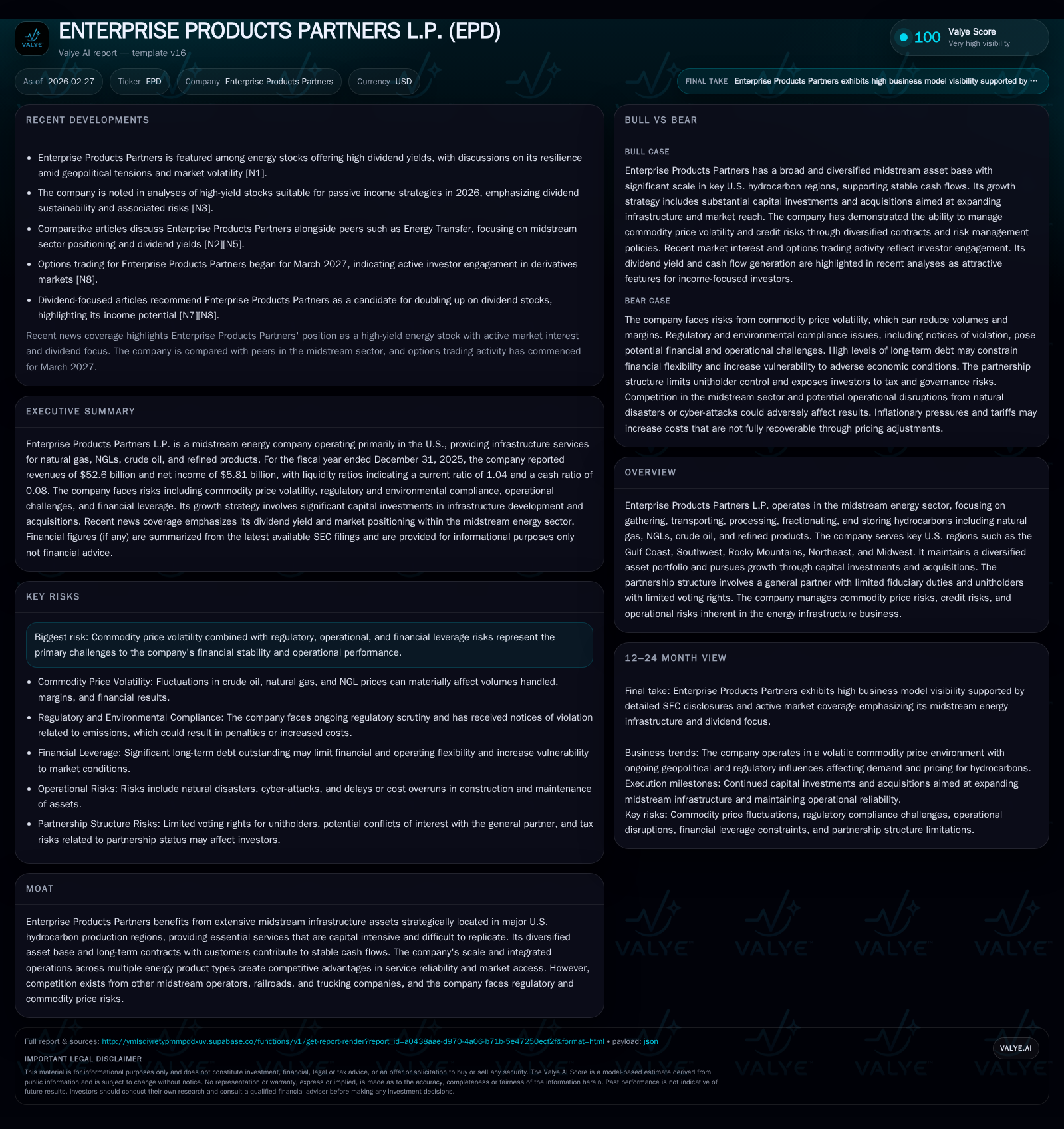
Enterprise Products Partners L.P. (EPD) operates a diverse portfolio of midstream energy assets essential to U.S. hydrocarbon flows, delivering stable cash generation supported by long-term contracts. Recent years saw fluctuating revenues driven by commodity price volatility and broader economic conditions, while the firm has maintained solid operating income and net income margins. Looking ahead, growth hinges on strategic capital investments of $3.1–3.5 billion planned for 2026 focused on organic projects and acquisitions; however, elevated debt levels and regulatory compliance spending may curb financial flexibility. Monitoring capital markets access, integration success of acquisitions, and evolving regulatory landscapes will be critical to sustaining distributions and shareholder value.
Enterprise Products Partners L.P.: Business Overview
Enterprise Products Partners L.P. (EPD) is a leading U.S.-focused midstream energy partnership that operates an integrated network of assets for gathering, transporting, processing, fractionating, and storing hydrocarbons including natural gas, natural gas liquids (NGLs), crude oil, refined products, and petrochemicals [S1][S7]. The firm's operations span key producing basins and consumption markets across the Gulf Coast, Southwest, Rocky Mountains, Northeast, and Midwest regions of the United States.
Its core strategy leverages a diversified asset portfolio anchored by capital-intensive infrastructure crucial for energy supply chains that are difficult to replicate or displace due to high barriers to entry inherent in pipeline construction, storage facilities, and processing plants. Long-term contracts with established customers underpin stable cash inflows allowing EPD to maintain consistent distributions despite commodity price volatility.
Historical Performance Drivers
EPD's recent financial performance reflects the dynamic nature of energy markets combined with disciplined operational execution:
Historical performance (annual)
| FY | Rev ($bn) | Net ($bn) | CFO ($bn) | OpInc ($bn) | Rev YoY | Net YoY |
|---|---|---|---|---|---|---|
| 2025 | 52.6 | 5.8 | 8.6 | 7.3 | -6.4% | -1.5% |
| 2024 | 56.2 | 5.9 | 8.1 | 7.3 | +13.1% | +6.7% |
| 2023 | 49.7 | 5.5 | 7.6 | 6.9 | -14.6% | +0.8% |
| 2022 | 58.2 | 5.5 | 8.0 | 6.9 |
Source: SEC companyfacts cache [F1].
Capital returns and efficiency (annual)
| FY | Buybacks ($mm) | FCF ($bn) |
|---|---|---|
| 2025 | 300 | |
| 2024 | 219 | 3.6 |
| 2023 | 188 | 4.3 |
| 2022 | 250 | 6.1 |
Source: SEC companyfacts cache [F1].
Sources: [F1]
Revenue peaked in FY2022 at nearly $58 billion before moderating through FY2024-25 amid global macroeconomic volatility impacting commodity prices — notably crude oil prices which have fluctuated significantly during this period [S22]. Despite a revenue decline of about 6%, operating income remained relatively stable with only a slight decrease of approximately 1%, reflecting effective cost controls and contract structures insulating earnings from price swings.
Operating cash flow increased by nearly 6% to $8.59 billion in FY2025 even as capital expenditures reached a record high of $4.54 billion to fund growth projects in pipeline expansions and processing capabilities [F1][S10]. Strategic share buybacks totaled $300 million in FY2025 indicating a balanced approach to capital allocation.
Key Growth Prospects
For fiscal year 2026, EPD expects total capital investments between $3.1 billion to $3.5 billion primarily directed towards organic growth projects ($2.5–$2.9 billion) complemented by sustaining capital expenditures near $580 million [S4][S10]. These investments aim to expand midstream infrastructure such as pipelines and NGL fractionation facilities as well as targeted acquisitions that enhance feedstock capacity or geographic coverage.
The company’s diversified operations across natural gas gathering/processing, crude oil transportation & storage terminals provide optionality to adapt to regional production shifts or evolving demand patterns.
However:
- Growth depends on successful project execution without significant delays or cost overruns.
- Access to affordable capital is critical given the substantial existing debt load that limits financial flexibility ([Debt ~$34B senior plus subordinated] as per liquidity disclosures).
- Regulatory changes including environmental standards or tariffs on steel/materials could increase development costs or cause project delays [S2][S27].
- Competitive pressures from other midstream operators plus alternatives like railroads or trucking could lead to tariff compression if capacity exceeds demand [S15][S16].
Regulatory and Operational Risks
Enterprise operates under extensive federal and state regulations covering pipeline safety governed by the Department of Transportation integrity rules and environmental laws including emissions standards enforced by the EPA alongside evolving climate legislation at state levels affecting fossil fuel infrastructure investments [S21][S26]. Notably:
- Pipeline integrity programs require ongoing multi-million dollar testing and repairs estimated around $150 million annually — necessary for safe operation but costly over time as inspection technologies advance [S26].
- Past EPA Notices of Violation related to emissions at refining/product terminals acquired recently underscore regulatory scrutiny risks [S6].
- Cybersecurity remains a significant risk given reliance on IT/OT systems critical for distributed asset management vulnerable to disruptions [S18].
- While insurance coverage is deemed adequate by management for typical liabilities, material unforeseen liabilities from accidents or litigation related to environmental or operational incidents could negatively impact financials [S6].
Credit risk is managed through diversification and monitoring but remains a concern given dependence on counterparty performance under long-term contracts amid economic cycles affecting customers’ liquidity [S18].
Capital Structure and Returns Profile
Capital deployment balances reinvestment in growth with returning cash via buybacks:
- As of December 31, 2025, consolidated senior long-term debt stood at approximately $32 billion plus about $2 billion junior subordinated debt outstanding; credit agreements impose covenants limiting additional borrowing but allow substantial leverage which could attract negative rating agency actions during downturns [S4][F1 Cash & equivalents ~$970M indicate liquidity buffer].
- Debt service obligations consume a meaningful portion of cash flow thereby constraining distribution capacity if earnings decline or refinancing conditions worsen.
- Free cash flow after capital expenditures approximates $4 billion providing some runway for distributions but susceptible to commodity price fluctuations.
- Distribution sustainability depends heavily on cash flows distributed upstream from subsidiaries such as EPO within the partnership structure since standalone operations are conducted through these entities .
- Buybacks totaling $300 million in FY2025 reflect moderate focus on returning capital balanced against funding needs for growth.
These factors illustrate the trade-off between growing a capital-intensive asset base while maintaining attractive yields amid rising financing costs driven by inflationary pressures on materials and higher interest rates globally.
Competitive Positioning
Enterprise benefits from its extensive geographic footprint spanning prolific shale basins — Permian Basin expansions complement Gulf Coast storage hubs while presence in Northeast Appalachia via gas gathering assets positions it well across North America’s diverse hydrocarbon markets . Integrated operations covering NGL fractionation through marine transportation provide diversified revenue streams reducing reliance on any single commodity.
Nevertheless:
- Competition includes independent gatherers offering competitive pricing aimed at securing producer contracts;
- Railroads offer alternative crude logistics especially when pipelines face regulatory constraints or capacity bottlenecks;
- Overbuilding infrastructure risks creating surplus capacity which can depress fee structures.
Maintaining reputation for reliability combined with scale advantages supports securing long-term take-or-pay contracts providing revenue stability uncommon among commodity-dependent firms.
What To Watch Going Forward
In absence of explicit forward guidance beyond planned capex ranges,[N#] investors should monitor:
- Quarterly throughput trends influenced by drilling activity sensitive to oil & gas prices;
- Progress integrating acquisitions realizing expected synergies;
- Execution of debt maturities amid changing interest rate environments;
- Regulatory developments affecting pipeline safety mandates or climate-driven policies impacting project timelines or costs;
- Tariff adjustments or competitor capacity additions influencing pricing power;
- Effects of geopolitical events or trade policies altering supply chain costs notably steel tariffs affecting project economics [S2,S27];
- Distribution announcements relative to operating cash flows signaling confidence in earnings stability.
Conclusion - Strategic Strengths With Material Constraints
Enterprise Products Partners L.P.’s vast midstream footprint supported by diversified assets provides resilience generating stable operational margins despite volatile commodity markets evidenced by recent consistent financial performance amid lower revenue post-pandemic price swings.
The sizeable capital growth agenda underscores ambition but reveals dependency on balancing elevated leverage while navigating rising regulatory burdens alongside competitive risks compressing rate-setting flexibility.
Investors should weigh contracted fee-based revenue stability against macro-financial risks shaping acquisition success and access-to-capital dynamics influencing future growth prospects.
This analysis is prepared solely for informational purposes without investment recommendation.
Disclaimer: This is research-only, informational analysis and not investment advice. It may include AI-generated interpretation and general industry context. Always verify important details using primary sources.

Comments