
Evolution Petroleum: Acquisition-Driven Growth Meets Operating
Recent mineral and royalty acquisitions in the Permian and Louisiana expand Evolution Petroleum’s diversified, non-operated portfolio, but liquidity pressure and negative earnings highlight the importance of disciplined capital allocation and exposure to commodity price volatility.
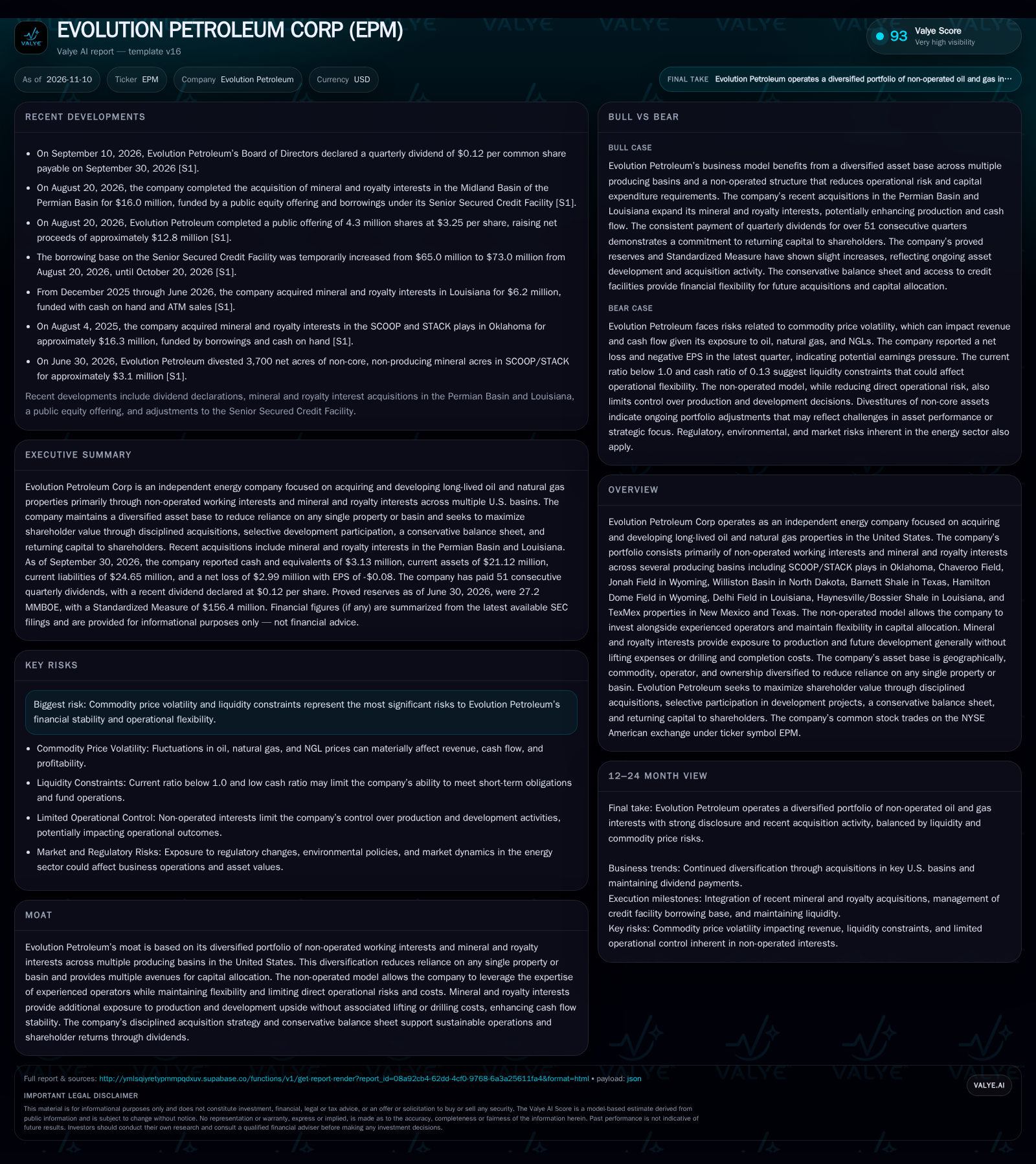
Evolution Petroleum has expanded its mineral and royalty interests with acquisitions in the Permian Basin and Louisiana, funded by a public equity offering and increased credit facility. [S1] [S2]
Evolution Petroleum’s recent acquisition spree—most notably in the Permian and Louisiana—reflects a strategic commitment to asset diversification and shareholder returns. The company’s non-operated, royalty-heavy model provides exposure to upside from experienced operators while capping direct capital risk. Balancing acquisition-driven growth with disciplined capital management will be crucial as Evolution Petroleum navigates the next phase of U.S. oil and gas market realities.
Recent Acquisitions, Dividend Continuity, and Liquidity Pressures Define the Landscape
Evolution Petroleum recently acquired mineral and royalty interests in the Midland Basin of the Permian for $16 million, funded through a $12.8 million public equity offering and a temporary increase in its Senior Secured Credit Facility from $65 million to $73 million [S1]. Additional acquisitions in Louisiana for $6.2 million and in Oklahoma’s SCOOP/STACK for $16.3 million further expanded its non-operated asset base [S1]. As of September 30, 2026, the company reported a net loss of $2.99 million, a current ratio of 0.86, and a cash ratio of 0.13 [S2]. Despite these pressures, Evolution Petroleum declared its 51st consecutive quarterly dividend at $0.12 per share [S1]. These facts highlight an aggressive acquisition strategy, a strong commitment to shareholder returns, and emerging liquidity constraints.
How the Non-Operated Model Shapes Economics and Capital Discipline
Evolution Petroleum’s business model centers on acquiring non-operated working interests and mineral and royalty interests, which allows it to participate in production without incurring direct operating or drilling costs. Mineral and royalty interests, in particular, provide revenue streams from production with minimal capital expenditure, as operators bear the bulk of development risk and cost. This structure supports high-margin cash flow when commodity prices are favorable, but it also exposes the company to volume and price fluctuations over which it has limited control.
The company’s economics are further influenced by its ability to allocate capital opportunistically across basins and operators. Recent acquisitions were funded through a mix of equity issuance and credit facility drawdowns, reflecting a capital-light approach but also introducing dilution and leverage. Operating leverage is inherently constrained by the non-operated model, as fixed costs are relatively low, but so is the upside from direct operational improvements. Sustaining and growing dividends, as evidenced by the long payment streak, requires stable free cash flow—which is subject to commodity volatility and the success of acquisition integration.
The non-operated and royalty interest model inherently shifts operational risks and capital demands away from Evolution Petroleum, but this also means the company’s cash flow is highly sensitive to the operators’ drilling efficiency and commodity price cycles. While minimal capital expenditure supports liquidity preservation, it also limits the company’s ability to influence or accelerate production growth through operational improvements. Consequently, Evolution Petroleum’s financial performance is often reactive to external factors rather than proactive, underscoring the importance of rigorous asset selection and timing in acquisitions to ensure resilience across commodity cycles. Furthermore, the capital structure choices—balancing equity dilution against leverage—must carefully consider the tradeoff between growth ambitions and potential financial flexibility, especially under volatile market conditions.
Diversification and Non-Operator Status: Strengths and Strategic Tradeoffs
Evolution Petroleum’s competitive edge lies in its broad geographic and commodity diversification—spanning the Permian, SCOOP/STACK, Barnett, Williston, and other key U.S. basins—and its focus on non-operated and royalty interests. This model reduces single-asset or operator risk and allows the company to benefit from the expertise and scale of leading operators. However, the tradeoff is a lack of operational control, making the company dependent on partner operators’ capital allocation, development pace, and technical execution.
Peers include other royalty aggregators, non-operated E&Ps, and mineral/royalty trusts. Evolution Petroleum’s willingness to recycle capital—evidenced by recent divestitures of non-core acreage—suggests a pragmatic approach to portfolio management. However, barriers to entry in mineral and royalty aggregation are moderate, and competition for high-quality assets can compress acquisition yields. The real test will be whether Evolution can continue to find accretive deals and maintain favorable cost structures relative to its peers.
Geographic and operator diversification mitigate concentration risk but introduce complexity in portfolio management, as Evolution Petroleum must continuously evaluate partner operators’ capital allocation priorities and operational execution. The company reported cash and liquidity metrics for the period; these figures do not by themselves establish operating runway, investment capacity, financial flexibility, or financing capacity. Moreover, competitive pressures in mineral and royalty acquisitions can compress yields, requiring Evolution Petroleum to maintain disciplined underwriting standards and cost controls. The company’s ability to identify undervalued assets or negotiate favorable terms will be crucial to preserving margins and enhancing returns relative to peers in a moderately competitive aggregation market.
Acquisition Integration and Commodity Tailwinds Unlock Upside
If Evolution Petroleum successfully integrates its recent Permian and Louisiana acquisitions, and if commodity prices remain supportive, the company could see a meaningful uplift in production, cash flow, and distributable income. The non-operated, royalty-heavy model would amplify the benefits of higher oil and gas prices without requiring significant incremental capital outlay.
Additional upside could come from further accretive acquisitions, especially if funded with minimal dilution or at attractive debt terms. A visible increase in proved reserves, particularly liquids-weighted, and a rising Standardized Measure would further validate asset quality and reserve replacement. Progress would also be evident in improved liquidity ratios and a narrowing of the gap between current assets and liabilities.
Disciplined Acquisition Pace Balances Growth with Financial Caution
The most plausible trajectory for Evolution Petroleum is a measured pace of acquisitions and portfolio optimization, supported by cautious capital management. The company is likely to remain focused on non-operated and royalty interests, recycling capital from non-core divestitures into higher-yielding assets. Dividend payments will probably continue, but at modest levels unless commodity prices strengthen materially or operating costs decline.
Falsification would come from a sharp deterioration in cash flow, a need for dilutive equity raises, or a dividend cut.
Commodity Price Weakness and Liquidity Strains Force Retrenchment
The primary risk is a sustained decline in oil and gas prices, which would directly compress cash flows from both working and royalty interests. This, combined with high current liabilities and reported cash balance, could force Evolution Petroleum to curtail acquisitions, sell assets at unfavorable terms, or reduce the dividend. The non-operated model offers some cost flexibility, but it also limits the ability to proactively manage production or costs in a downturn.
Confirmation of this adverse scenario would include persistent net losses, further deterioration of liquidity ratios, a dividend suspension or reduction, and possibly distressed asset sales. Additional warning signs would be an inability to refinance or extend credit facilities on acceptable terms, or the need for emergency equity issuance at depressed valuations.
If commodity prices enter a prolonged downturn, Evolution Petroleum’s limited control over production timing and cost structures could exacerbate cash flow volatility, as operators may prioritize capital spending on higher-return projects elsewhere, potentially reducing volumes from Evolution’s interests. Liquidity pressures could intensify if cash inflows decline while fixed obligations, including dividend commitments and debt service, remain. Additionally, constrained access to capital markets or unfavorable credit terms could limit the company’s ability to capitalize on acquisition opportunities or refinance existing debt, further restricting strategic flexibility in a challenging environment.
Milestones That Will Determine Evolution Petroleum’s Strategic Trajectory
Quarterly net income trends, especially a return to profitability, would demonstrate successful integration of recent acquisitions and commodity price resilience.
Changes in proved reserves and the Standardized Measure, especially liquids weighting and proved developed proportion, would help gauge asset quality and replacement.
Pace, size, and funding mix of future acquisitions: reliance on equity vs. debt and the accretiveness of new deals will signal capital discipline.
Dividend continuity or changes—both increases and reductions—will reflect management’s view of underlying cash flow stability.
Any material changes to the borrowing base or credit facility terms, as these impact flexibility for future acquisitions and working capital needs.
If disclosed, operator performance and development pace in key non-operated properties, as these drive volume and cash flow but remain outside direct company control.
Disclaimer: This is research-only, informational analysis and not investment advice. It may include AI-generated interpretation and general industry context. Always verify important details using primary sources.

Comments