
Grocery Outlet’s Optimization Plan: Can Value Retail Resilience Offset Margin and Debt Pressures?
Grocery Outlet is executing a major operational overhaul as it faces modest growth, margin compression, and the constraints of substantial variable-rate debt. The company’s unique independent operator model, deep-discount positioning, and ongoing store network adjustments are central to its thesis—but macroeconomic, regulatory, and competitive challenges loom large.
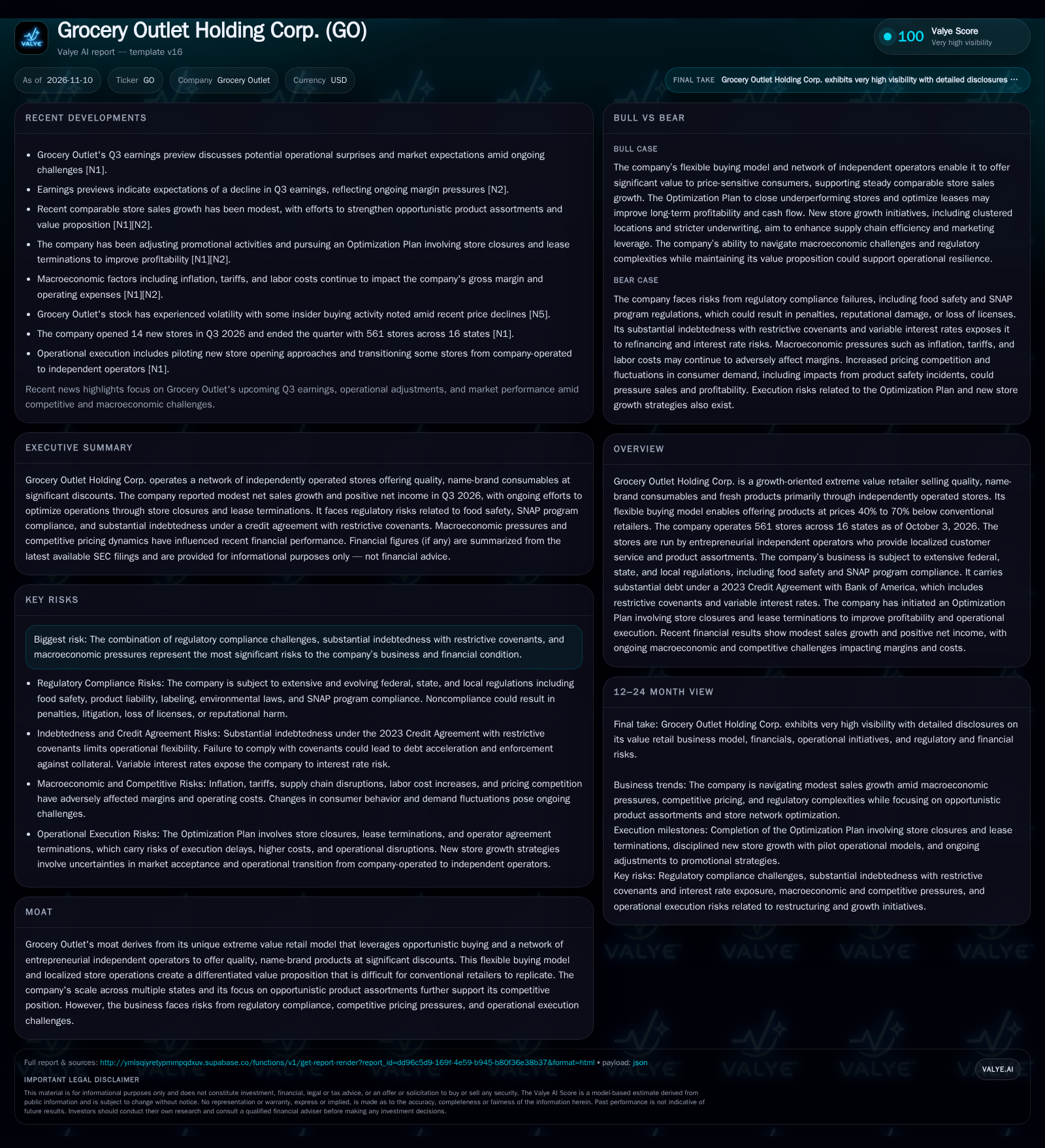
Grocery Outlet is navigating modest sales growth and margin pressure as it restructures its store network and manages substantial variable-rate debt. The company’s differentiated value retail model, dependent on independent operators and opportunistic buying, is being tested by inflation, competition, and regulatory risk. The success of its Optimization Plan and disciplined new store growth will determine whether Grocery Outlet can restore margin resilience and sustain its growth narrative. [S2] [N1] [N2]
Grocery Outlet stands at a pivotal juncture: its extreme value, independent-operator model has historically delivered strong growth by serving price-sensitive consumers with deep discounts on branded consumables. Yet, as of late 2026, the company faces a convergence of margin compression, inflationary and competitive pressures, and the realities of a substantial, restrictive debt load. Its recently launched Optimization Plan, involving targeted store closures and lease exits, is a strategic attempt to restore profitability and operational focus. The key question now is whether this realignment and continued controlled expansion can reignite margin momentum and potential financial flexibility—or whether macroeconomic, regulatory, and competitive crosswinds will continue to erode the company’s distinctive advantages.
Operational Restructuring, Margin Compression, and Debt Shape the 2026 Outlook
Grocery Outlet reported modest net sales growth of 0.9% in Q3 2026, with comparable store sales up just 0.5%—a deceleration versus historical expansion rates. At the same time, gross margin fell by 40 basis points to 30.0%, reflecting the squeeze from inflation, labor costs, and heightened promotional activity. The company is in the midst of an Optimization Plan that includes closing 36 underperforming stores, terminating operator agreements, and restructuring leases, with estimated net restructuring charges between $22 million and $29 million. As of October 3, 2026, Grocery Outlet operated 561 stores across 16 states and maintains substantial indebtedness under a 2023 variable-rate credit facility, subject to restrictive covenants and maturing in 2028. Approximately 9% of sales are tied to EBT, with SNAP program dynamics remaining a material external risk. These developments define the company’s near-term risk/reward profile. [S2] [N1] [N2]
How Grocery Outlet’s Flexible Model Drives—and Constrains—Profitability
Grocery Outlet’s economics hinge on its ability to source branded consumables at deep discounts through opportunistic buying and to leverage its independent operator (IO) model to deliver localized service with lower corporate overhead. Revenue is primarily driven by product volume and the company’s ability to pass on value to price-sensitive consumers, typically offering prices 40% to 70% below traditional grocers. The flexible buying model allows for margin capture on opportunistic deals, but also exposes the company to gross margin volatility when inflation, tariffs, or supply constraints elevate input costs. The IO structure shifts much of the in-store operating cost and execution risk to local entrepreneurs, enabling a leaner corporate expense base and some variable cost protection during downturns.
However, fixed costs—including lease obligations—can become problematic when stores underperform, as evidenced by the current wave of closures and restructuring charges. The company’s substantial variable-rate debt magnifies exposure to interest rate changes and restricts capital allocation flexibility due to covenant limitations. Operating leverage is significant: incremental sales growth in mature stores can flow efficiently to the bottom line, but negative comp periods or cost inflation can rapidly erode profitability. The balance between disciplined new store openings and the risk of overexpansion is now front and center, as the company pilots more selective, clustered growth strategies and tighter underwriting.
Unique Value Proposition Meets Escalating Price Wars and Regulatory Scrutiny
Grocery Outlet’s core competitive advantage lies in its extreme value positioning and the flexibility of its opportunistic sourcing model, which allows it to stock recognizable brands at deep discounts. The independent operator approach fosters localized merchandising and stronger community engagement—elements that traditional corporate-owned grocery chains often struggle to replicate. This model can drive customer loyalty among budget-conscious shoppers, particularly in periods of economic stress.
Yet, these advantages are being tested by intensifying competition from discount grocers, dollar stores, regional value chains, and even larger national players increasing their private-label and discount offerings. Price wars, especially in inflationary environments, can compress margins and force more aggressive promotions. Regulatory risk is heightened by the company’s exposure to food safety and SNAP compliance; roughly 9% of sales are EBT-related, so changes in SNAP funding or eligibility could directly impact revenue. The company’s scale is growing, but its model depends on a steady pipeline of opportunistic inventory and successful IO recruitment—both of which may be challenged if supply chains remain volatile or if the entrepreneurial operator pool thins.
Margin Recovery and Disciplined Expansion Could Restore Growth Premium
If Grocery Outlet’s Optimization Plan succeeds in pruning underperforming stores and renegotiating leases, fixed cost drag could be reduced and operational efficiency improved. This, combined with ongoing efforts to cluster new stores in high-density regions and stricter underwriting of IOs, may lead to higher average unit volumes and improved supply chain leverage. Should inflation moderate and supply chain conditions stabilize, gross margin could rebound as the company secures more favorable opportunistic deals and reduces the need for promotional margin giveback. The IO model could show resilience, with strong operators adapting quickly to local market needs and driving positive comp sales.
Confirmation of this scenario would include a stabilization or increase in gross margin, sustained positive comparable store sales growth above 1-2%, and evidence that new store cohorts are achieving faster ramp-up and profitability. Signs of successful lease renegotiations and lower restructuring charges than currently forecast would also support the bull case. If interest rates decline or the company refinances its debt on more favorable terms, the financial constraint from variable-rate interest could ease, enabling more flexible capital allocation.
Steady-State Performance Hinges on Optimization Execution and External Stability
The most plausible near-term outcome is that Grocery Outlet delivers modest top-line growth and maintains slim but positive net income as it works through its Optimization Plan. Comparable store sales are likely to grow in the low single digits, with gross margin remaining under pressure from lingering inflation and competitive discounting. Store closures and restructuring charges will weigh on near-term earnings, but if the company executes its plan without major disruptions, long-term profitability could stabilize.
Regulatory and SNAP-related risks remain, but absent major policy shifts, EBT-linked sales should persist as a stable if not growing revenue stream. The company’s differentiated value proposition and IO model should support a loyal core customer base, but market share gains will be incremental rather than dramatic. Evidence supporting this scenario would be continued modest comp growth, stable store count after the Optimization Plan, and no covenant breaches or major regulatory setbacks.
Margin Erosion and Regulatory Shocks Could Undermine the Value Proposition
In an adverse scenario, persistent cost inflation, rising interest rates, or intensifying price competition could further compress gross margin and erode net profitability. If the Optimization Plan encounters execution delays, higher-than-expected restructuring costs, or operational disruptions, the company could face negative operating leverage. A material regulatory event—such as a significant change in SNAP funding, a high-profile food safety incident, or noncompliance penalties—could cut into both revenue and consumer trust.
If variable-rate debt costs rise or if the company breaches debt covenants, forced asset sales or restricted access to capital could result, potentially triggering a more severe contraction. A thinning pool of entrepreneurial IOs or supply chain breakdowns could further impair the company’s ability to execute its localized, flexible merchandising strategy. Evidence of this scenario would include declining comp sales, further gross margin deterioration, negative net income, covenant breaches, and a spike in store closures or operator turnover.
Testing Grocery Outlet’s Thesis: Operational, Regulatory, and Margin Markers
Gross margin trend: Ongoing improvement or stabilization in gross margin would support the thesis that the Optimization Plan and buying model are restoring pricing power.
Comparable store sales: Sustained positive comp growth above 1-2% would indicate continued customer traction and value proposition resilience.
Restructuring costs and store closure cadence: Actual charges and pace versus forecast ($22–$29 million) will indicate execution quality and risk of further disruption.
New store cohort ramp-up: Performance of recently opened stores, especially those piloted under new operational models, would help test the scalability and effectiveness of the disciplined expansion strategy.
Debt covenant compliance: Any disclosures of covenant breaches, waivers, or amendments would signal financial stress or flexibility constraints.
SNAP/EBT sales mix: Changes in the proportion of sales derived from EBT, or policy shifts impacting SNAP funding, would directly affect revenue visibility.
Interest rate sensitivity: Updates on the effective interest rate paid on the company’s variable-rate debt and the impact on net income.
Operator turnover and recruitment: Trends in IO retention and new operator pipeline would provide insight into the sustainability of the decentralized operating model.
Disclaimer: This is research-only, informational analysis and not investment advice. It may include AI-generated interpretation and general industry context. Always verify important details using primary sources.

Comments