
NexPoint Real Estate Finance Confronts Profitability and Liquidity Pressures
The company's future hinges on its ability to manage real estate market volatility, demonstrate durable earnings power, and provide greater operational transparency.
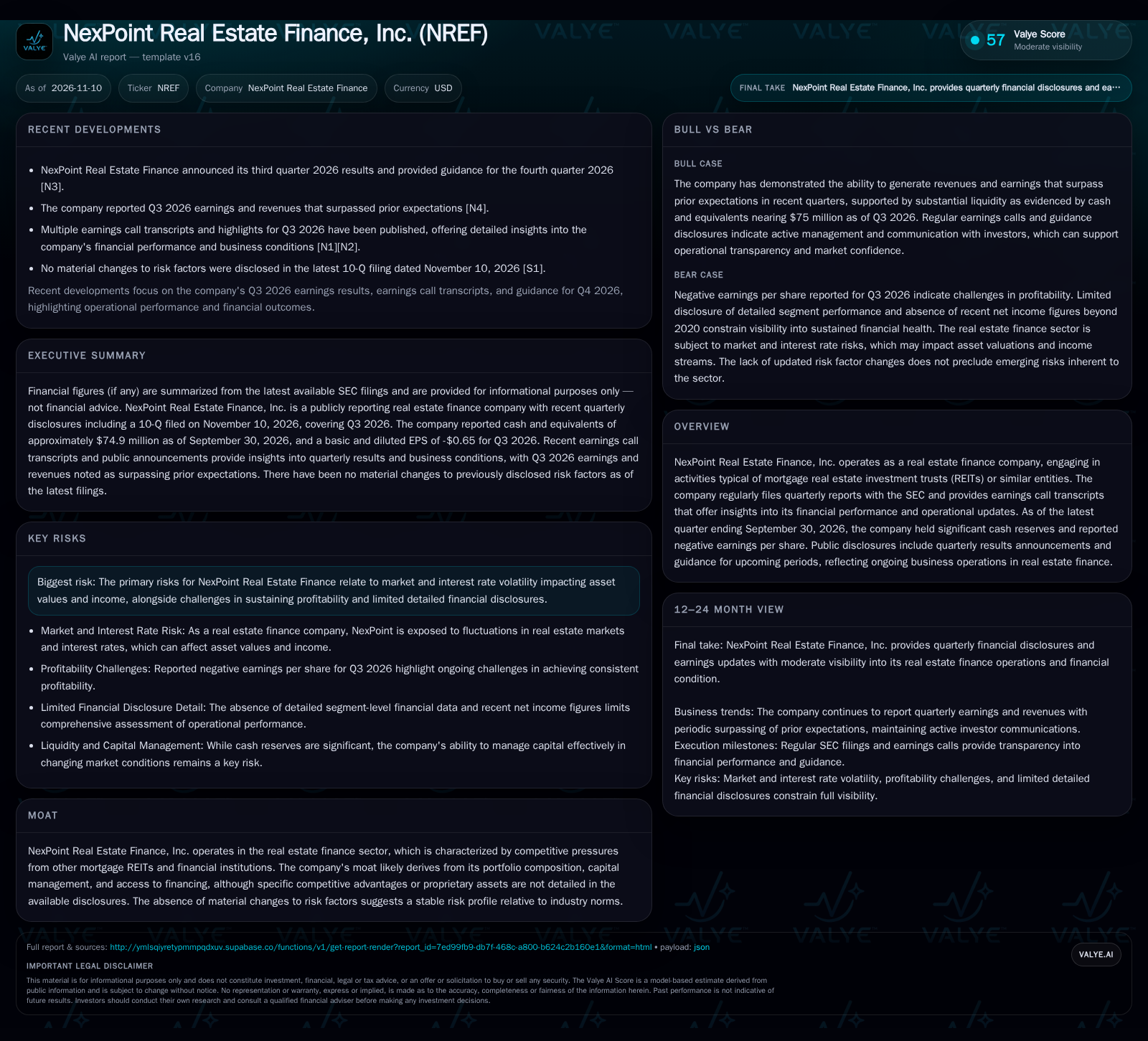
NexPoint Real Estate Finance reported Q3 2026 earnings and revenues above expectations and held $74.9 million in cash, but negative EPS and limited segment detail highlight unresolved profitability and transparency challenges. The company's near-term prospects depend on navigating market volatility and demonstrating that recent outperformance is sustainable, not episodic.
NexPoint Real Estate Finance sits at a crossroads: The company’s Q3 2026 performance exceeded expectations, signaling operational resilience, yet negative earnings per share and sparse segment-level disclosure raise questions about the sustainability of its results. The next phase for investors will be testing whether recent outperformance is a turning point or a temporary reprieve in a sector defined by cyclical swings and disclosure gaps.
Q3 2026 Results Reveal Strength Despite Emerging Challenges
NexPoint Real Estate Finance reported earnings and revenue for Q3 2026 that surpassed prior expectations, drawing positive attention in a challenging sector environment [N4]. However, the company still posted a negative basic and diluted EPS of -$0.65 for the quarter, highlighting unresolved profitability issues [S1]. [S1] Management disclosed no material changes to risk factors in the latest 10-Q, suggesting stability in known exposures but not necessarily an absence of new or evolving threats [S1].
Real Estate Finance Dynamics Underpinning NexPoint’s Profit Structure
NexPoint Real Estate Finance operates in a business model typical of mortgage REITs or real estate finance entities, generating income primarily through the spread between the yield on real estate-related assets (such as commercial or residential mortgage loans) and the cost of funding. Core revenue drivers are net interest income, origination fees, and potentially gains on asset sales or securitizations. The economics are highly sensitive to interest rate movements, credit quality of the underlying assets, and the competitive pricing environment for both assets and funding.
Fixed costs tend to be moderate, with variable costs tied to origination, servicing, and asset management. Operating leverage emerges if the company can scale its asset base without proportionally increasing costs. However, leverage is also a double-edged sword: high leverage amplifies both returns and risk, especially when asset valuations are volatile or credit losses spike.
[S1] Without detailed segment or asset-level disclosure, it is difficult to assess the precise margin structure, loan performance, or the sustainability of the reported spread.
The interplay between interest rate cycles and credit risk is particularly critical in shaping NexPoint's earnings stability. In rising rate environments, the cost of funding typically increases faster than asset yields can adjust, compressing net interest margins. Conversely, during periods of rate declines, asset yields may lag, but funding costs can decrease, potentially enhancing margins. However, this dynamic is contingent on the composition of the asset portfolio—fixed-rate versus floating-rate instruments—and the company's ability to hedge interest rate exposure effectively. Additionally, credit quality fluctuations can exacerbate earnings volatility; even modest upticks in default rates or loss severities can erode returns, especially when leverage is elevated.
Market Competition Tests NexPoint’s Strategic Position
NexPoint competes with a broad array of mortgage REITs, specialty finance firms, and traditional banks for both assets and funding. The sector is marked by price competition, with spreads compressing when capital is abundant and expanding in periods of market stress. Larger players may enjoy funding cost advantages, greater diversification, and more robust asset sourcing channels.
Potential competitive advantages for NexPoint could include niche asset expertise, differentiated underwriting standards, or proprietary origination relationships, but the available disclosures do not detail unique capabilities or portfolio composition. The company’s ability to access attractively priced capital and manage credit and interest rate risk will be central to its competitive positioning.
Substitution risk is present from both non-bank lenders and digital lending platforms, which can erode traditional spreads and accelerate competitive cycles. In the absence of visible proprietary technology or a unique market niche, NexPoint’s moat appears tied to execution and capital management rather than structural barriers.
Conditions Required for NexPoint to Sustain Earnings Outperformance
A favorable scenario would see NexPoint translating its current liquidity into high-quality asset growth, capturing attractive spreads as market volatility creates selective opportunities. If the company can demonstrate stable or expanding net interest margins, low credit losses, and leverage operating scale, earnings could inflect to sustained profitability.
Confirmation of this scenario would require future filings showing positive net income on a consistent basis, improved earnings per share, and increased transparency around portfolio composition and asset quality. Additional signals would include upward revisions to guidance, successful deployment of cash into accretive investments, and evidence of prudent risk management during periods of interest rate or credit stress.
A falsification of this scenario would occur if earnings remain volatile or negative despite favorable market conditions, or if increased disclosure reveals asset quality or funding cost issues that offset revenue gains.
Projected Trajectory Marked by Market Volatility and Steady Advances
The most plausible near-term outcome for NexPoint is continued navigation of a challenging real estate finance environment, with intermittent quarters of outperformance offset by persistent earnings volatility.
Incremental improvements in disclosure, portfolio quality, or funding costs could support gradual earnings progress. However, continued lack of transparency at the segment or asset level will limit investor confidence and may cap valuation. The company’s risk profile is likely to remain in line with sector peers unless management articulates and executes on a differentiated strategy. Evidence supporting this scenario would include modest improvements in EPS, stable credit metrics, and more detailed operational reporting.
Earnings Growth Threatened by Market and Disclosure Complexities
In a less favorable scenario, NexPoint’s negative EPS persists or worsens as spread compression, credit losses, or funding cost pressures outweigh any gains from asset growth. If real estate market volatility increases or interest rates move unfavorably, asset values could decline, triggering mark-to-market losses or impairments.
Further, the ongoing lack of detailed disclosure could mask deteriorating portfolio quality or concentration risks, undermining investor trust and limiting access to capital. Confirmation of this scenario would be continued negative earnings, adverse asset quality trends (if disclosed), and any signs of distress in funding or liquidity. A downgrade in guidance or risk disclosures, or reduced transparency, would further support the downside thesis.
Key Developments Shaping NexPoint’s Financial Stability and Growth
Quarterly net income trends—consistent movement toward or away from profitability will be critical for thesis validation.
EPS progression over subsequent quarters—whether the company can sustain improvements after Q3’s negative result.
Detailed disclosure of portfolio composition and asset quality—if disclosed, would help assess risk concentration and credit performance.
Net interest margin evolution—demonstrates the company’s ability to manage spread compression amid changing rates.
Liquidity deployment and new investment activity—tracking how $74.9 million in cash is allocated and its impact on future revenue and risk.
Funding cost trends and capital structure changes—shift in weighted average cost of capital or leverage ratio would indicate changing risk profile.
Management’s guidance revisions—upward or downward changes will signal internal confidence and emerging challenges or opportunities.
Any material changes to risk factors in future filings—new disclosures could signal emerging headwinds or shifting market conditions.
Disclaimer: This is research-only, informational analysis and not investment advice. It may include AI-generated interpretation and general industry context. Always verify important details using primary sources.

Comments