
Oak Valley Bancorp: Community Banking Franchise Navigates Cost Inflation, Leadership Change, and Regional Dynamics
Oak Valley Bancorp’s recent results reveal the competing forces shaping regional bank economics: modest loan growth and asset mix are supporting net interest income, but expense pressure and deposit outflows are tightening the margin for error. With a new leadership team and a concentrated California footprint, the bank’s next chapter will be shaped by cost discipline, credit quality, and its ability to defend local customer relationships in a shifting rate and competitive environment.
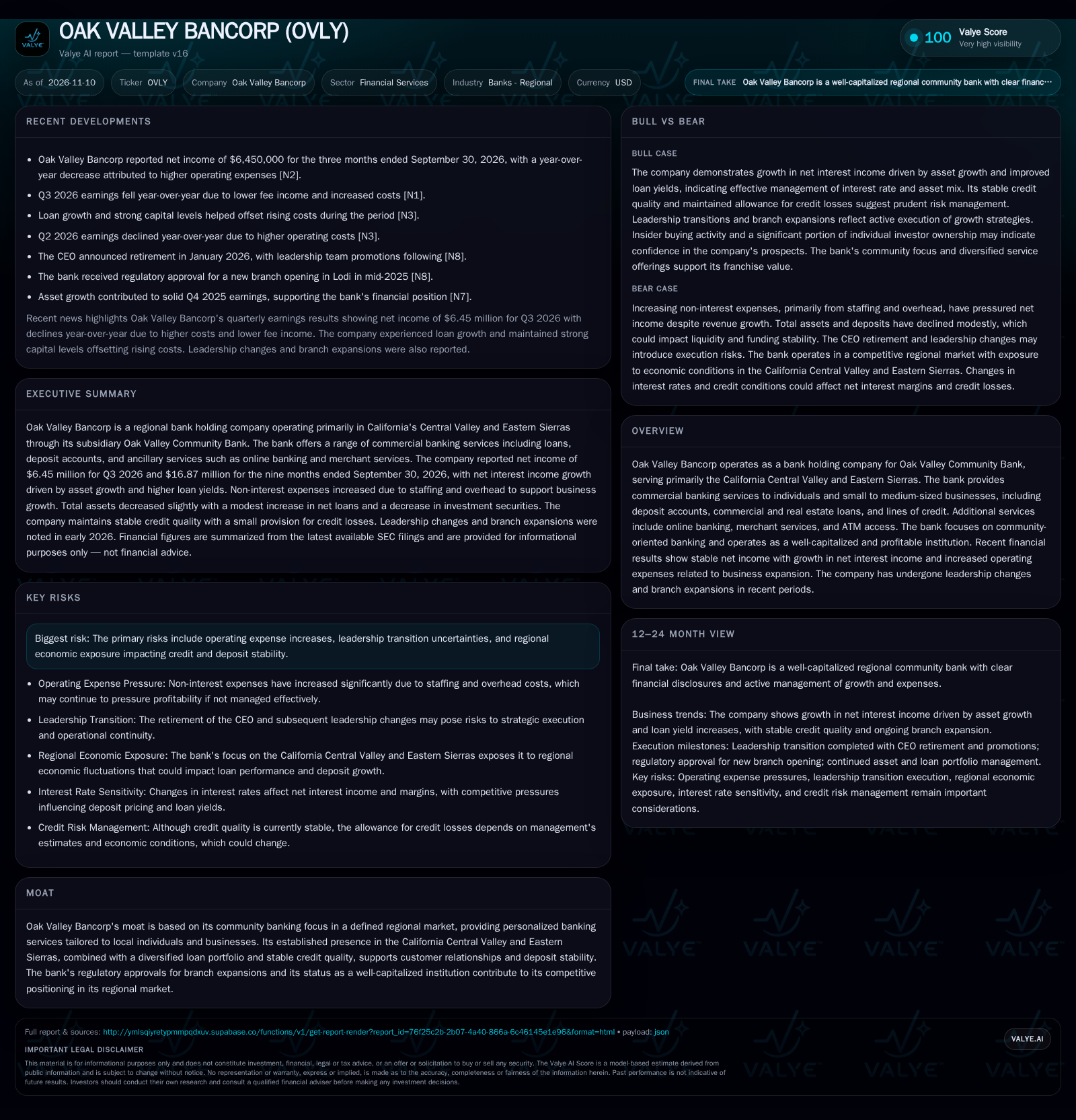
Oak Valley Bancorp reported modest loan growth and higher net interest income, but faces profitability pressure from rising operating costs and a slight decline in deposits and total assets. Leadership transitions and branch expansion add both execution risk and potential for renewed franchise momentum. The sustainability of credit quality, cost management, and deposit retention will shape its ability to preserve its community bank advantage as regional competition and macroeconomic headwinds persist. [S2] [N1] [N2]
Oak Valley Bancorp’s latest financials paint a nuanced picture for regional bank investors: while the bank has managed to grow its loan book and sustain net interest income in a softening rate environment, profitability is under pressure from rising non-interest expenses and a modest contraction in deposits and total assets. The recent CEO retirement and internal promotions mark a pivotal moment, as the bank seeks to extend its community franchise amid intensifying competition and evolving customer needs. The next phase will test Oak Valley’s ability to control costs, preserve credit quality, and leverage its regional relationships for sustainable growth.
Recent Results Highlight Margin Compression and Franchise Transition
For the quarter ended September 30, 2026, Oak Valley Bancorp reported net income of $6.45 million, down year-over-year as higher operating expenses and lower fee income offset gains in net interest income. Net interest income increased by $605,000 for the quarter, reflecting modest loan growth and higher yields despite short-term rate cuts. However, non-interest expenses rose by $720,000, driven by staffing and overhead expansion to support business growth. Total assets declined by $46.9 million (2.3%) since year-end 2025, with deposits down $30.4 million (1.7%), net loans up $11.4 million (1.0%), and investment securities reduced by $22.6 million (4.1%). Leadership changes—including the CEO’s retirement and branch expansions—frame the current period as one of both operational challenge and franchise renewal. [S2] [N1] [N2] [N8]
How Community Banking Economics Are Evolving Under Cost Pressure
Oak Valley’s revenue model is anchored in net interest income from lending and deposit-taking, supplemented by limited fee-based services. The recent period demonstrates classic community bank economics: net interest margin (4.24% for Q3 2026) has held up due to loan growth and asset mix, but with diminishing support from non-interest income and rising operating costs. Unlike larger peers, Oak Valley’s ability to offset cost inflation with fee income appears limited, making expense management and loan growth critical. The increase in non-interest expenses, primarily staffing and overhead, reflects both the costs of scaling and the challenge of maintaining personal service. While the bank remains well-capitalized, declining deposits and assets suggest some funding pressure, potentially forcing further balance-sheet optimization or tactical repricing. Operating leverage could improve if new branches deliver deposit and loan growth, but execution risk is elevated during leadership transition. [S2]
The interplay between loan portfolio composition and interest rate sensitivity is another critical factor shaping community bank economics under cost pressure. Oak Valley’s ability to maintain net interest margin depends not only on loan growth but also on the mix between fixed-rate and variable-rate loans, as well as the repricing frequency of deposits. If a significant portion of assets are fixed-rate loans originated during higher rate periods, margin compression may accelerate as funding costs adjust upward. Conversely, a higher share of variable-rate loans could provide more immediate benefit from rising rates, though this also introduces borrower credit risk in a slowing economy. Similarly, deposit repricing lags and competitive pressures on deposit rates can squeeze margins, underscoring the importance of diversified funding sources and proactive balance sheet management.
Cost inflation pressures in community banking often stem from a combination of wage competition in local labor markets and investments in compliance and technology infrastructure. Oak Valley’s rising non-interest expenses reflect these dynamics, where scaling operations to support growth paradoxically increases fixed costs before achieving sufficient operating leverage. The bank’s ability to automate routine processes and leverage digital tools can materially influence future expense trajectories. However, such investments require upfront capital and may temporarily elevate costs. Therefore, the timing and effectiveness of technology adoption will be pivotal in balancing short-term expense growth against long-term efficiency gains, especially as customer expectations evolve towards seamless digital experiences.
Defending Local Relationships in a Crowded Regional Market
Oak Valley’s competitive position relies on its community focus and established presence in California’s Central Valley and Eastern Sierras. Its customer base—primarily small-to-medium businesses and local consumers—values relationship banking, but these segments are increasingly targeted by digital-first banks, larger regionals, and fintech lenders. The bank’s lack of international and trust services may limit its appeal to higher-value clients, while its product breadth and technology investments must keep pace to retain core customers. Deposit outflows and asset contraction suggest competitive pressure, possibly from higher-yield alternatives or more aggressive pricing by peers. Oak Valley’s moat is its local knowledge and service—but without sustained deposit growth and technology investment, switching costs may erode and franchise value could come under pressure if competitors encroach more deeply.
The competitive landscape for community banks like Oak Valley is increasingly defined by the convergence of traditional relationship banking and digital innovation. While local knowledge and personalized service remain core differentiators, the rise of fintech lenders and digital-first banks introduces alternative credit and deposit products that can undercut pricing or offer superior convenience. Oak Valley’s regional focus means its competitive moat is geographically concentrated, which can be both a strength and a vulnerability. If regional economic conditions weaken or demographic shifts alter the customer base, the bank’s reliance on local relationships may limit diversification opportunities. Strategic partnerships or selective product expansion could mitigate these risks, but such moves require careful alignment with the bank’s community-oriented brand and operational capabilities.
What Could Drive a Positive Reacceleration: New Leadership, Branch Leverage, and Credit Outperformance
A favorable scenario would see the new leadership team successfully leveraging recent branch expansions to grow low-cost deposits and local lending relationships. If operating costs stabilize as scale is achieved, the bank could restore margin expansion even with modest loan growth. Sustained credit quality—with low provisions and minimal charge-offs—would further support profitability. Confirmation would come from sequential increases in core deposits, improved efficiency ratio, and stable or rising net interest margin. Evidence of technology upgrades or expanded fee-based services would signal adaptability to the evolving competitive landscape. On the capital side, maintaining strong regulatory ratios and selectively reducing investment securities to fund higher-yielding loans could further enhance returns.
Sustaining Core Profitability Amidst Cost and Deposit Headwinds
The most plausible outcome is that Oak Valley continues to generate modest profitability as net interest income growth is partially offset by elevated operating expenses and slight deposit erosion. Credit quality remains stable, allowing for controlled provisioning, but non-interest income remains a modest contributor. The leadership transition is managed without major disruption, and the new branches contribute incrementally to growth, but do not radically alter the franchise’s scale or economics. Confirmation would be a steady net interest margin, tolerable efficiency ratio, and stable return on assets and equity. A falsification would be a sharp deterioration in deposit balances, a spike in non-performing loans, or a sustained drop in margin as rate competition intensifies.
How Cost Escalation and Deposit Attrition Could Undermine the Franchise
In an adverse chain, operating expenses continue rising faster than revenue, driven by wage inflation, technology costs, or branch underperformance. If deposit outflows accelerate—either due to competition, rate sensitivity, or regional economic weakness—the bank may need to increase deposit costs or shrink the balance sheet, compressing margins. Credit quality could deteriorate if local economies slow, forcing higher provisions and eroding profitability. Leadership instability or failed branch integration could exacerbate execution risk. Confirmation would be a rising efficiency ratio, negative operating leverage, declining net interest margin, and increased loan loss provisions. A sustained decline in regulatory capital ratios or market share would signal franchise impairment.
What Will Determine Whether Oak Valley Preserves Its Community Banking Edge
Trends in core (non-brokered) deposit balances and cost of funds, especially if disclosed by branch or customer segment.
Quarterly changes in the efficiency ratio, as a measure of expense discipline versus revenue growth.
Net interest margin trends relative to regional and peer banks, indicating pricing power and funding cost management.
Non-performing loan and charge-off rates, as indicators of credit quality stability or stress.
Growth in fee-based or non-interest income lines, which would reflect progress in service diversification.
Branch-level loan and deposit growth, especially from newly opened locations, if disclosed.
Progress on technology upgrades or digital banking adoption, as evidence of competitive adaptability.
Management commentary on deposit competition, pricing strategy, and local economic conditions in the Central Valley and Eastern Sierras.
Disclaimer: This is research-only, informational analysis and not investment advice. It may include AI-generated interpretation and general industry context. Always verify important details using primary sources.

Comments