
Standard Premium Finance: Expansion Momentum, Funding Structure, and the Realities of Premium Finance Economics
Standard Premium Finance Holdings, Inc. is scaling its commercial insurance premium financing business beyond Florida, supported by a diversified but credit-heavy funding model. Recent growth in loan originations and revenue signals operational momentum, but regulatory complexity, funding constraints, and competitive pressure on agent relationships shape both the opportunity set and the risk calculus.
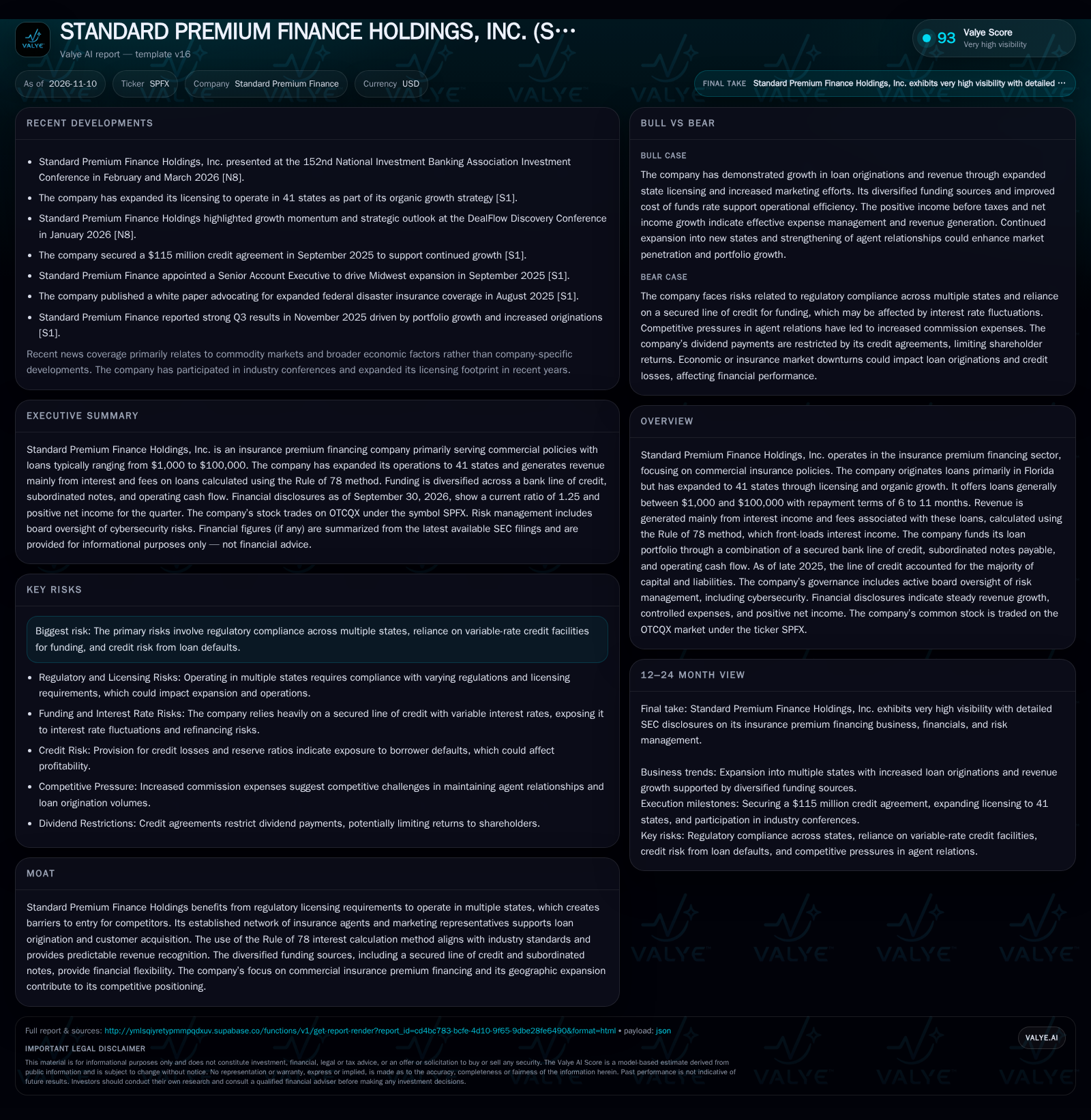
Standard Premium Finance is posting solid loan origination and income growth as it expands to 41 states, but its reliance on a variable-rate, collateralized credit line and the competitive cost of agent relationships remain critical watchpoints. Regulatory hurdles, funding structure, and the economics of short-term premium loans define both its resilience and its vulnerabilities. [S1] [S2]
Standard Premium Finance Holdings, Inc. is executing on an ambitious geographic expansion, increasing its presence from Florida to 41 states and showing steady growth in both loan originations and revenue. Its business model—financing commercial insurance premiums through short-term loans—offers attractive economics in a niche market, but also exposes the firm to a unique blend of regulatory, funding, and competitive risks. As the company leans on a sizable variable-rate credit facility to fund its growth, the interplay between loan portfolio expansion, agent-driven origination, and funding costs will determine the sustainability of its recent performance—and shape its future value proposition.
Recent Expansion and Financial Performance: What’s Changing Now
Standard Premium Finance’s operational footprint has expanded significantly, with licensing in 41 states as of 2025—up from a historical concentration in Florida. This broadening of the addressable market has coincided with a 5.8% year-over-year increase in loan originations, reaching $158.1 million in 2025, and gross revenue growth of 2.7% to $12.47 million [S1]. While the topline gain is modest relative to originations, income before taxes rose 20.6% in 2025, suggesting improved operating leverage or lower credit costs. Q3 2026 results showed $3.58 million in revenue and $401,695 in net income, with basic EPS of $0.13 [S2]. The funding structure remains heavily reliant on a secured, variable-rate bank line of credit, which now accounts for two-thirds of total capital and liabilities [S1].
How Premium Financing Economics Drive Profitability—and Set Constraints
The core business of Standard Premium Finance is advancing funds to cover commercial insurance premiums, repaid by customers through short-term (6–11 months) installment loans. Revenue is generated from interest charges and fees, with the Rule of 78 method front-loading income recognition. This creates a strong incentive to grow originations, as new loans disproportionately boost current period revenue. The company’s cost structure combines variable funding costs (primarily interest on the credit line and subordinated notes) with fixed costs such as office leases and salaried personnel, while commissions to insurance agents are largely variable and tied to loan volume.
Operating leverage can be achieved if originations outpace increases in fixed costs and if credit losses remain contained. However, the flip side is exposure to funding cost volatility—especially with a majority of capital coming from a variable-rate, collateralized credit facility. If interest rates rise or credit markets tighten, the cost to fund new loans could outstrip the yield on new originations, compressing margins. The short-term nature of the loans limits duration risk, but also requires constant origination throughput to sustain revenue and cover overhead. Capital needs are ongoing, as loan repayments and new originations are in constant flux; the ability to roll or expand credit facilities is a structural dependency.
Barriers, Agent Dynamics, and the Challenge of Differentiation
Standard Premium Finance benefits from regulatory licensing requirements that create barriers to entry in the premium finance market, especially for commercial lines across multiple states. The company’s longstanding network of insurance agents is a distribution advantage, but also a source of competitive friction: rising commission and salary expenses point to intensified competition for agent loyalty and origination flows. Larger or more technologically advanced rivals may compete on price, technology integration, or service speed, while smaller local players may undercut on commission splits.
Differentiation is challenging in premium finance, as loan products are typically short-term, commoditized, and price-sensitive. The Rule of 78 method is industry standard, so pricing innovation is limited. However, scale can confer marginal funding advantages and geographic reach. Regulatory compliance creates a moat against new entrants but can also slow expansion and drive up administrative costs. The company’s OTCQX listing may slightly enhance access to capital and credibility with agents, but does not fundamentally change the competitive dynamic.
What Sustained Origination Growth and Funding Stability Could Unlock
If Standard Premium Finance can continue to expand its state licensing, deepen its agent network, and grow originations without a proportional rise in funding costs or credit losses, operating leverage could drive faster earnings growth than revenue growth. The critical causal chain would involve: (1) sustained high single-digit or better growth in new loans; (2) stable or improving net interest margins despite funding cost volatility; (3) manageable credit losses; and (4) incremental gains in agent productivity or market share in new states.
Evidence that would confirm this scenario includes continued increases in loan originations and finance charges outpacing expense growth, net interest margin stability in a rising rate environment, and further geographic expansion without regulatory setbacks. A successful renegotiation or expansion of the credit facility at favorable rates, or a shift toward more retained earnings funding, would further support this thesis.
Incremental Growth Balanced by Funding and Competitive Pressures
The most plausible outlook is that Standard Premium Finance maintains modest growth in originations and revenue as it consolidates its position in newly entered states. Funding costs may rise marginally if rates increase, but are likely manageable given the short-term nature of the loan book. Commission and salary expenses will remain elevated as agent competition persists, limiting margin expansion. Regulatory compliance will be a continuous operational burden, but not an existential threat unless major legislative changes occur.
This scenario would be confirmed by steady, single-digit growth in originations, stable or slightly contracting net interest margins, and expense increases roughly tracking revenue. Watch for stable credit quality and no major changes in the cost or terms of the primary credit facility. Any significant regulatory or funding disruption would challenge this baseline.
How Funding Shocks or Regulatory Setbacks Could Derail Momentum
A plausible negative scenario involves a sharp rise in funding costs due to interest rate hikes, credit market stress, or tighter collateral requirements from the primary bank lender. Because 66% of capital is tied to the variable-rate credit line, even modest increases in rates could quickly erode net interest margins. In parallel, if competitive pressure forces higher commissions or loan pricing compression, profitability could be squeezed from both ends.
Regulatory setbacks—such as license delays, non-compliance penalties, or adverse legislative changes in large states—could also materially slow growth or increase costs. A spike in credit losses, perhaps due to an economic downturn affecting commercial policyholders, would further pressure earnings and liquidity. Evidence of this scenario would include a sudden drop in originations, margin compression, a spike in credit loss reserves, or a material change in credit facility terms.
Testing the Standard Premium Finance Thesis: What Needs to Be Tracked
Quarterly loan origination volumes and total dollars originated—sustained growth would support the expansion thesis, while stagnation or decline would indicate market saturation or competitive setbacks.
Net interest margin (if disclosed)—tracking the spread between finance charges and funding costs is crucial given variable-rate funding exposure.
Commission and salary expenses as a percentage of revenue—rising ratios could signal intensifying competition for agent business and shrinking profitability.
Credit loss provisions and actual charge-offs—deterioration here would flag rising risk in the underlying loan portfolio, especially in new or economically weaker states.
Terms, availability, and pricing of the primary bank credit facility—any tightening or repricing could directly affect growth and margin outlook.
Progress on further state licensing and regulatory compliance milestones—delays or setbacks could limit growth or increase costs.
Disclaimer: This is research-only, informational analysis and not investment advice. It may include AI-generated interpretation and general industry context. Always verify important details using primary sources.

Comments