
Hyperfine, Inc.: Record Revenues, Liquidity Strength, and the Strategic Imperative of Restoring Investor Confidence
Hyperfine, Inc.
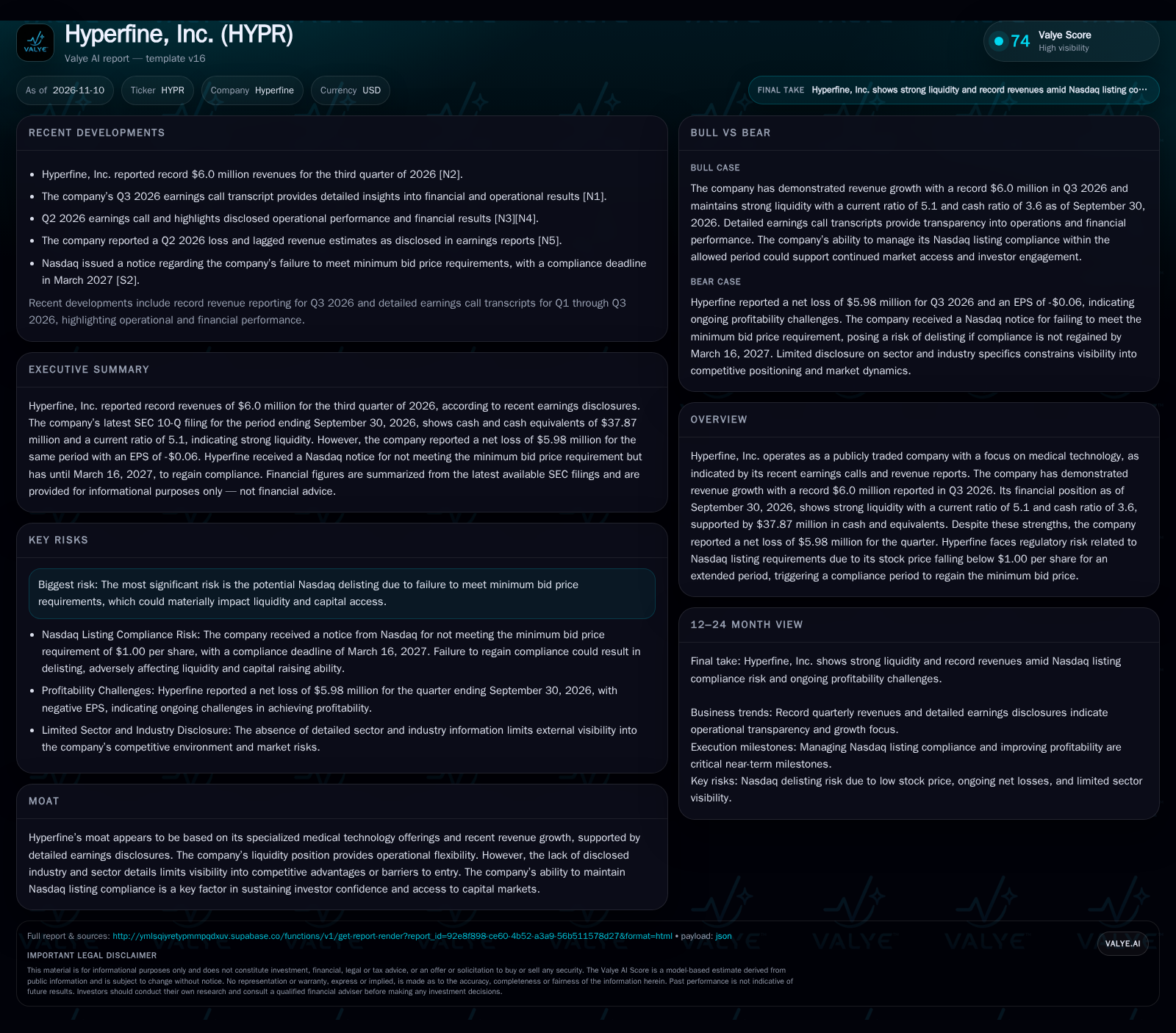
Hyperfine, Inc. reported record Q3 2026 revenues and maintains a reported liquidity position, but continues to operate at a loss. The company faces a compliance deadline to restore its Nasdaq listing status due to a low share price, making near-term profitability and market confidence critical to its trajectory. Ongoing transparency in financial reporting supports investor engagement, but the lack of detailed sector disclosures limits clarity on competitive dynamics and future growth levers. [S2] [N2]
Hyperfine, Inc. enters late 2026 with a mix of operational momentum and existential challenges. Yet, persistent net losses and a Nasdaq notice for failing to meet the minimum share price requirement underscore the urgency of demonstrating a credible path to profitability and restoring investor confidence. With a compliance deadline looming and limited visibility into its competitive landscape, Hyperfine’s next steps will determine whether recent commercial progress translates into sustainable business model validation or if capital market constraints begin to dominate the narrative. [S2] [N2]
Recent Financial Milestones and Compliance Challenges Shape the Near-Term Outlook
Hyperfine, Inc. reported record quarterly revenues of $6.0 million for Q3 2026, marking a notable step up in commercial activity. This revenue expansion coincides with a reported liquidity position: as of September 30, 2026, the company held $37.87 million in cash and cash equivalents, with a current ratio of 5.1 and a cash ratio of 3.6. Despite these financial buffers, Hyperfine posted a net loss of $5.98 million for the quarter, continuing a pattern of unprofitable operations. Compounding these operational headwinds, the company received a Nasdaq notice for failing to maintain the minimum $1.00 share price, with a compliance window extending to March 16, 2027. This duality—commercial progress paired with persistent losses and capital market risk—defines the company’s current strategic context. [S2] [N2]
How Hyperfine’s Commercial Model Could Achieve Scale and Margin Expansion
Hyperfine’s business economics hinge on its ability to convert technology-driven medical solutions into a recurring, profitable revenue stream. Record revenues suggest growing adoption, but the quarterly net loss indicates that fixed costs—likely R&D, field support, and regulatory compliance—still outpace gross profits. The company reported cash and liquidity metrics for the period; these figures do not by themselves establish operating runway, investment capacity, financial flexibility, or financing capacity.
If Hyperfine’s business model relies on hardware sales (such as portable imaging devices), initial growth often comes with high unit costs and sales expenses. Over time, as production scales, gross margins could improve—especially if software, service contracts, or consumable components are layered on top, creating recurring revenue. However, the limited disclosure on product mix, pricing strategy, and service attachment rates leaves open questions about the path to operating leverage. The critical lever will be whether recent revenue growth reflects improved sales efficiency, higher average selling prices, or a broadening customer base—and whether fixed costs can be contained as the company scales.
A critical dimension to Hyperfine's path toward scale and margin improvement lies in the potential for network effects or ecosystem development around its technology. If the company can cultivate a user base that generates data or clinical insights feeding back into product enhancements, this could create a virtuous cycle increasing customer stickiness and pricing power. Conversely, failure to establish such an ecosystem might limit differentiation to one-time hardware sales, which are more susceptible to commoditization and competitive pricing pressures. The balance between upfront capital expenditure by customers and ongoing value delivered through software or services will be a key determinant of sustainable economics.
Assessing Hyperfine’s Position Amid Unclear Sector Boundaries and Technology Substitutes
Hyperfine’s competitive position is difficult to benchmark due to limited disclosure about its sector, industry peers, and product specifics. In the broader medical technology space, companies often face entrenched competitors with established distribution, regulatory clearances, and hospital relationships. If Hyperfine’s core offering is a differentiated portable medical imaging device, it may benefit from a technology edge—such as lower cost, improved portability, or new clinical applications. Yet, the absence of explicit data on intellectual property, regulatory status, or customer switching costs makes it hard to assess the durability of any moat.
Potential substitutes could include traditional imaging modalities, competing portable devices, or entirely new diagnostic approaches. The degree of integration into hospital workflows, ease of use for clinicians, and reimbursement dynamics will heavily influence adoption and pricing power. Without more granular disclosures, it remains an open question whether Hyperfine can defend or expand its niche against better-capitalized incumbents or emerging startups.
Another layer of complexity in assessing Hyperfine’s competitive position involves regulatory pathways and reimbursement environments. Medical devices that require FDA clearance or equivalent approvals often face lengthy and costly processes, which can serve as barriers to entry but also slow market penetration. Moreover, reimbursement rates and policies for diagnostic imaging influence hospital purchasing decisions significantly. If Hyperfine’s technology aligns well with favorable reimbursement codes or can demonstrate cost savings and clinical efficacy, it may gain a competitive edge. However, shifts in healthcare policy or reimbursement frameworks could introduce volatility in adoption rates and pricing power, underscoring the importance of strategic regulatory and payer engagement.
What Would Signal Hyperfine’s Transition from Growth to Sustainable Profitability?
A favorable scenario for Hyperfine would involve continued revenue growth coupled with a narrowing net loss, signaling that operating leverage is taking hold. This could be confirmed by sequential improvements in gross margin, evidence of recurring revenue streams (such as service contracts or software subscriptions), and disciplined expense management. If the company announces new customer wins, expanded hospital deployments, or strategic partnerships, these could further validate market traction.
Regaining Nasdaq compliance—either through organic share price appreciation or a successful reverse split—would remove an overhang and potentially reopen access to broader capital markets. Falsification of this scenario would occur if revenue growth stalls, losses widen, or if the company is unable to demonstrate improving unit economics despite higher sales volumes.
Operational scalability will also be pivotal in signaling a transition to sustainable profitability. This entails not only expanding sales but optimizing supply chain efficiencies, manufacturing costs, and customer support infrastructure. If Hyperfine can leverage economies of scale in procurement and production, it may reduce unit costs materially, improving gross margins. Additionally, implementing scalable service delivery models—such as remote diagnostics or cloud-based software updates—could enhance recurring revenue potential without proportionally increasing operating expenses. These operational improvements, combined with strategic pricing and customer segmentation, would strengthen the company’s financial profile and investor confidence.
Growth and Losses Continue as Hyperfine Seeks Proof Points for Its Business Model
The most plausible near-term scenario is that Hyperfine sustains modest revenue growth while continuing to operate at a net loss. Hyperfine is likely to focus on incremental improvements—expanding its installed base, refining its go-to-market approach, and seeking operational efficiencies.
Progress on Nasdaq compliance will likely hinge on a combination of business execution and capital market sentiment. Confirmation of this scenario would include stable or gradually increasing revenues, persistent but manageable quarterly losses, and ongoing communication about efforts to address both operational and compliance challenges.
If Losses Persist and Compliance Risks Materialize, Hyperfine Could Face Strategic Constraints
The adverse scenario for Hyperfine involves ongoing losses, flat or declining revenues, and failure to regain Nasdaq compliance by the March 2027 deadline. Delisting could impair liquidity, limit access to institutional capital, and erode stakeholder confidence, potentially forcing the company into strategic alternatives such as asset sales, private financing on unfavorable terms, or even restructuring.
This scenario would be confirmed by continued negative EPS with no improvement in gross margin, repeated Nasdaq compliance warnings, or a public announcement of delisting proceedings. Additionally, if cash burn accelerates and the company is forced to seek dilutive capital raises or cut core investments, it would signal mounting pressure on the viability of the business model.
Milestones and Metrics to Gauge Hyperfine’s Transition from Liquidity to Sustainable Growth
Quarterly revenue growth rates and the underlying sources of expansion (e.g., new customers, expanded deployments, higher ASPs) would help clarify whether commercial traction is accelerating or plateauing.
Gross margin trends, if disclosed, would provide insight into operating leverage and the scalability of the business model.
The mix and structure of revenue (hardware vs. recurring services/software) would clarify the durability and predictability of future cash flows.
Progress on reducing quarterly net losses or achieving profitability would be a critical test of business model viability.
Nasdaq compliance updates—particularly any actions taken to address the minimum bid price requirement or communications regarding potential delisting.
Cash burn rates and runway estimates, especially in light of continued net losses and investment needs.
Announcements of new partnerships, regulatory approvals, or expanded product indications would be important external validation milestones.
Any disclosure of competitive wins, customer retention rates, or market share gains would help benchmark Hyperfine’s position in the broader medtech landscape.
Disclaimer: This is research-only, informational analysis and not investment advice. It may include AI-generated interpretation and general industry context. Always verify important details using primary sources.

Comments