
Rigetti Computing: Commercial Orders, Technology Progress, and the Race to Quantum Viability
Rigetti Computing stands out for its vertically integrated approach, technical milestones in multi-chip quantum processors, and recent commercial system orders. Yet, persistent operating losses, dependence on milestone-driven government funding, and the unpredictability of quantum commercialization raise foundational questions about long-term value capture.
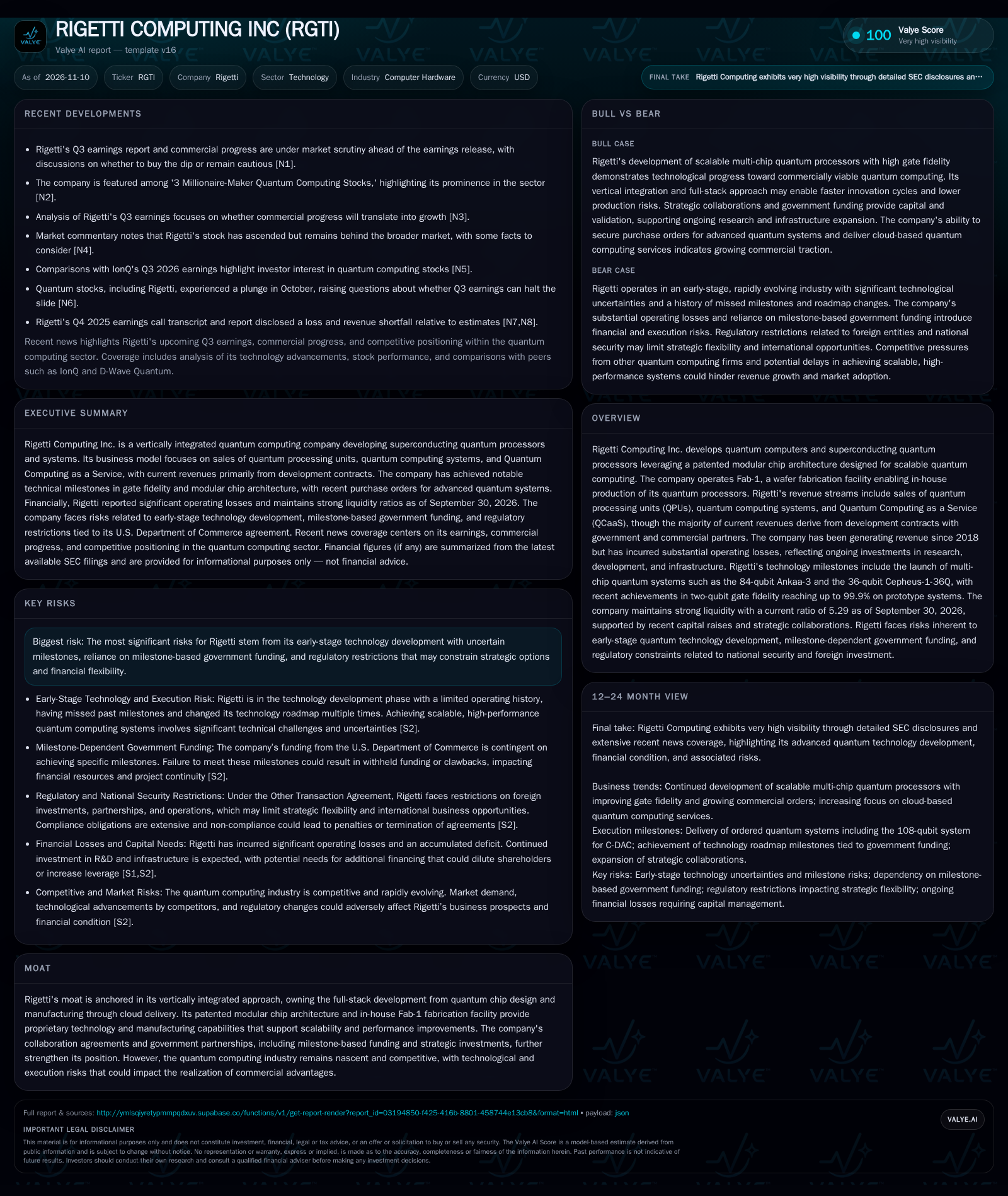
Rigetti Computing has secured multi-million dollar purchase orders for its advanced quantum systems and continues to push technical boundaries with high-fidelity, multi-chip architectures. However, the company’s business remains anchored in development contracts, with heavy losses and reliance on government-linked funding. The challenge ahead is turning technical achievement and early commercial traction into a sustainable, scalable business as quantum computing inches toward real-world adoption. [S1] [S2]
Rigetti Computing has achieved visible progress toward scalable quantum computing, not only in hardware performance but also via recent commercial system orders. Its vertically integrated operation—from chip design to cloud service—positions it as a prominent player in a market that remains largely experimental. But the company’s persistent losses, reliance on milestone-based government funding, and the uncertainties of quantum market timing make the leap from technical achievement to sustained commercial success a formidable one. The next phases for Rigetti will test whether its technology and early traction can transition into durable economics as quantum computing moves closer to practical applications.
Recent System Orders and Technical Performance Define the Current State
Rigetti Computing’s most material recent developments include securing two purchase orders for its Novera quantum systems totaling $5.7 million, with delivery expected in early 2026, and an $8.4 million order for a 108-qubit system to be installed at India’s C-DAC in the second half of 2026. These commercial wins, while modest in absolute dollar terms relative to accumulated losses, mark increasing external validation of Rigetti’s multi-chip quantum architecture. On the technical front, Rigetti has demonstrated median two-qubit gate fidelities up to 99.7% on a 9-qubit chip and 99.0% on its largest 108-qubit prototype, suggesting meaningful progress in error rates—a key metric for quantum utility. However, the company remains deeply unprofitable, with net losses of $216.2 million in 2025 and an accumulated deficit of $771.0 million as of year-end 2025. Liquidity is supported by a $350 million capital raise in 2025 and a current ratio of 5.29 as of September 2026, but the business model is still dominated by development contracts tied to government and research partners, rather than at-scale commercial usage. [S1] [S2]
Quantum Revenue Streams: The Realities Behind Hardware, Cloud, and Contracts
Rigetti’s revenue model is a blend of quantum processing unit (QPU) sales, system sales, and Quantum Computing as a Service (QCaaS), but the bulk of revenue to date comes from development contracts with government and research entities. This contract-heavy mix typically means less predictable, milestone-driven inflows rather than recurring revenue, and often requires customization or collaborative development. System sales—such as the Novera and 108-qubit orders—offer higher nominal value but likely involve long lead times, high integration costs, and may be lumpy rather than recurring. QCaaS has the potential to create more scalable, high-margin recurring revenue, but industry adoption remains nascent. The company’s vertically integrated model, including its Fab-1 chip facility, should theoretically allow for better control over cost structure and yield improvements, but also requires sustained capital investment and exposes Rigetti to high fixed costs. Operating leverage will only materialize if system and QCaaS adoption accelerate and the company can scale production and cloud delivery without proportional increases in R&D and SG&A. Rigetti’s burn rate and capital needs remain high, with ongoing losses expected as R&D and infrastructure investments continue. [S1] [S2]
How Rigetti’s Modular Architecture and Vertical Integration Stack Up in Quantum’s Race
Rigetti’s main strategic differentiator is its full-stack, vertically integrated approach—owning everything from chip design and in-house wafer fabrication to cloud-based service delivery. Its patented modular chip architecture enables the construction of larger, multi-chip quantum systems, such as the 84-qubit Ankaa-3 and 108-qubit Cepheus-1-108Q. This could allow Rigetti to scale more rapidly and control quality compared to peers relying on third-party fabrication or less modular designs. However, the competitive field includes firms pursuing alternative hardware approaches (e.g., trapped ions, photonics) and aggressively investing in software and ecosystem development. Players like IonQ and D-Wave are cited in news coverage as direct peers, but global technology giants and startups are also investing heavily in quantum. Rigetti’s government and strategic collaborations provide some validation and funding, but milestone-based funding structures and regulatory obligations could limit flexibility. Switching costs for customers are likely low at this stage, as quantum systems are still largely experimental, but could rise if software ecosystems or proprietary architectures gain traction. The question is whether Rigetti’s technical milestones and vertical model can translate into lasting switching frictions or ecosystem lock-in as the market matures. [S1] [S2] [N1] [N3] [N4]
Technical Milestones Catalyze Commercial Adoption—What Would Confirm a Breakout?
The upside case is that Rigetti’s ongoing progress in multi-chip scalability and gate fidelity enables it to deliver quantum systems with error rates and qubit counts sufficient for practical, real-world applications. If its 108-qubit and future systems prove useful for commercially relevant workloads, Rigetti could transition from contract-driven revenue to broader system sales and recurring QCaaS subscriptions. Confirmation would come from repeat or follow-on orders from major research institutions, the emergence of enterprise or government clients using QCaaS for mission-critical workloads, and visible growth in cloud-based quantum usage. Additional evidence would include successful delivery and customer validation of the C-DAC 108-qubit system, further purchase orders, and disclosures of commercial (not just research) use-cases. If Rigetti’s ecosystem or proprietary software tools gain traction, this could further reduce churn and boost pricing power.
Incremental Progress, Persistent Losses: The Most Likely Path Forward
The most plausible scenario is continued technical progress and occasional system sales, but with revenue still dominated by development contracts and milestone-driven funding. Rigetti is likely to deliver on its announced orders, further improve qubit fidelity, and expand collaborations, but recurring commercial adoption will remain slow as quantum computing’s practical utility is still emerging. Ongoing R&D and infrastructure investments will keep the company unprofitable for the foreseeable future, and further capital raises may be needed if new commercial revenue streams do not materialize quickly. Confirmation of this scenario would be a continued pattern of single-digit-million system orders, incremental QCaaS uptake, and sustained but heavy operating losses. Falsification would require a step-change in either recurring QCaaS revenue or high-volume system sales beyond the research sector. [S1] [S2] [N3] [N7] [N8]
Milestone Misses, Funding Gaps, and the Risk of Commercial Stagnation
The adverse scenario is driven by a failure to achieve technical or commercial milestones—such as delays in system delivery, underperformance of new chips, or missed government funding triggers. If Rigetti cannot meet the conditions of its U.S. Department of Commerce agreement, milestone-based funding could be withheld, creating a funding gap and forcing a reduction in R&D or operations. Regulatory constraints could further limit strategic options or international expansion. In this scenario, new system orders would stall, QCaaS adoption would remain minimal, and the company would be forced to seek dilutive capital or cut costs, risking a downward spiral of reduced innovation and competitive relevance. Evidence would include missed or delayed deliveries, shrinking backlog, negative funding or regulatory developments, and worsening operating losses relative to expectations. [S2] [N7] [N8]
Milestones and Metrics That Will Shape Rigetti’s Quantum Commercialization Journey
The successful and timely delivery of the 108-qubit system to C-DAC in India, along with customer validation or follow-on orders.
Growth in QCaaS (Quantum Computing as a Service) revenue, if disclosed, which would signal transition toward recurring commercial revenue.
Updates on milestone achievement and funding under the U.S. Department of Commerce Other Transaction Agreement, especially any delays or clawbacks.
Further purchase orders for systems or QPUs from new or repeat customers, particularly outside the government/research sector.
Disclosures of real-world, non-research quantum applications by customers leveraging Rigetti’s systems or cloud platform.
Any changes to the technology roadmap, delays in chip development, or declines in reported qubit fidelity/yield metrics.
Capital-raising activity or shifts in liquidity that would indicate stress or a need to scale back investment.
Expansion or deepening of strategic collaborations, especially those involving co-investment or ecosystem development.
Disclaimer: This is research-only, informational analysis and not investment advice. It may include AI-generated interpretation and general industry context. Always verify important details using primary sources.

Comments