
Mount Logan Capital: Integrated Credit and Insurance Platform Seeks Scale Amid Spread Compression and Operational Complexity
Mount Logan Capital Inc. operates a hybrid business model combining private credit asset management with annuity reinsurance, aiming to generate recurring fee and spread income. The company faces the dual challenge of scaling both AUM and insurance liabilities while contending with net losses, macro-driven spread pressures, and a reliance on outsourced operational infrastructure.
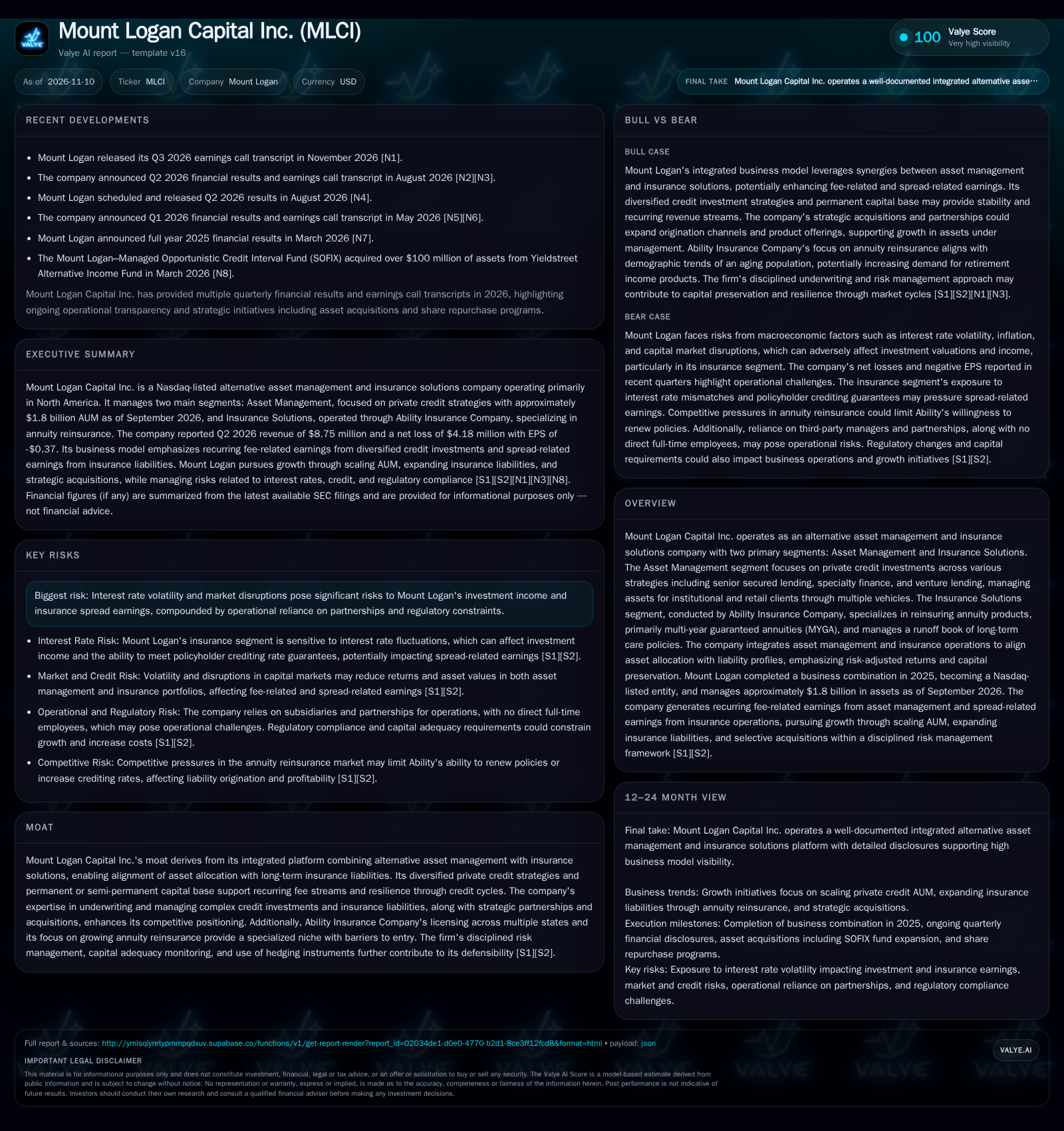
Mount Logan Capital Inc. (Nasdaq: MLCI) blends private credit asset management with insurance solutions, managing $1.8B in AUM as of September 2026 and reinsuring annuities through its Ability Insurance subsidiary. Q2 2026 results reveal $8.75M in revenue and a net loss of $4.18M. The business depends on recurring fee and spread earnings, but faces ongoing net losses, spread compression risks from higher crediting rates, and operational complexity due to its outsourced model. The company’s future hinges on its ability to scale AUM, manage insurance asset-liability matching, and navigate a volatile macro environment.
Mount Logan Capital Inc. stands at the intersection of private credit asset management and insurance solutions, leveraging its integrated platform to pursue recurring revenues through management fees and insurance spread income. As of September 2026, the company manages $1.8 billion in AUM and reinsures annuity liabilities through its subsidiary, Ability Insurance. However, recent results—Q2 revenue of $8.75 million and a net loss of $4.18 million—underscore the profitability challenge inherent in scaling such a hybrid model. Mount Logan’s future trajectory will depend on its ability to grow fee-generating assets, optimize insurance spreads amid rising crediting rates, and manage operational risk in an outsourced, partnership-driven structure.
Recent Results Highlight Scale and Profitability Hurdles
Mount Logan Capital Inc. reported approximately $1.8 billion in assets under management (AUM) as of September 30, 2026, reflecting its ambition to establish a meaningful presence in private credit and insurance reinsurance [S2]. Despite this scale, the company posted Q2 2026 revenue of $8.75 million alongside a net loss of $4.18 million, with EPS at -$0.37 [S2]. This underscores the challenge of achieving operating leverage and profitability in a business model that relies on both fee and spread income. The insurance subsidiary, Ability Insurance, remains focused on reinsuring multi-year guaranteed annuities (MYGA) and managing a runoff book of long-term care policies, while the asset management segment continues to pursue growth through diversified credit strategies and partnerships [S1] [S2]. The company’s operational structure is unusual—Mount Logan reported no direct full-time employees as of October 2025, highlighting a reliance on subsidiaries, affiliates, and external partners for execution [S2].
Hybrid Earnings Streams and the Strain of Spread Compression
Mount Logan’s economics are anchored in two recurring revenue streams: Fee Related Earnings (FRE) from asset management and Spread Related Earnings (SRE) from insurance activities [S1] [S2]. FRE is generated by management fees, performance fees, advisory/transaction fees, and equity investment income, net of compensation and operating costs. This model provides a degree of predictability, especially when assets are locked into interval funds, BDCs, or insurance products. SRE, on the other hand, depends on the net spread between investment portfolio yields and the guaranteed crediting rates Mount Logan must pay to annuity policyholders.
Spread compression is a fundamental risk: as interest rates rise, policyholders demand higher guaranteed rates, while legacy assets may yield less, squeezing the spread. The company attempts to offset this through prudent asset-liability matching and the use of interest rate swaps, but the effectiveness relies on both market conditions and execution [S1] [S2]. Mount Logan’s insurance book is invested predominantly in high-grade, senior secured fixed income assets to reduce downside risk, but this also limits upside during periods of spread expansion.
The business is moderately capital intensive, especially in the insurance segment, which must meet regulatory risk-based capital requirements and maintain sufficient reserves. Asset management, by contrast, is less capital intensive but heavily reliant on scale for margin expansion. Operating leverage remains limited until AUM and insurance liabilities reach a level where fixed costs are absorbed.
Integrated Platform: Niche Strengths and Structural Vulnerabilities
Mount Logan’s integrated approach—combining private credit asset management with insurance solutions—offers some differentiation. The ability to originate and manage assets that are directly aligned with insurance liabilities can create a more efficient asset-liability matching process than a pure-play asset manager or insurer might achieve. This structure is particularly valuable in the MYGA reinsurance niche, where specialized expertise and regulatory compliance create barriers to entry.
However, the company faces competitive pressures from larger alternative asset managers, established insurance companies, and specialist reinsurers. These competitors may have lower funding costs, greater distribution, and deeper origination networks. Furthermore, Mount Logan’s reliance on minority ownership in asset management platforms and on partnerships for distribution and operations may dilute its control over origination, underwriting, and client relationships.
The absence of direct employees underscores a dependence on the effectiveness of subsidiary management and external partners. While this can reduce fixed overhead, it also introduces operational risk and potential misalignment of incentives, especially as the business scales or if regulatory requirements change.
Sustained AUM Growth and Spread Stability Could Unlock Profitable Scale
If Mount Logan can continue to grow AUM—both in private credit vehicles and insurance liabilities—while maintaining stable or widening spreads, the company could achieve the operating leverage necessary to turn recurring revenue into sustainable profitability. Success would likely rest on expanding origination partnerships, capturing a larger share of the MYGA reinsurance market, and leveraging cross-segment synergies to optimize asset allocation.
Evidence confirming this scenario would include: a clear acceleration in AUM growth, especially in high-fee or high-spread products; a trend of positive fee-related and spread-related earnings outpacing fixed costs; and improved net income and EPS moving into positive territory. Additional indicators would be successful new counterparty agreements for annuity reinsurance and evidence of Mount Logan’s ability to attract incremental capital at competitive rates.
Navigating a Tightrope: Incremental Growth Amid Margin Pressures
The most plausible medium-term scenario is that Mount Logan achieves incremental AUM and insurance liability growth, but faces ongoing margin pressure from higher policyholder crediting rates and rising operating costs. Recurring fee and spread income may be sufficient to modestly narrow losses but not deliver robust profitability unless significant scale is reached or spreads widen.
Confirmation would come from continued, albeit moderate, AUM growth; steady, but not dramatic, increases in insurance liabilities; and break-even or slightly negative net income. Falsification would be signaled by a stall in AUM growth, persistent or widening net losses, or evidence that spread compression is outpacing Mount Logan’s ability to reprice assets or liabilities.
Spread Squeeze and Operational Complexity Undermine Viability
In a less favorable scenario, Mount Logan could see its insurance spreads further compressed by rising crediting demands from policyholders or by asset yield deterioration if credit quality erodes or capital markets turn risk-off. If macro volatility triggers asset impairments or limits new origination, both fee and spread income could stagnate or decline. Operational complexity—stemming from reliance on subsidiaries and minority partnerships—could exacerbate execution risk, regulatory scrutiny, or cost overruns.
Downside evidence would include declining AUM, negative fee or spread earnings, an increase in insurance segment losses, regulatory actions related to capital adequacy, or a failure to renew or expand key reinsurance relationships. Persistent net losses without a credible path to scale would raise questions about the long-term sustainability of the integrated model.
Signals That Will Define Mount Logan’s Integrated Model Trajectory
Quarterly progression in total AUM and insurance liabilities—acceleration would support the scalability thesis, while stagnation or decline would challenge it.
Disclosure of aggregate management fees, performance fees, and net spread income—if disclosed, these would help gauge the durability and growth of recurring earnings.
Net yield on insurance assets versus crediting rates paid to policyholders—a narrowing spread would pressure insurance earnings and test Mount Logan’s asset-liability management.
Frequency and terms of new MYGA reinsurance agreements or counterparty expansions—successful new partnerships would signal continued liability origination capacity.
Progress in reducing net losses or achieving positive EPS—improvement would indicate operating leverage and business model viability.
Changes in regulatory capital ratios and risk-based capital disclosures—deterioration would increase the risk of regulatory constraints or forced deleveraging.
Evidence of operational disruption or partner misalignment, such as service interruptions, compliance failures, or loss of key external managers.
Disclaimer: This is research-only, informational analysis and not investment advice. It may include AI-generated interpretation and general industry context. Always verify important details using primary sources.

Comments