
Orion180 Insurance Group: Agent-Driven Growth, Reinsurance Leverage, and the Realities of Specialty Property Insurance
Orion180’s rapid revenue growth and profitability are built on a broad network of independent agents and strategic reinsurance partnerships. Sustaining momentum will depend on managing agent economics, outpacing competitive pressures—including the dominant NFIP in flood insurance—and balancing rapid expansion with operational discipline.
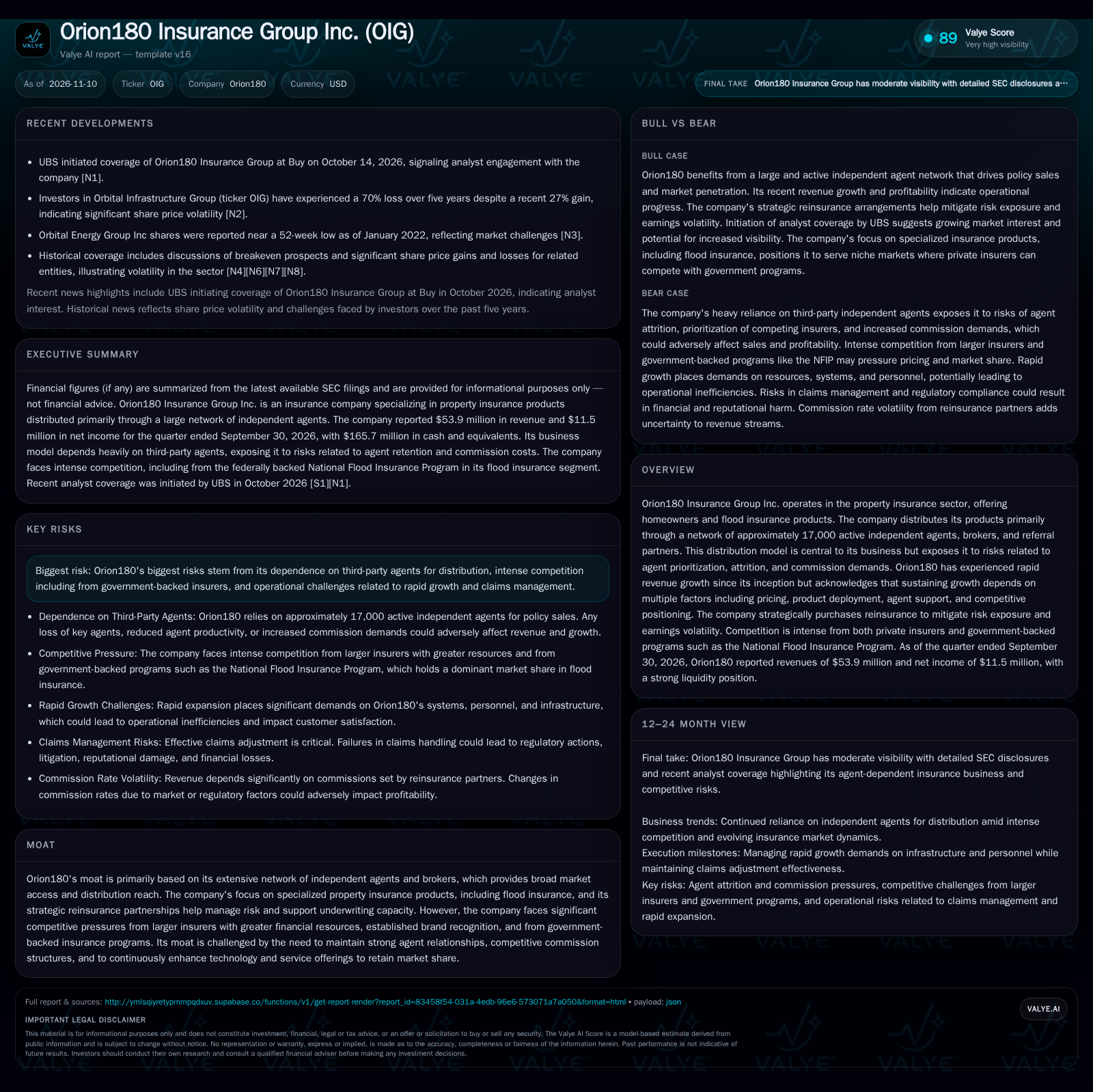
Orion180 Insurance Group leverages a network of 17,000 independent agents to distribute property and flood insurance products, recently reporting $53.9M in quarterly revenue and $11.5M in net income. Its dependence on agents and reinsurance exposes it to commission volatility and competitive risks, especially from the federally backed NFIP in flood. The company's future will hinge on its ability to maintain agent loyalty, control commission expenses, and execute operationally as it scales. [S1] [N1]
Orion180 Insurance Group’s ascent in the property insurance sector is powered by a vast network of independent agents, strategic use of reinsurance, and a focus on specialized products like flood insurance. With $53.9 million in quarterly revenue and $11.5 million in net income as of September 30, 2026, the company has demonstrated strong top- and bottom-line momentum. However, its growth model is deeply intertwined with third-party agent economics and the vagaries of the reinsurance market, making future performance highly sensitive to external commission dynamics, agent loyalty, and competitive forces—especially from government-backed programs such as the NFIP. The company’s next phase will test whether operational scaling and agent management can keep pace with the demands of a rapidly evolving insurance landscape. [S1]
Recent Financials and Distribution Model Shape Orion180’s Present Position
Orion180 Insurance Group reported $53.9 million in revenue and $11.5 million in net income for the quarter ended September 30, 2026, supported by $165.7 million in cash and equivalents and $20.1 million in short-term investments. The company distributes its property and flood insurance products through a network of approximately 17,000 active independent agents, brokers, and referral partners. This agent-dependent model is central to Orion180’s growth but also creates exposure to shifts in agent loyalty, prioritization, and commission expectations. The company’s revenue model is further shaped by reinsurance commissions, which are subject to market and regulatory volatility. UBS’s recent initiation of coverage at Buy (October 2026) signals growing analyst interest, but does not alter the fundamental operational dependencies and competitive challenges the company faces. [S1] [N1]
How Orion180’s Revenue Model Amplifies Both Growth and Sensitivities
Orion180’s economics are defined by a high-volume, third-party agent-driven distribution platform. Revenue is generated primarily through insurance premiums and commissions, with reinsurance playing a pivotal role in smoothing earnings volatility by offloading catastrophic risk. The company’s reliance on reinsurance commissions means its top line is partially a function of terms negotiated with reinsurance partners—these can fluctuate based on macro reinsurance market cycles, loss events, and regulatory changes.
The agent-centric approach enables Orion180 to scale rapidly without incurring the fixed costs of a captive salesforce, but introduces a variable cost structure dominated by agent commissions. If commission rates rise—either through agent negotiation or competitive necessity—margins could compress. Operational leverage may be limited by the need to continually invest in agent support, technology, and claims infrastructure to sustain growth and meet service standards. Capital requirements are significant, not only for regulatory reserves and claims-paying ability but also to maintain reinsurance relationships and buffer against adverse loss trends.
Distribution Power Meets Market Realities: Where Orion180 Stands Among Rivals
Orion180’s large agent network offers broad geographic reach and access to diverse customer segments, but this advantage is not unique—many specialty and regional insurers also rely on independent agents. The company competes with national carriers, mutual insurers, and alternative risk-sharing platforms, all vying for agent mindshare and customer policies. In flood insurance, the National Flood Insurance Program (NFIP) is the dominant player, holding around 90% market share and benefitting from federal guarantees, which allow for lower pricing and greater perceived security.
Competitive differentiation hinges on pricing, product terms, service quality, claims turnaround, and technological tools for agents and policyholders. Orion180’s focus on specialized property products may help it carve niches that are underserved by larger, more generalized competitors, but this requires ongoing investment in underwriting expertise and product innovation. The risk is that agents may shift focus to carriers offering higher commissions, better technology, or greater marketing support, diluting Orion180’s distribution strength.
If Agent Loyalty Holds and Reinsurance Terms Remain Favorable, Profitable Growth Could Extend
A favorable scenario for Orion180 would see continued agent engagement, stable or improving reinsurance commission structures, and operational execution that keeps pace with premium growth. If the company can deepen relationships with its 17,000 agents—perhaps through technology, training, or superior claims support—it could defend its distribution footprint even as competitors intensify their efforts.
Further, if the reinsurance market remains benign, allowing Orion180 to renew coverage at attractive terms and maintain healthy commission flows, earnings volatility could be contained. Expansion into underserved property or flood markets, or the rollout of new products that leverage existing agent networks, could drive incremental growth. Confirmation of this scenario would come from sustained or rising agent productivity (measured by policies per agent if disclosed), stable commission expense ratios, and continued top- and bottom-line expansion above industry averages.
Most Likely: Growth Moderates as Commission and Claims Dynamics Normalize
The most plausible outlook is one of moderating revenue growth as Orion180’s rapid expansion gives way to the realities of agent competition and rising operational complexity. Commission expense may trend upward as agents demand higher compensation or as Orion180 is forced to match competitive offers. At the same time, increased policy volumes could strain claims management systems and personnel, leading to potential service bottlenecks or higher loss adjustment expenses.
Revenue and net income are likely to grow at a slower pace, reflecting both market saturation in core geographies and intensifying competition from both private and government-backed insurers. Confirmation of this scenario would be seen in relatively stable but not accelerating revenue, modest margin compression, and increased investment in infrastructure and claims handling. Falsification would require evidence of either a sharp drop in agent productivity or an inability to renew reinsurance at terms consistent with historical norms.
When Agent Attrition and Commission Inflation Converge, Growth and Margins Are at Risk
A negative trajectory could emerge if Orion180 faces heightened agent attrition—perhaps due to more aggressive recruitment or higher commission offers from competitors—leading to a shrinking or less productive distribution base. Simultaneously, if reinsurance partners reduce commission rates or increase the company’s cost of coverage following adverse loss events or market tightening, profitability could deteriorate quickly.
Operational stress from rapid growth—such as claims backlogs or regulatory missteps—could further erode reputation and agent confidence, amplifying the risk of lost market share. This scenario would be confirmed by a drop in active agent count, rising commission expense as a percentage of revenue, elevated loss ratios, or negative surprises in claims-related costs. Falsification would require evidence of agent retention and productivity holding steady, and commission expenses remaining within historical ranges.
What Will Determine Orion180’s Next Chapter in Specialty Insurance?
Active agent count and productivity (policies per agent, if disclosed), to gauge distribution health and early signs of attrition or engagement shifts.
Commission expense as a share of revenue, especially any upward drift that could indicate competitive pressure or agent bargaining strength.
Reinsurance commission rate trends and renewal terms, as these directly impact revenue and margin volatility.
Loss ratio and claims adjustment expense, to monitor underwriting discipline and operational effectiveness amid growth.
Retention and tenure of key claims professionals and agent-facing personnel, since talent stability is critical to both service and growth.
Product mix evolution (e.g., proportion of flood vs. homeowners policies), which could signal risk concentration or diversification progress.
Any regulatory or market changes affecting the NFIP or private flood insurance dynamics, as this could alter competitive balance.
If disclosed, renewal/retention rates for both agents and policyholders, which would provide insight into franchise durability.
Disclaimer: This is research-only, informational analysis and not investment advice. It may include AI-generated interpretation and general industry context. Always verify important details using primary sources.

Comments