
National Vision Holdings: Transformation Initiatives, Margin Expansion, and the Stakes of Competitive and Financial Discipline
National Vision Holdings, one of America’s largest value-focused optical retailers, is executing a broad modernization strategy—refreshing brands, integrating digital technologies, expanding premium offerings, and growing its physical footprint.Recent margin gains and profit growth highlight progress, but a reported current ratio and fierce competition from both physical and online peers underscore the need for flawless execution and vigilant capital management.
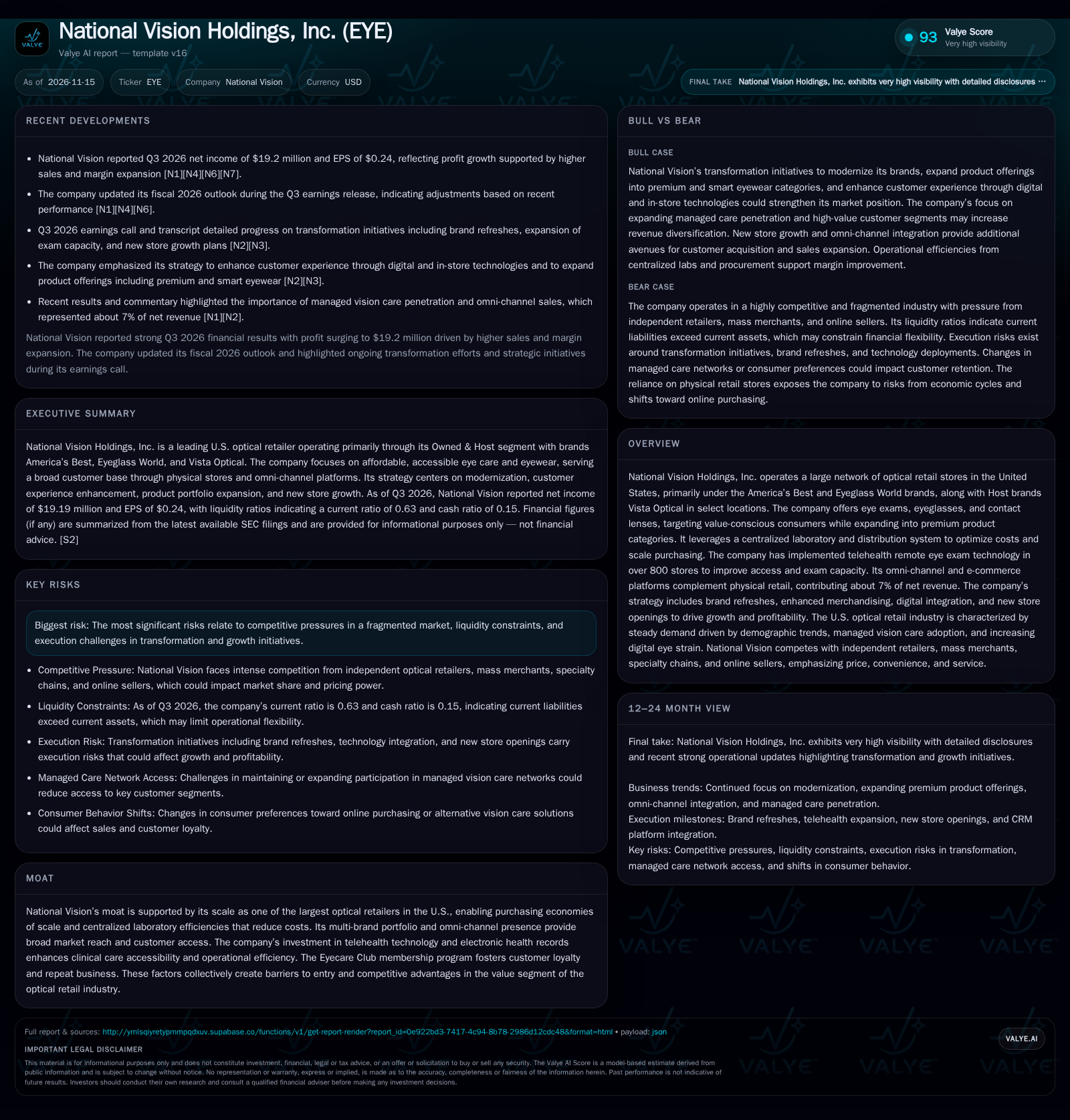
National Vision Holdings has delivered higher Q3 profits and updated its 2026 outlook as it advances a multi-pronged transformation strategy. Sustained success will depend on the company’s ability to balance growth, margin improvement, and financial discipline, particularly as it expands into new customer segments and premium categories.[N1] [N4] [N6] [S2]
National Vision Holdings, Inc. is at a pivotal juncture as it seeks to redefine its role in the U.S. optical retail sector. Recent operational updates reveal meaningful progress in its transformation initiatives—ranging from store network growth to digital integration and expansion into premium eyewear. This momentum has translated into improved profitability and margin gains in Q3 2026, prompting an updated fiscal outlook.
Recent Margin Gains and Transformation Milestones: What’s Changed for National Vision
National Vision Holdings delivered a significant surge in Q3 2026 profits, driven by higher sales and margin expansion, leading management to update its fiscal 2026 outlook.[N1] [N4] [N6] The company highlighted progress across multiple transformation initiatives, including brand refreshes for its core banners, expansion of in-store and digital technologies, and a renewed focus on premium product categories such as advanced lens technologies and smart eyewear.[N2] [N3] [S1] Notably, the company continues to execute on its store growth plan, aiming to open 30-35 new locations annually, and is actively integrating omni-channel capabilities and a new CRM system to enhance customer experience. The company reported cash and liquidity metrics for the period; these figures do not by themselves establish operating runway, investment capacity, financial flexibility, or financing capacity. [S1][S2] These facts together suggest a business advancing on operational and strategic fronts, but still facing meaningful financial and competitive pressures.
How the Value Optical Retail Model Scales—and Where Margin Leverage Might Emerge
National Vision’s economics rely on high-volume, value-focused retailing, leveraging scale and centralized laboratory operations to drive down costs and support attractive price points. The company’s primary revenue streams are eyeglasses (frames and lenses), contact lenses (including private labels), and eye exams, supplemented by membership programs like the Eyecare Club.[S1] Pricing in the value segment generally depends on offering bundled deals (e.g., two pairs for a fixed price), which attract cost-conscious customers but can compress margins if not offset by operational efficiencies.
Fixed costs include store leases, salaried optometrists or contracted providers, laboratory operations, and technology investments. Variable costs are largely tied to product procurement and direct labor for eye exams and lens finishing. Centralized labs and bulk purchasing offer fixed-cost leverage as store count and unit volumes rise, but expansion also raises capital requirements for new buildouts, technology upgrades, and inventory.
Recent transformation initiatives—such as digital enhancements, CRM integration, and premium product expansion—could support larger baskets (AOV) and margin improvement if customers adopt advanced lens technologies and designer frames. However, success depends on the mix shift toward higher-margin products, retention of value-oriented customers, and the ability to avoid promotional races to the bottom amid intense competition. The company’s liquidity profile suggests that major capital outlays must be carefully sequenced to avoid operational strain, especially if sales growth falters or competitive pricing intensifies.
Competing Across Channels: Fragmented Rivals, Online Threats, and the Value Proposition
National Vision operates in one of the most fragmented retail categories in the U.S., facing competition from independent optical retailers, mass merchants (such as big-box stores with optical departments), specialty chains, and a growing cohort of online direct-to-consumer sellers.[S1] The company’s core differentiators include its scale (with approximately 1,250 stores), multi-brand strategy, and centralized cost structure. Its value-focused positioning, especially through the America’s Best brand, is designed to capture price-sensitive customers who might otherwise choose discount independents or mass merchants.
The rise of online optical retail threatens to erode share, particularly as digital-native players improve their prescription fulfillment logistics, virtual try-on technology, and at-home eye exam offerings. National Vision’s omni-channel investments and telehealth-enabled eye exams (now in over 800 stores) are a direct response, aiming to blend physical convenience with digital accessibility and to maximize clinical capacity. However, online players may still undercut on price and convenience, especially for repeat contact lens orders or basic frame/lens packages.
Premium and smart eyewear expansion is intended to broaden the addressable market and attract higher-spending customer segments, but this brings National Vision into more direct competition with specialty chains and designer boutiques. The company’s ability to manage this channel conflict—preserving its low-cost value proposition while selectively moving upmarket—will be a key test of its brand management and merchandising strategy.
Transformation Success: When Brand Modernization and Premium Expansion Fuel Profitable Growth
The most favorable scenario for National Vision is one in which its transformation initiatives—brand refreshes, digital enhancements, premium and smart eyewear, and CRM-driven engagement—lead to sustained sales growth, higher average order value, and improved margins. In this scenario, new store openings deliver incremental revenue without cannibalizing existing locations, while omni-channel and telehealth investments drive both new customer acquisition and greater efficiency in eye exam delivery.
Confirmation of this scenario would include continued margin expansion (gross and operating), rising revenue per store, robust Eyecare Club membership growth, and strong adoption of premium lens and frame categories.
This path would be falsified by stagnating or declining same-store sales, weak uptake of premium offerings, or technology investments failing to generate measurable improvements in customer experience or clinical capacity. Signs of competitive price wars or margin erosion would also undermine the upside thesis.
Sustaining Share in a Fragmented Market: Incremental Growth with Ongoing Margin Pressures
The most plausible outcome is that National Vision achieves modest growth by continuing to expand its store base and product mix, but faces ongoing margin pressures from competition and the need to balance value pricing with premium expansion. The company’s scale and operational efficiencies likely help it maintain share among value-focused consumers, while telehealth and digital integration offset some of the convenience advantage of online rivals.
Key confirming evidence would include steady (but not accelerating) growth in store count, stable or slightly rising per-store sales, and maintenance of current margin levels. The Eyecare Club could continue to support recurring visits, but not deliver breakout growth.
This scenario would be challenged by evidence of significant market share loss to online or mass merchant competitors, sustained margin compression, or any material deterioration in customer retention or managed care network participation. Conversely, unexpected acceleration in premium product sales or meaningful improvement in liquidity would tilt the outlook more positive.
Liquidity Strain or Competitive Shock: How Execution Missteps Could Amplify Downside Risk
The principal risk for National Vision is that liquidity constraints—reflected in a current ratio of 0.63 and cash ratio of 0.15—become acute if margin improvement stalls or competitive pricing intensifies, leaving the company unable to fund store growth, technology upgrades, or inventory needs.[S2] In this scenario, execution missteps in transformation initiatives (such as delayed brand refreshes, failed CRM implementation, or poor premium product uptake) could exacerbate cost pressures and erode customer loyalty.
A competitive shock, such as aggressive discounting by mass merchants or a step-change in online optical adoption, could force National Vision into promotional pricing or reduced service levels, further compressing margins. Loss of access to managed vision care networks or a shift in consumer preferences toward online-only solutions would accelerate share loss and undermine the economics of physical retail.
Downside confirmation would come from declining same-store sales, shrinking Eyecare Club membership, negative operating cash flow, or announcements of store closures, workforce reductions, or delays in planned investments. Evidence of rising short-term borrowing or distressed asset sales would further validate this scenario.
Testing the National Vision Thesis: What Could Confirm or Challenge the Story Ahead
Sustained gross and operating margin expansion, particularly as premium and smart eyewear categories scale.
Trends in same-store sales growth or decline, providing a real-time signal of customer retention and competitive positioning.
Membership growth and retention metrics for the Eyecare Club program—if disclosed—including repeat purchase rates and frequency of eye exams.
E-commerce penetration as a percentage of total net revenue, especially if omni-channel and CRM integration drive online conversion.
Store opening cadence and productivity of new locations, measured by revenue per new store and time to profitability.
Progress and utilization rates for telehealth-enabled eye exams, including patient satisfaction and optometrist productivity—if reported.
Liquidity ratio trends and any changes in working capital management or short-term borrowing, as indicators of potential financial flexibility.
Updates on managed vision care network participation and changes in reimbursement or referral patterns.
Disclaimer: This is research-only, informational analysis and not investment advice. It may include AI-generated interpretation and general industry context. Always verify important details using primary sources.

Comments