
Investcorp Credit Management BDC: Valuation Discipline, Tax Hurdles, and the Strategic Stakes of a Merger
A rigorous credit investment process and active financing management meet escalating risks from tax qualification lapses and portfolio headwinds, as Investcorp Credit Management BDC enters a pivotal merger with BCP Investment Corporation.
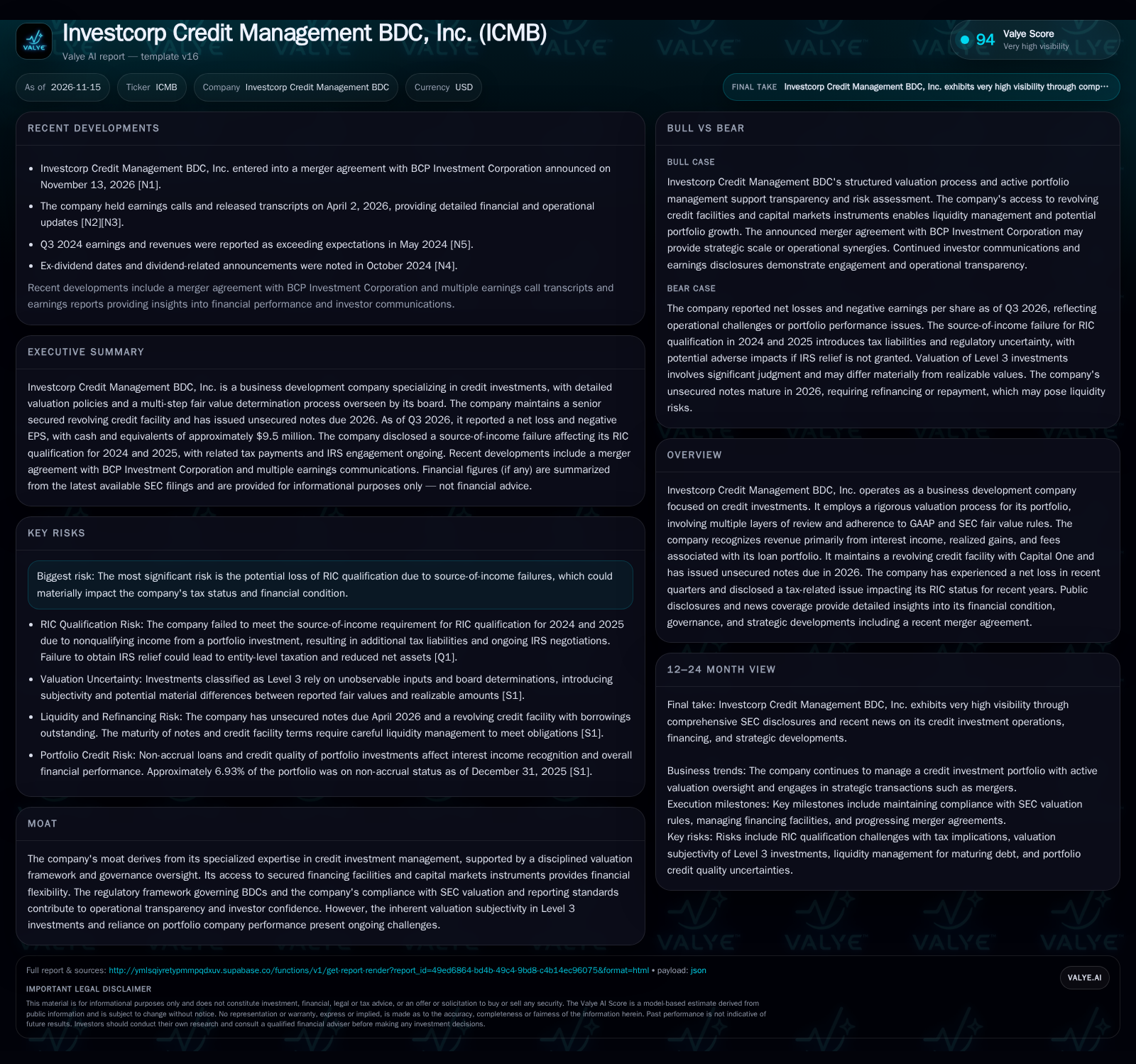
Investcorp Credit Management BDC, Inc. faces a critical inflection point: while it upholds a multi-layered portfolio valuation process and maintains diversified financing, recent net losses, a costly RIC qualification failure, and the onset of a strategic merger with BCP Investment Corporation collectively redefine its risk-reward profile. The company's ability to navigate regulatory, credit, and refinancing challenges will determine whether it can restore earnings power and unlock merger-driven value. [S1] [S2] [N1]
Investcorp Credit Management BDC, Inc. stands at a strategic crossroads as it grapples with the immediate repercussions of a rare RIC qualification lapse, persistent net losses, and looming debt maturities. At the same time, it brings a disciplined, multi-step valuation process and active financing toolkit to bear on its portfolio management. The recently announced merger with BCP Investment Corporation could reset the company’s growth trajectory, but intensifies the stakes around regulatory, operational, and refinancing execution. The next 12 to 24 months will be defined not just by credit market cycles, but by the company’s ability to address tax status, restore earnings, and deliver on merger integration.
Recent Tax Setbacks, Portfolio Losses, and a Potentially Transformative Merger
Investcorp Credit Management BDC, Inc. reported a net loss of $4.76 million and basic/diluted EPS of -$0.33 for Q3 2026, indicating ongoing portfolio or operational headwinds. The company reported cash and liquidity metrics for the period; these figures do not by themselves establish operating runway, investment capacity, financial flexibility, or financing capacity. [S2]
A significant adverse development is the company’s failure to meet the source-of-income requirement for regulated investment company (RIC) qualification for both 2024 and 2025, resulting in a $3.3 million tax liability and requiring a closing agreement request with the IRS. The outcome of this process could materially affect after-tax income and net asset value going forward.
The company announced a merger agreement with BCP Investment Corporation on November 13, 2026, which introduces both strategic opportunity and integration risk at a time when underlying earnings power and regulatory status are unsettled. [N1]
Earning Through Credit Spreads: Revenue Streams and Leverage Constraints
Investcorp Credit Management BDC generates revenue primarily from interest income on its investment portfolio, supplemented by net realized gains/losses, structuring fees, and payment-in-kind (PIK) interest or dividends. The company’s ability to earn attractive yields depends on prudent underwriting, effective risk pricing, and active management of loan performance and non-accruals. Revenue recognition policies are directly impacted by credit quality, with non-accrual loans reducing current income and potentially leading to realized losses. [S1]
The company’s capital structure blends a $100 million revolving credit facility (with $58.9 million drawn as of year-end 2025) and $65 million in unsecured notes due April 2026. The cost of debt—tied to SOFR plus a spread for the revolver and 4.875% on the notes—directly influences net interest margins. High leverage amplifies both return potential and downside risk, especially in a rising rate or deteriorating credit environment.
Operating leverage is present, but constrained by regulatory leverage limits for BDCs and the need to maintain asset coverage ratios. Fixed costs related to investment management, regulatory compliance, and valuation are significant, making scale and portfolio growth important for margin improvement. However, persistent net losses suggest that current portfolio yields and fee income are insufficient to offset credit losses, operating expenses, and financing costs. [S2]
Specialization, Transparency, and the Challenge of Unobservable Inputs
Investcorp Credit Management BDC’s core competitive asset is its disciplined, multi-step portfolio valuation process, which is designed to enhance transparency and investor confidence. This involves internal investment team reviews, independent valuation firms, a valuation committee, and board oversight, all in line with GAAP and SEC Rule 2a-5. [S1]
However, the company’s reliance on Level 3 fair value measurements for a portion of its portfolio exposes it to significant subjectivity and potential volatility. In comparison to other BDCs or private credit funds, the competitive landscape is shaped by access to proprietary deal flow, underwriting discipline, and the ability to manage illiquid or distressed assets. Larger peers may benefit from greater scale, lower cost of capital, and broader deal sourcing networks.
The announced merger with BCP Investment Corporation could, in theory, provide additional scale, broaden the investment universe, or deliver operating synergies. Yet, integration risks and the need to harmonize valuation, compliance, and investment processes remain material hurdles.
Merger Synergies and Regulatory Resolution Unlock New Value
The most constructive scenario would see the IRS accept the company’s closing agreement, restoring RIC status and eliminating the risk of further entity-level taxation. This would stabilize the company’s after-tax earnings and support net asset value retention.
Successful execution and integration of the merger with BCP Investment Corporation could deliver scale benefits, expand deal sourcing, and enable fixed cost absorption—potentially leading to improved operating leverage and more competitive portfolio yields. If credit quality stabilizes and the company is able to refinance or roll its $65 million in unsecured notes on favorable terms, the resulting potential financial flexibility could be redeployed toward higher-yielding investments or selective growth.
Evidence supporting this scenario would include IRS approval of the closing agreement, a sustained return to net profitability, positive EPS, and merger integration milestones (such as cost synergies or asset growth) being met. A decline in non-accruals and successful refinancing of maturing debt would further confirm the upside thesis.
Managing Through Regulatory and Credit Headwinds While Executing a Merger
The most plausible scenario for Investcorp Credit Management BDC involves gradual resolution of its RIC qualification issue—potentially with additional tax leakage if negotiations with the IRS are protracted or only partially successful. The company continues to face portfolio performance challenges, with net income fluctuating around break-even or modest losses, depending on credit market conditions and non-accrual trends.
The merger with BCP Investment Corporation proceeds, but initial integration costs and operational complexity offset some of the intended synergies. The company is able to refinance or extend its unsecured notes, but likely at a higher cost given current credit market conditions and its recent earnings record.
Confirmation of this scenario would be visible in quarterly results that show stabilization of net losses, moderate improvement in portfolio yields, and incremental progress on integration without major disruptions. Partial IRS relief and a manageable level of tax payments would also support the base case.
Tax Uncertainty, Refinancing Stress, and Portfolio Deterioration Compound
In a more adverse scenario, the company fails to secure favorable IRS relief, resulting in continued or escalating entity-level taxation and a material reduction in distributable income and net asset value. This could also undermine investor confidence and impair access to new capital.
If portfolio credit quality further deteriorates—evidenced by rising non-accruals or realized losses—interest income declines, and net losses accelerate. The company may face difficulty refinancing its $65 million in unsecured notes, potentially forcing asset sales, increased borrowing costs, or dilutive capital raises.
Merger integration proves disruptive, with operational or cultural misalignment leading to additional expenses and portfolio distractions. Evidence of this scenario would include further increases in non-accruals, negative cash flow, IRS rejection of the closing agreement, or distressed refinancing transactions.
Metrics to Gauge Progress on Tax, Earnings, and Merger Integration
Resolution status of the IRS closing agreement for RIC qualification—final IRS determination and any additional tax liabilities would help test the regulatory risk thesis.
Quarterly net income and EPS trends—consistent improvement or return to profitability would signal underlying portfolio stabilization.
Level and trend of non-accrual loans—rising non-accruals could indicate worsening credit quality and threaten current income.
Refinancing terms and timing for the $65 million unsecured notes due April 2026—successful refinancing at a reasonable cost would mitigate liquidity risk.
Merger integration milestones—disclosures regarding cost synergies, changes in portfolio composition, or operating expense reductions would clarify merger execution.
Portfolio yield and interest income metrics—if disclosed, these would indicate whether the company is earning a sufficient spread over its cost of capital.
Changes in fair value estimates for Level 3 investments—large downward adjustments would raise concerns about future losses or NAV erosion.
Cash and equivalents relative to upcoming obligations—a useful metric would be projected cash needs through the next 12 months, especially as debt maturities approach.
Disclaimer: This is research-only, informational analysis and not investment advice. It may include AI-generated interpretation and general industry context. Always verify important details using primary sources.

Comments