
TEAM INC: Operational Diversification Meets Profitability Headwinds in Industrial Services
The interplay between diversified industrial services, sector cyclicality, and capital discipline will determine whether recent momentum can be sustained—or if further restructuring is required.
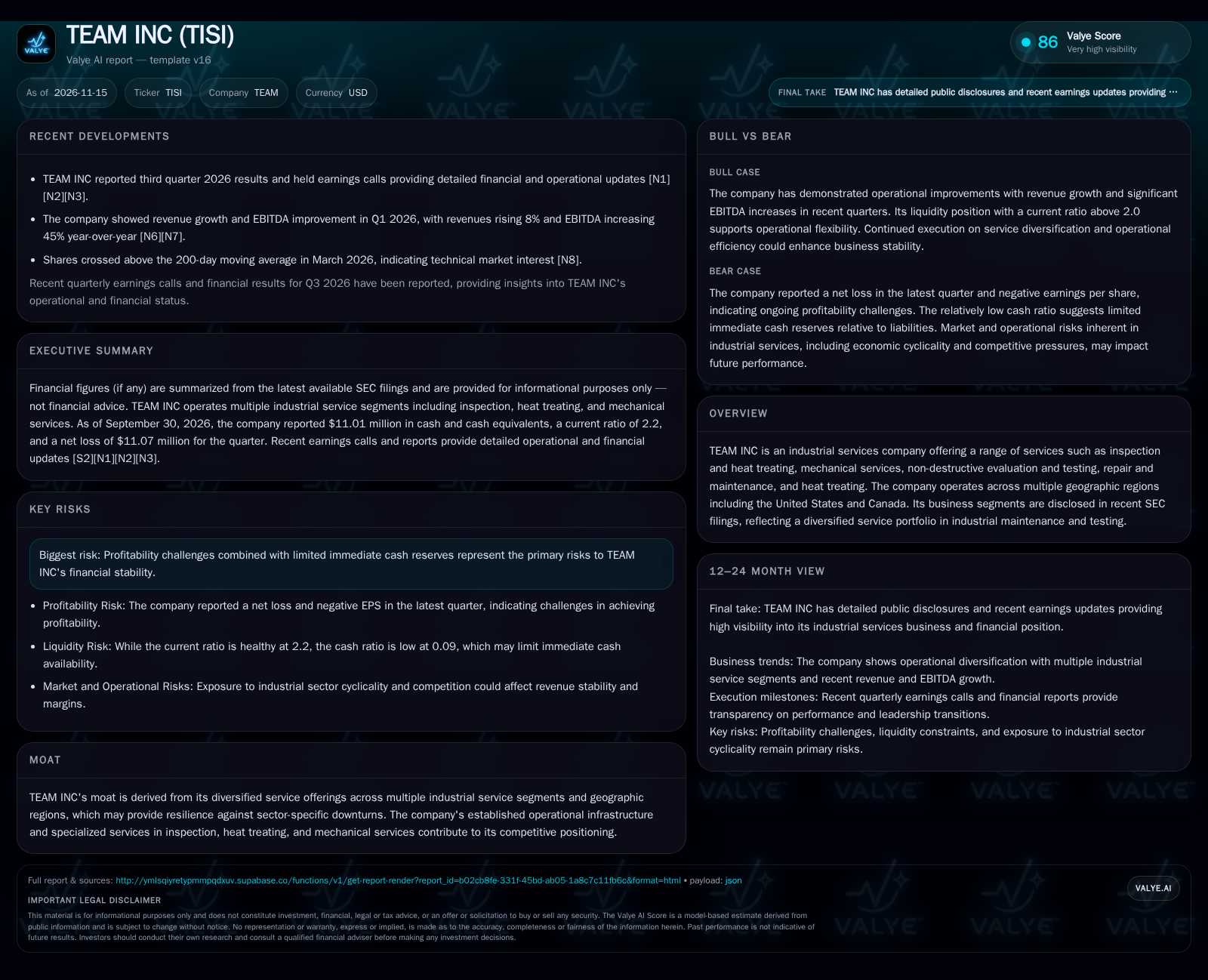
TEAM INC posted Q3 2026 net losses despite revenue and EBITDA gains earlier in the year, with a current ratio of 2.2 but a reported cash ratio of 0.09. Future performance hinges on converting top-line gains into sustainable margins while managing liquidity and sector volatility. [S2] [N6] [N7]
TEAM INC’s Q3 2026 results reveal a company at a crossroads: operational improvements have driven revenue and EBITDA growth, yet net losses persist and cash reserves remain tight. The company’s diversified industrial services portfolio—spanning inspection, heat treating, mechanical, and non-destructive evaluation—offers a degree of resilience, but the core challenge remains translating scale and operational breadth into sustainable profitability.
Recent Results Spotlight Margin Challenge Despite Revenue Growth
TEAM INC closed Q3 2026 with $11.01 million in cash and cash equivalents, current assets of $278.2 million, and current liabilities of $126.6 million, resulting in a current ratio of 2.2 and a cash ratio of 0.09 [S2]. While the company achieved notable revenue growth (8% in Q1 2026) and a 45% year-over-year EBITDA increase, it nevertheless reported a net loss of $11.07 million and negative earnings per share (-$3.10) for the most recent quarter [S2] [N6] [N7]. These facts underscore the tension between operational progress and persistent profitability headwinds.
How Diversification and Service Mix Shape TEAM INC’s Profit Potential
TEAM INC’s business model revolves around providing essential industrial services—including inspection, heat treating, mechanical, and non-destructive evaluation—typically delivered under project-based or time-and-materials contracts. These services are often non-discretionary for customers in regulated or safety-critical sectors, which can underpin stable baseline demand but also expose TEAM to pricing pressure during sector downturns. The company’s cost structure likely features a substantial variable component (labor, materials, subcontracting), with fixed costs anchored in infrastructure, specialized equipment, and administrative overhead.
Revenue mix across service lines and geographies could, in theory, buffer against sector-specific volatility. However, the recurring nature of inspection and maintenance work is often offset by the project-based, lumpy character of larger mechanical or heat-treating engagements. Operating leverage is possible if TEAM can drive higher utilization of its workforce and assets, but low margins and ongoing net losses suggest that either pricing power is limited or fixed costs remain too high relative to current volume. The persistent net loss, despite EBITDA growth, implies that interest, depreciation, or restructuring charges may be absorbing incremental gains—highlighting the need for either further cost rationalization or a more profitable service mix.
Defensive Advantages and Sector Pressures in Industrial Services
TEAM INC’s competitive positioning draws from its diversified service portfolio and established operational infrastructure, enabling it to serve a wide array of industrial clients across North America [S2]. This breadth can provide switching friction for customers seeking bundled or integrated services, as well as some resilience against downturns in any single end-market. Specialized technical capabilities—such as non-destructive testing or advanced heat treating—may create barriers for less sophisticated competitors and insulate certain revenue streams.
However, the industrial services landscape remains highly competitive, with regional and national players often competing on price, responsiveness, and safety record. Customer retention is influenced by both performance and cost, and large industrial clients may have significant bargaining power. In addition, industry cyclicality means that even diversified providers face periods of utilization pressure and price competition. Substitution risk is relatively low for critical inspection and compliance-driven services but can be higher for commoditized maintenance or repair work. TEAM’s ability to defend margins will depend on sustaining technical differentiation, scale-driven cost advantages, and high renewal rates in core service lines.
Margin Expansion and Utilization Gains Drive Sustainable Turnaround
A favorable trajectory for TEAM INC would see recent revenue and EBITDA momentum convert into consistent net profitability. This could be achieved through a mix of higher workforce utilization, improved asset leverage, and disciplined pricing—especially if industrial end-markets remain robust or recover further. If the company successfully shifts its service mix toward higher-margin, recurring inspection and compliance contracts, operating leverage could meaningfully improve. Additional upside may come from cross-selling across service lines, deepening customer relationships, and leveraging data-driven maintenance offerings.
Evidence supporting this scenario would include a sustained trend of positive net income, sequential margin improvement, and increased backlog or contract renewal rates (if disclosed). A rising EBITDA margin—especially if accompanied by stable or growing cash balances—would confirm that operational improvements are translating into financial resilience. Conversely, if margin gains stall or net losses persist despite revenue growth, it would challenge the thesis that scale and diversity can drive durable profitability.
Steady Revenue, Tight Margins: Incremental Progress Amid Sector Cycles
The most plausible outlook is one in which TEAM INC continues to deliver modest revenue growth and occasional EBITDA improvement, but net profitability remains elusive due to sector cyclicality, competitive pricing, and a still-heavy fixed cost base. Incremental gains may arise from operational efficiency programs, selective service line expansion, and ongoing cost containment.
This scenario would be confirmed by continued reporting of small or narrowing net losses, stable or slightly improving EBITDA, and current ratios remaining healthy but cash ratios persistently low. Evidence that would challenge this baseline includes either a decisive return to net profitability and margin expansion (suggesting a stronger-than-expected turnaround) or a material worsening of liquidity and operating losses (pointing to deeper structural issues).
Liquidity Constraints and Sector Downturn Force Restructuring
In this scenario, sector cyclicality or a downturn in key end-markets could drive lower utilization, compress margins, and accelerate cash burn—forcing the company to seek external financing, divest assets, or undertake further restructuring. Erosion in customer renewals or project pipeline would exacerbate the challenge, as would any inability to pass through cost increases.
Confirmation would come from a sharp deterioration in cash balances, rising short-term debt, or disclosure of covenant breaches, asset sales, or emergency capital raises. Persistent or widening net losses, coupled with declining EBITDA and unfavorable working capital trends, would reinforce the downside case.
Testing TEAM INC’s Turnaround: What Will Confirm or Challenge the Thesis
Sustained net income or a clear trend toward profitability in quarterly results would directly test whether operational improvements are translating into durable financial gains.
EBITDA margin trajectory—sequential improvement, stability, or contraction—will be critical to assessing whether efficiency initiatives are delivering leverage.
Cash flow from operations, if disclosed, would provide insight into underlying business health and liquidity risk beyond static balance-sheet ratios.
Trends in customer retention rates, contract renewals, or backlog (if disclosed) would reveal the stickiness and forward visibility of TEAM’s revenue base.
Changes in service line mix—specifically the proportion of recurring inspection and compliance work versus project-based or discretionary services—could signal margin improvement potential.
Any external financing events, asset sales, or restructuring announcements would indicate stress and shape the company’s capacity to invest or weather shocks.
Sector demand signals (industrial production indices, capex cycles in key end-markets) will influence both volume and pricing environment for TEAM’s offerings.
Management commentary on pricing discipline, cost structure, and strategic priorities in future earnings calls will help clarify the company’s path to sustainable margins.
Disclaimer: This is research-only, informational analysis and not investment advice. It may include AI-generated interpretation and general industry context. Always verify important details using primary sources.

Comments