
Rising Dragon Acquisition Corp.: SPAC Mechanics, China-Focused Deal Risks, and the Implications of a Terminated Merger
Rising Dragon Acquisition Corp. The company’s path forward depends on its ability to identify a viable business combination amid tightening regulatory scrutiny and a shrinking acquisition universe.
The company’s China-centric management and exclusion of VIE targets create both opportunities and pronounced regulatory risk. Its future hinges on finding a new, compliant target before trust account deadlines force liquidation or further shareholder redemption.
Rising Dragon Acquisition Corp. exemplifies the current complexities facing China-focused SPACs. While the company successfully raised nearly $58 million in 2024 and placed the proceeds in trust, its initial merger agreement with HZJL Cayman Limited has been terminated, thrusting RDAC back into the acquisition search with the clock ticking. The outcome will depend on the company’s ability to secure a compliant, value-creating deal before shareholder redemptions or regulatory hurdles force liquidation.
Termination of Merger, Trust Account Structure, and Regulatory Exposure Define RDAC’s Present
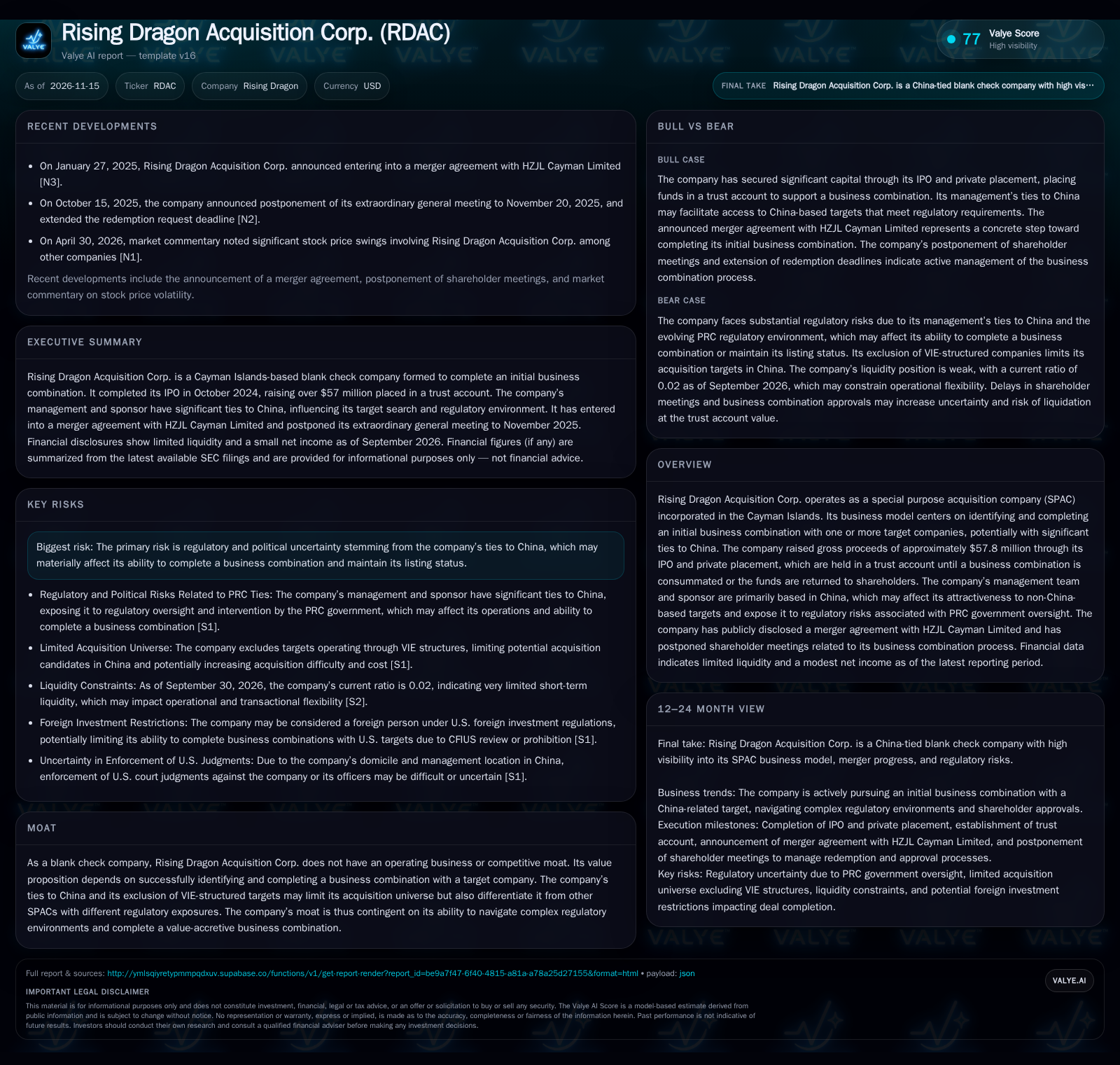
The most material development for Rising Dragon Acquisition Corp. is the termination of its previously announced merger agreement with HZJL Cayman Limited, as disclosed in its most recent 10-Q. This resets the SPAC’s acquisition process and increases time pressure, as SPACs are typically required to consummate a deal within a defined window or return trust funds to shareholders [S2].
The company’s $57.8 million raised in the IPO and private placement remains in a trust account, earmarked exclusively for a qualifying business combination or shareholder redemption [S1]. While this structure protects public investors, it means RDAC’s day-to-day liquidity is extremely limited; as of September 30, 2026, current assets were just $27,729 versus $1.6 million in current liabilities, yielding a current ratio of 0.02 [S2].
RDAC’s management and sponsor are based in China and have significant PRC ties, exposing the company to both Chinese regulatory scrutiny and U.S. foreign investment restrictions. The company’s exclusion of VIE-structured targets further narrows its acquisition universe, especially within China, where VIEs are common [S1].
SPAC Economics: Trust Account, Sponsor Incentives, and the Cost of Delay
RDAC’s core economics are those of a typical SPAC: proceeds from the IPO and private placement are placed in a trust account and must be used for an approved business combination or returned to shareholders. The company earns non-operating income from interest on these funds until a transaction is completed [S2]. Operating expenses, transaction costs, and administrative costs must be covered by minimal cash held outside the trust, which is currently severely limited.
Sponsor incentives are strongly aligned with deal completion. The sponsor’s initial investment—typically at a nominal price—translates into a large equity stake only if a business combination closes. This creates a powerful incentive to pursue a deal, but also potential conflicts regarding deal quality versus speed.
The cost structure is heavily front-loaded, with substantial transaction costs (noted at $3.4 million) already incurred [S2]. If no deal occurs, sponsors and founders lose their investment, and public shareholders receive their pro-rata trust account value. The risk of value destruction is asymmetric: sponsors lose their warrants and shares, while public holders are largely protected by the trust mechanism.
Delayed deal closure or repeated failed negotiations can erode the remaining time to complete a combination, increase administrative costs, and heighten the risk of forced liquidation.
China-Focused SPAC Dynamics: Regulatory Constraints and a Shrinking Target Pool
RDAC’s competitive positioning is shaped by three factors: its China-focused management, the exclusion of VIEs, and heightened regulatory oversight from both U.S. and PRC authorities. These elements simultaneously differentiate the SPAC and limit its flexibility.
The company’s management and sponsor connections in China could, in theory, provide access to proprietary deal flow in a market that remains attractive for certain growth sectors. However, the exclusion of VIE-structured companies—a common workaround for foreign investment restrictions in China—significantly narrows the universe of eligible targets.
At the same time, U.S. regulatory scrutiny (including potential CFIUS review) can further restrict the types of targets available, especially if RDAC is classified as a 'foreign person' under U.S. rules [S1]. This places RDAC at a disadvantage versus SPACs with more flexible mandates or those targeting other geographies.
The SPAC’s ability to win competitive deal processes is also affected by these limitations, as many attractive China-based companies may be off-limits or unwilling to navigate the dual regulatory gauntlet.
If RDAC Secures a Compliant, High-Growth Target: How a SPAC Could Create Value
The primary upside scenario involves RDAC identifying and consummating a business combination with a non-VIE, high-growth company with substantial operations in China or another emerging market. If such a target is found and can clear both PRC and U.S. regulatory hurdles, the trust account could be deployed into a transaction that delivers above-average returns to shareholders and meaningful sponsor upside.
Confirmation of this scenario would require: (1) announcement of a new merger agreement with a credible, compliant target; (2) clear PRC and U.S. regulatory approval signals; (3) evidence of limited shareholder redemption, preserving trust account capital for the de-SPAC’d entity; and (4) investor enthusiasm reflected in post-deal trading.
Falsification would occur if repeated deal attempts are announced and then terminated, if regulatory authorities block or delay transactions, or if high redemption rates drain the trust and reduce the post-merger capital base.
Most Likely Trajectory: Prolonged Search, Heightened Redemptions, and Regulatory Friction
Given the terminated merger and the narrowing pool of eligible targets, the most plausible path is that RDAC will continue searching for a business combination but will face increasing time pressure and dealmaking friction. The risk of shareholder redemption grows with each delay, potentially shrinking the available trust capital for any eventual target.
This scenario would be confirmed by ongoing extensions of shareholder meeting dates, repeated adjustments to redemption deadlines, and lack of progress toward a new transaction. Regulatory developments—such as new PRC restrictions or heightened U.S. scrutiny—would further complicate the process.
A base case outcome could involve a last-minute deal with a less attractive target, high redemption rates, and a de-SPAC’d company with limited scale and market appeal. Alternatively, RDAC may be forced to liquidate if an acceptable deal cannot be closed within the required timeframe.
Deal Failure, Liquidation, and Sponsor Loss: The Adverse Chain of Events
The downside scenario is straightforward: RDAC fails to secure a viable, compliant business combination by the trust account deadline. Regulatory blockages, an insufficient pool of eligible targets, or repeated shareholder redemptions could precipitate this outcome.
In this case, the trust account is liquidated and returned to public shareholders, while sponsors and insiders lose their at-risk capital and potential upside. Transaction costs already incurred are not recoverable, and the SPAC structure winds down without delivering a business combination.
Evidence supporting this scenario would include further terminated merger talks, continued regulatory uncertainty, or explicit disclosures of a wind-down process in future filings.
Milestones and Events That Will Define RDAC’s Prospects in the Months Ahead
The announcement of any new merger agreement, including target details and deal structure, is crucial for assessing RDAC’s direction.
Shareholder redemption rates at each extension or combination vote—if disclosed—will determine how much trust capital remains available for a post-merger entity.
Any regulatory guidance or statements from PRC or U.S. authorities regarding the permissibility of the proposed combination would materially affect deal feasibility.
Evidence of an extension to the SPAC’s trust account deadline or changes to shareholder meeting dates would signal ongoing deal search or execution delays.
Disclosure of target company financials, operating metrics, and growth potential would help evaluate the quality of any proposed transaction.
A useful metric would be cash burn rate outside the trust account, as continued administrative costs could affect the SPAC’s flexibility.
If disclosed, the degree of sponsor or insider commitment to backstop redemptions or inject additional capital could support deal certainty.
Post-announcement trading volumes and price action would provide a market-based test of investor confidence in any new merger plan.
Disclaimer: This is research-only, informational analysis and not investment advice. It may include AI-generated interpretation and general industry context. Always verify important details using primary sources.

Comments