
Greenpro Capital: Complex Structure, Expansion Gambits, and the Search for Profitable Scale
Greenpro Capital Corp. operates a sprawling multinational network of financial consulting and corporate service entities, with a reported cash position but persistent losses and limited revenue transparency. The company’s recent moves into digital banking and a Thai entertainment consortium highlight its appetite for diversification, but raise questions about focus, execution, and the path to sustainable profitability.
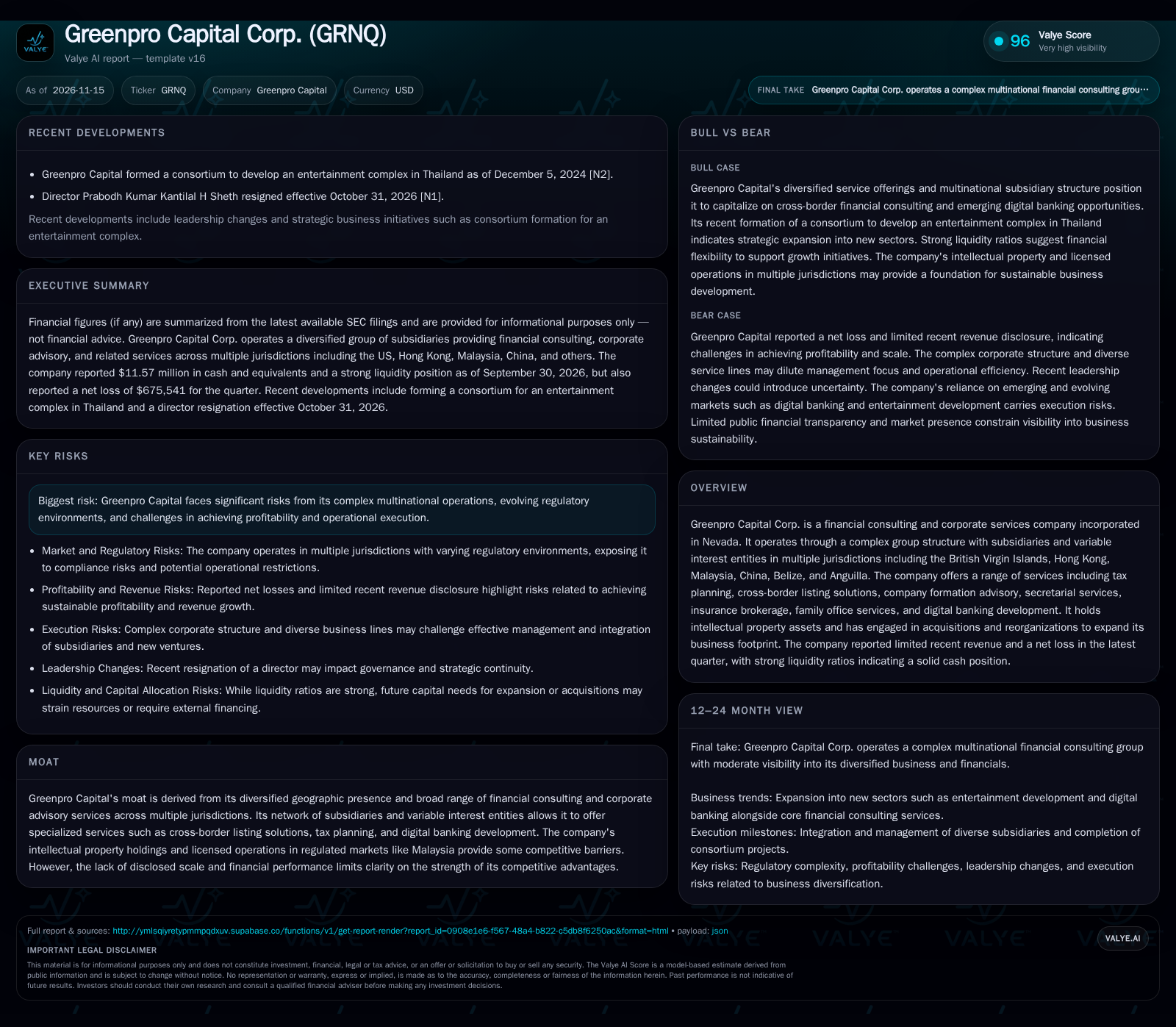
Greenpro Capital’s vast geographic reach and diversified service portfolio are underpinned by substantial cash reserves, yet the company continues to post losses and offers little recent revenue detail. Expansion into new sectors like digital banking and entertainment signals ambition, but operational complexity and limited financial transparency challenge the investment thesis. Execution on new ventures and the ability to convert liquidity into profitable growth remain central uncertainties. [S1] [S2] [N2]
Greenpro Capital Corp. sits at the intersection of ambition and ambiguity. With a complex web of entities spanning Asia and offshore jurisdictions, the firm offers everything from tax planning and company formation to digital banking development. Its recent expansion into entertainment infrastructure in Thailand exemplifies a willingness to diversify, yet persistent losses, limited up-to-date revenue disclosure, and a recent leadership change cloud the outlook. The question for investors is whether Greenpro’s balance-sheet strength and geographic reach can be transformed into coherent, profitable growth—or whether complexity and diversification will dilute returns and focus.
Recent Liquidity, Losses, and Strategic Pivots: What’s Changed Lately?
As of September 30, 2026, Greenpro Capital reported cash and cash equivalents of $11.57 million, with current assets of $14.82 million and current liabilities of only $0.93 million—resulting in a striking current ratio of 15.92 and cash ratio of 12.43. While this signals reported liquidity position, the company posted a net loss of $675,541 for the latest quarter, and EPS remained in negative territory at -$0.37. The most recent revenue disclosure is for March 2023, at $637,735 for that quarter, suggesting either stagnation or a lack of transparency in reporting subsequent performance. [S2]
On the strategic front, Greenpro formed a consortium to develop an entertainment complex in Thailand as of December 2024, marking a move into a new sector beyond its core consulting and corporate services. Meanwhile, the resignation of director Prabodh Kumar Kantilal H Sheth, effective October 31, 2026, highlights recent governance turnover. [N1] [N2]
Together, these developments underscore a company with ample cash resources and a willingness to expand into new domains, but also one facing profitability challenges and organizational flux.
How Greenpro’s Multi-Jurisdiction Model Could Create—or Erode—Economic Value
Greenpro Capital generates revenue from a suite of professional services: corporate advisory, tax planning, cross-border listing facilitation, secretarial services, insurance brokerage, family office solutions, and digital banking development. The group’s structure—spanning the British Virgin Islands, Hong Kong, Malaysia, China, Belize, and Anguilla—enables access to diverse regulatory environments and client bases, but also introduces overhead and complexity. [S1]
The economics of these services typically favor high gross margins and low incremental costs per client, but require ongoing investment in compliance, licensing, and relationship management. The company’s foray into digital banking and the entertainment complex represents a shift toward higher capital intensity and potentially longer project cycles, with less predictable revenue recognition and higher execution risk compared to core advisory services.
Operating leverage may be limited by the need to maintain legal, compliance, and sales teams across multiple jurisdictions. The company reported cash and liquidity metrics for the period; these figures do not by themselves establish operating runway, investment capacity, financial flexibility, or financing capacity. Without more recent revenue figures or disclosure about the profitability of individual business lines, the sustainability of Greenpro’s model remains an open question.
Diversification as Double-Edged Sword: Where Greenpro Stands Among Global Service Providers
Greenpro’s competitive landscape is shaped by a mix of local boutique consultancies, regional corporate service firms, and global players offering overlapping services. Its multi-jurisdictional presence allows it to serve clients with cross-border needs, and its ability to bundle advisory, formation, and digital banking tools could be a differentiator—if executed effectively.
However, the sheer breadth of its service lines and geographical footprint may dilute focus and make it difficult to achieve scale or specialization in any one area. In digital banking, Greenpro faces formidable competition from established fintechs and regulated banks with deeper technology stacks and client relationships. In the entertainment infrastructure space, the company is a new entrant, likely lacking the operational expertise and local partnerships of incumbent real estate and project development firms.
Intellectual property holdings (six trademarks and related applications) and licenses in regulated markets like Malaysia offer some barriers to entry, but are unlikely to constitute a robust moat without clear, recurring revenue streams or sticky client relationships. Regulatory risk is a persistent headwind, as compliance standards and enforcement vary widely across the jurisdictions in which Greenpro operates.
Unlocking Profitable Growth: What Would a Bullish Transformation Look Like?
An upside scenario would see Greenpro Capital successfully leveraging its cash reserves and multi-jurisdictional network to capture high-value, cross-border advisory mandates, while also executing on new ventures like digital banking and the Thailand entertainment consortium. In this case, the company could achieve scale by cross-selling services to existing clients, deepening relationships, and building recurring revenue streams.
Confirmation would come from a sustained uptick in disclosed revenue (with recent figures surpassing prior quarterly run rates), a return to operating profitability, and evidence of successful project delivery in new sectors. Additional signs would include new client wins in digital banking, completion milestones in the entertainment complex, and stable or expanded leadership with sector-relevant expertise.
This scenario depends on disciplined capital allocation, effective integration of subsidiaries, and the ability to manage regulatory complexity while maintaining service quality. If Greenpro can demonstrate that its diversification strategy yields synergistic growth rather than distraction, the company could emerge as a differentiated mid-tier player in the global corporate services market.
Sustained Complexity, Modest Growth: The Most Likely Near-Term Trajectory
Absent new evidence of revenue acceleration or margin expansion, Greenpro is likely to continue as a niche player with diversified but modestly scaled operations. The company may maintain its reported liquidity position—thanks to limited capital outflows and conservative cash management—but persistent net losses and limited transparency will weigh on investor confidence.
Execution risk remains high, particularly as the company juggles legacy consulting operations, digital banking ambitions, and the Thailand entertainment project. The base case is that Greenpro’s complex structure supports a stable but unremarkable business, relying on occasional advisory mandates and incremental project wins. The multi-jurisdictional setup provides optionality, but may also perpetuate overhead and dilute focus.
This scenario would be confirmed by continued lag in revenue disclosure, ongoing net losses, and incremental rather than transformational project updates. Any improvement in profitability or disclosure practices would serve as early signals of positive deviation from this status quo.
When Diversification Backfires: How Complexity and New Ventures Could Undermine Value
In a negative scenario, Greenpro’s expansion into new sectors—such as digital banking and entertainment infrastructure—could amplify losses rather than generate growth. Execution missteps, cost overruns, or regulatory setbacks in unfamiliar domains could consume cash reserves and erode shareholder value. The risk is exacerbated by the company’s complex structure, which can obscure accountability and hinder swift response to operational challenges.
Further, persistent lack of revenue transparency may conceal deteriorating core business performance. Leadership turnover—such as the recent director resignation—could signal deeper governance or strategic disagreements, hampering the company’s ability to course-correct. If liquidity is depleted by failed ventures or unprofitable subsidiaries, Greenpro could face pressure to raise capital on unfavorable terms or divest strategic assets.
This scenario would be confirmed by a sharp deterioration in reported liquidity, acceleration of net losses, missed project deadlines, or negative regulatory developments in key jurisdictions. The absence of timely and detailed financial disclosure would further erode market confidence.
What Will Define Greenpro’s Next Chapter? Concrete Milestones for Testing the Thesis
Disclosure of current and segment-level revenue figures—especially for digital banking and the Thailand entertainment consortium—would help assess the health and momentum of core and new business lines.
Quarterly operating profit or loss trends, as well as gross margin evolution, if disclosed, will shed light on whether scale and diversification are translating into profitability.
Updates on project milestones and commercial agreements for the Thailand entertainment complex: evidence of tangible progress, financing, and tenant/customer commitments would validate strategic expansion.
Client acquisition and retention metrics in digital banking and cross-border advisory would provide insight into the company’s ability to win and keep business in competitive markets.
Regulatory developments or compliance disclosures in key jurisdictions (Hong Kong, Malaysia, China, Thailand) could materially affect operating flexibility and risk.
Leadership stability and new executive appointments—especially those with sector expertise—would be important signals for execution capacity and strategic direction.
Any improvement in the frequency and transparency of financial disclosures would demonstrate commitment to investor communication and governance best practices.
Disclaimer: This is research-only, informational analysis and not investment advice. It may include AI-generated interpretation and general industry context. Always verify important details using primary sources.

Comments