
Vista Gold: Feasibility, Funding, and the Strategic Stakes of Advancing Mt Todd
With a world-class gold resource, recent capital infusion, and progress toward permitting, Vista Gold stands at a pivotal juncture: the transition from asset development to execution, all while a pending merger with Artemis adds a new layer of uncertainty and potential.
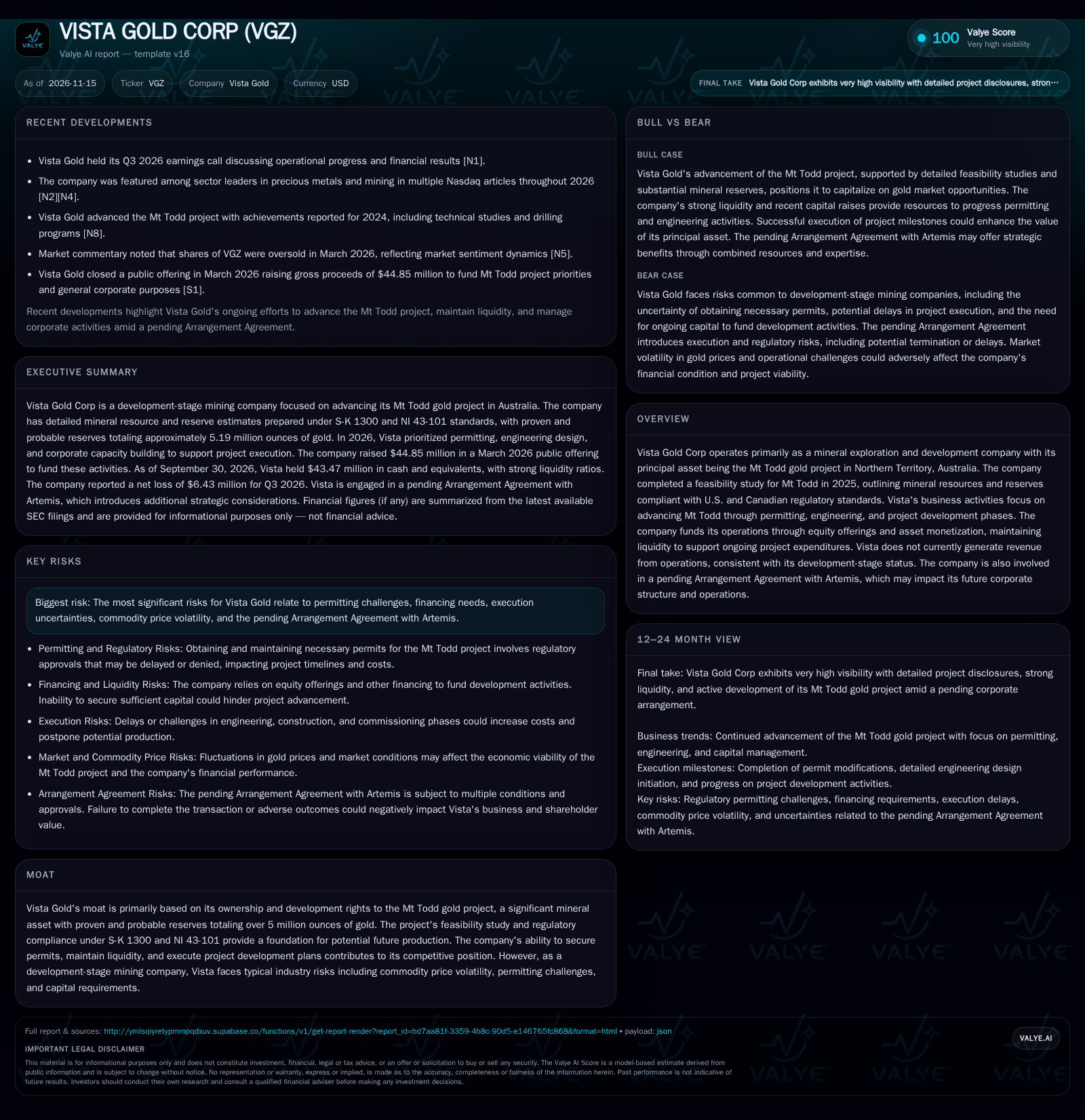
Vista Gold has advanced its Mt Todd project to a shovel-ready stage, supported by a recent $44.85 million capital raise and reported liquidity position. The company’s feasibility study outlines over 5 million ounces of gold reserves, but it remains pre-revenue and faces significant execution, permitting, and financing hurdles. A pending Arrangement Agreement with Artemis could reshape its future trajectory, amplifying both upside and risk. Investors must weigh the project's scale and preparedness against typical mining-sector uncertainties and the added complexity of corporate restructuring.
Vista Gold Corp sits at a decisive threshold in the mining value chain, having transformed Mt Todd in Australia into one of the largest undeveloped gold projects globally, at least on paper. With a robust feasibility study, over 5 million ounces in reserves, and a recent $44.85 million capital raise, the company is now equipped to push forward with permitting, detailed engineering, and de-risking efforts in 2027. Yet, it is still pre-revenue, and its future depends entirely on flawless execution, sustained funding, and external regulatory and gold market dynamics. The pending Arrangement Agreement with Artemis adds another strategic dimension, potentially accelerating the path to production or introducing integration and approval hurdles. Investors must grapple with a classic mining dilemma: world-class resource potential versus the uncertainties of bringing a major project to life.
Mt Todd’s Project Readiness, Funding, and Corporate Restructuring: The Latest Inflection Points
Vista Gold’s Mt Todd project in Australia now stands on a solid technical and regulatory foundation, with a feasibility study completed in 2025 establishing 172 million tonnes of proven and probable reserves at 0.94 g/t gold, containing approximately 5.19 million ounces [S1]. This scale positions Mt Todd among the largest undeveloped gold assets controlled by a junior developer. In March 2026, Vista raised $44.85 million in gross proceeds through a public offering, and as of September 30, 2026, it reported $43.47 million in cash and equivalents, with a current ratio exceeding 11 [S1] [S2]. These facts highlight strong near-term liquidity and readiness to advance the project’s next phase. However, Vista reported a net loss of $6.43 million for Q3 2026 and remains pre-revenue, underlining its ongoing dependence on external financing [S2]. Adding complexity, the company is engaged in a pending Arrangement Agreement with Artemis, subject to regulatory and shareholder approvals, which could materially alter its future business structure and operational control.
The Economics of Pre-Production Gold Development: Funding, Leverage, and the Path to Value
Vista Gold’s business model is emblematic of the development-stage mining sector: value is created by advancing a large-scale resource through feasibility, permitting, engineering, and ultimately construction. At this phase, the company generates no operating revenue, and all cash inflows are from external capital—primarily equity issuance [S1] [S2]. Cost structure is heavily weighted toward fixed costs such as technical studies, permitting, and staff expansion, while variable costs remain minimal until construction and operations begin.
The potential for operating leverage is significant, but only if Mt Todd transitions into production. At a 15 ktpd processing rate, the feasibility study suggests substantial gold output, which could deliver strong cash flow if gold prices remain robust and operating costs are contained. However, capital intensity is high: large-scale gold projects typically require hundreds of millions of dollars in upfront investment, exposing the company to dilution risk and the vagaries of capital markets. Until financing for full construction is secured, Vista’s value is largely tied to advancing the asset up the development curve and achieving key de-risking milestones, which may unlock incremental value or attract a strategic partner or acquirer.
How Mt Todd Stacks Up: Asset Quality, De-risking, and the Competitive Landscape in Junior Gold Mining
Vista Gold’s primary competitive advantage is its outright ownership and regulatory progress on the Mt Todd deposit, which is one of the largest undeveloped gold projects in Australia by contained ounces [S1]. This scale and jurisdictional stability differentiate it from many peers with smaller or riskier international assets. The completed feasibility study, regulatory compliance under S-K 1300 and NI 43-101, and ongoing permitting work all enhance the project’s credibility and potential attractiveness to larger producers or investors.
However, competition in the junior mining sector is fierce, with many companies vying for capital and attention—often with similarly promising but earlier-stage assets. The principal counterforce is the capital-intensive, binary nature of the sector: only a minority of development-stage projects ever reach production. Substitution risk is primarily driven by the fact that major gold producers can acquire or joint venture with multiple juniors, and that investor capital is highly mobile, chasing either near-term production or higher-risk exploration upside. The pending Arrangement Agreement with Artemis could provide scale, expertise, or financial muscle, but also introduces execution and integration risk.
What Success at Mt Todd Would Look Like: De-risking, Financing, and Strategic Optionality
The most favorable scenario for Vista Gold is a virtuous cycle of de-risking and value accretion: the company successfully completes permit modifications and launches detailed engineering in 2027, hitting all technical and regulatory milestones on time [S1]. This progress could enhance confidence in project economics, enabling Vista to secure attractive project financing or a strategic partnership on favorable terms. A rising gold price environment would amplify the project’s NPV and may attract interest from larger producers seeking growth in stable jurisdictions.
The pending Arrangement Agreement with Artemis, if completed, could combine resources and expertise, accelerating Mt Todd’s path to production and reducing funding risk. Confirmation of this scenario would require evidence of timely permit approvals, a finalized Artemis transaction, strong project financing commitments, and disciplined execution on engineering and construction schedules. Signs of off-take agreements, project-level debt, or a joint venture with a senior producer would further validate the upside thesis.
Advancing Through the Development Cycle: Probable Outcomes for Vista Gold
The most plausible near-term outcome is incremental progress on project de-risking. The company continues periodic equity raises to maintain liquidity as expenditures rise, while the Artemis Arrangement Agreement moves through regulatory and shareholder processes without immediate closure.
This scenario is confirmed by steady technical and permitting updates, cash burn consistent with development-stage mining, and delays or extensions in securing project-level financing. Falsification would come from either a breakdown in permitting or regulatory processes, or a failure to secure additional capital, forcing a halt in project advancement.
Execution, Permitting, and Funding Risks: How the Wheels Could Come Off
The primary risk chain for Vista Gold is a combination of permitting setbacks, cost inflation, and market volatility. If the company faces unexpected regulatory or environmental challenges in obtaining permit modifications, the project’s timeline could slip, eroding investor confidence and making future capital raises more dilutive or even unavailable [S1]. Rising costs for engineering and construction—common in the mining sector—could further increase the capital requirement, worsening the funding gap.
Should gold prices decline materially, the project’s economics could deteriorate, diminishing its attractiveness to partners or acquirers. The Artemis Arrangement Agreement, if delayed or terminated, could leave Vista isolated and less credible in the eyes of financiers. Evidence for this scenario would include negative permitting news, cost overruns, stalled financing processes, or a failure to close the Artemis transaction.
Milestones and External Factors That Will Define Vista Gold’s Trajectory
Progress on securing permit modifications and any indication of regulatory approval timelines for Mt Todd.
Updates on the initiation and pace of detailed engineering and design activities, as well as associated cost guidance.
Cash burn rate relative to planned development milestones—if disclosed, quarterly cash flow from operations and investing would help test the thesis.
Status and terms of the pending Arrangement Agreement with Artemis, including shareholder and regulatory approval milestones.
Announcements of project-level financing, strategic partnerships, or off-take agreements, which would validate funding and market interest.
Any changes in estimated capital expenditure requirements for construction, especially if inflationary pressures emerge.
Movements in gold prices and their impact on project economics, as disclosed in management commentary or sensitivity analyses.
Quarterly updates on team expansion and operational readiness, particularly in Australia, to assess Vista’s capacity to execute the next development phase.
Disclaimer: This is research-only, informational analysis and not investment advice. It may include AI-generated interpretation and general industry context. Always verify important details using primary sources.

Comments