
First American Financial Leverages Title Plant Innovation to Sustain Industry Leadership
FAF's Q2 2026 results highlight the resilience of its proprietary data assets and digital initiatives in maintaining operational leverage amid real estate market cycles.
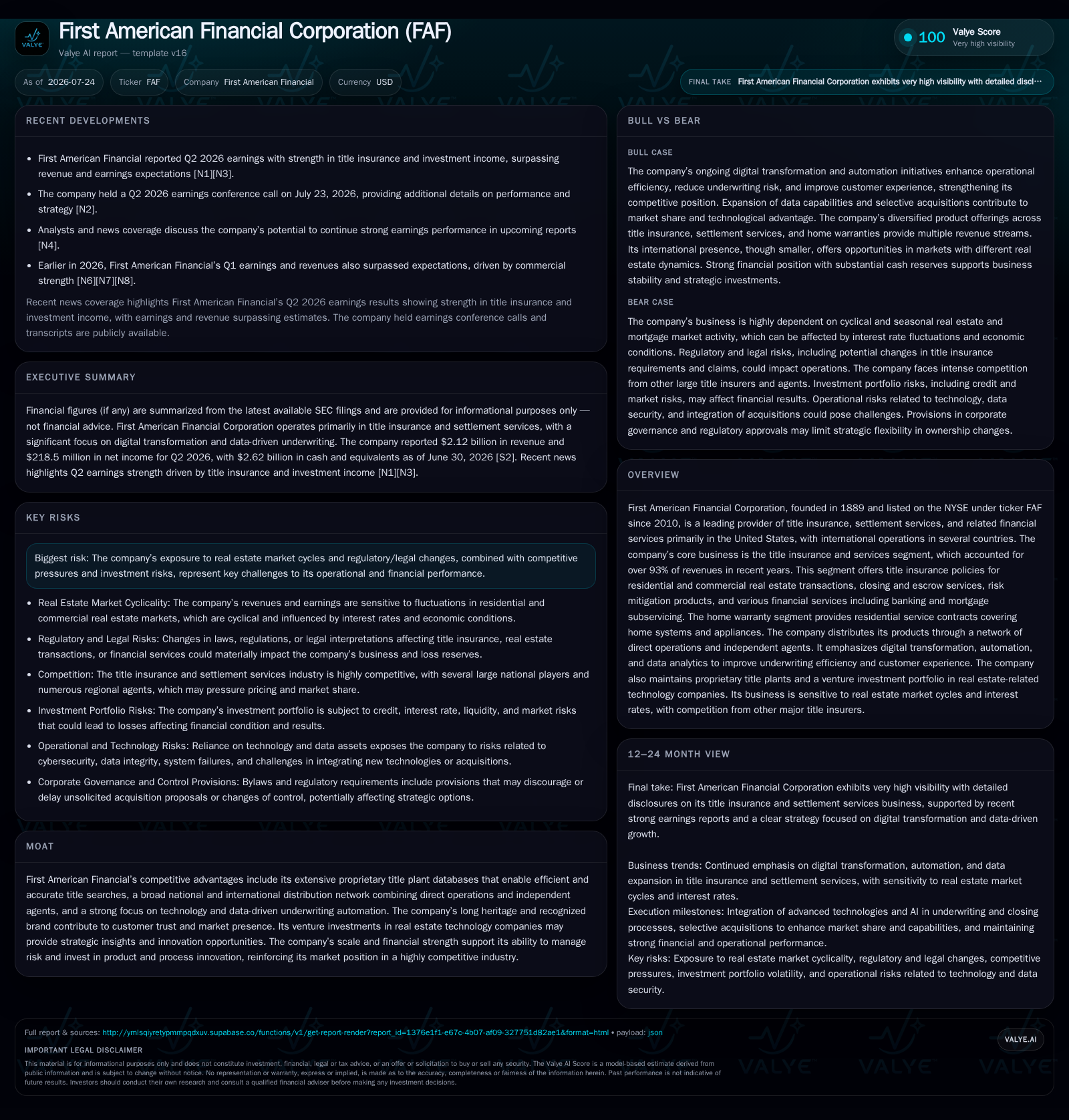
First American Financial reported strong second-quarter performance marked by stable title insurance policy volumes and robust investment income, signaling durable demand despite cyclical pressures in U.S. real estate markets. The company’s competitive moat is underscored by extensive proprietary title plants and accelerating digital transformation efforts that streamline underwriting and closing processes. Regulatory complexities and ongoing litigation remain key risks, but FAF’s capital position and scale enable strategic flexibility. Growth drivers include expanding mortgage subservicing portfolios and leveraging technology to improve efficiency and customer experience.
Q2 Operating Momentum Highlights Role of Proprietary Data Assets
In the second quarter ending June 30, 2026, First American Financial (FAF) demonstrated operational strength with title insurance revenues exceeding expectations alongside robust investment income from its securities portfolio [S2], [S3], [N1]. The number of title insurance policies issued remained stable despite ongoing cyclical softness in the broader U.S. residential real estate market. This stability underscores the enduring value of FAF’s transaction-linked revenue model—where premiums and fees flow directly from residential and commercial property transactions processed through the Company’s proprietary data infrastructure. The firm’s ability to generate solid returns during this period signals durable demand anchored by its extensive title plant databases that enable efficient risk assessment and underwriting automation.
This performance confirms FAF's strategic advantage derived from scale—both in data asset breadth across multiple jurisdictions and in capital deployment capacity—that smaller regional competitors struggle to replicate. Tracking upcoming quarterly policy counts relative to industry transaction volumes will be critical to gauge whether FAF can sustain this momentum in a fluctuating market.
Title Insurance Economics: Transaction Linkages and Pricing Power Trends
FAF's revenue generation depends primarily on transaction volume sensitivity tied to U.S. real estate activity levels, particularly within residential purchase markets which continue to be sluggish yet steady in Q2 2026 [S1], [S2]. Title insurance premiums fluctuate based on the number of policies issued paired with average premium per policy—a function influenced by factors such as property values, geographical mix, product complexity, and regulatory rate approvals. Escrow and closing service fees complement premium income but are also transaction-dependent.
The company manages underwriting risk via proprietary title plants which minimize losses stemming from title defects or litigation claims. The underwriting expense ratio benefits when higher automation reduces manual labor costs associated with title searches and examination. FAF's recent filings indicate relatively stable loss ratios with ongoing investments to streamline the underwriting process suggesting pricing power remains resilient despite competitive pressures from both national players like Fidelity National Financial (FNF) and regional insurers seeking local niche dominance.
Margins depend heavily on maintaining disciplined underwriting standards while adapting rates in regulated states—a challenge given varying state insurance commission requirements that can restrict rapid price adjustments [S4], [S15]. Persistent monitoring of loss ratios versus earned premiums will confirm risk management effectiveness.
Digital Transformation Enhances Operational Efficiency and Risk Mitigation
FAF continues accelerating initiatives leveraging technology to transform traditionally manual title insurance and closing processes into streamlined digital experiences for clients across direct operations and independent agency channels [S1], [S2]. Automation upgrades encompass enhanced underwriting algorithms powered by artificial intelligence analyzing complex title plant data to reduce time-to-issue policies while improving accuracy.
Digitizing closing and escrow workflows decreases cycle times for settlements while improving communication among buyers, sellers, lenders, and real estate agents—an operational improvement that directly impacts customer satisfaction metrics. Increased digital adoption correlates with lower underwriting expense ratios as fixed overhead costs are spread over higher automated throughput volumes.
Such investments are crucial for FAF to maintain operational leverage amid flat or declining transaction growth environments while staying ahead of competitors who may lag in tech deployment. The company's focus on IT-driven efficiencies also limits indemnity claims exposure by better detecting title defects early through deeper data analytics.
Navigating Regulatory Complexity: Compliance as a Competitive Moat?
Heightened regulatory oversight presents persistent challenges for FAF including constraints on pricing flexibility due to state-by-state rate approval processes coupled with increased capital adequacy requirements imposed on regulated insurance entities within its holding structure [S4], [S6], [S8], [S9], [S20]. These factors can delay or limit rate increases needed to offset inflationary cost pressures or compensate for adverse loss experience.
Additionally, FAF faces ongoing class action lawsuits linked to industry practices around settlement service charges or disclosure obligations. While the company maintains legal reserves against such contingencies, outcomes remain uncertain. Stricter government scrutiny notably by Consumer Financial Protection Bureau (CFPB) further complicates compliance demands potentially increasing operating costs or limiting certain fee structures.
However, FAF's scale affords it access to expert regulatory departments capable of anticipating changes swiftly; combined with adherence to complex licensing regimes across numerous states provides a durable barrier shielding against smaller operators less prepared for regulatory rigor.
Comparative Technology Adoption Positions FAF Among Top National Peers
Within its peer set—namely Fidelity National Financial (FNF), Old Republic International Corporation (ORI), and Stewart Title—FAF distinguishes itself through substantial investments in digital platforms integrating proprietary database expansions with AI-enabled underwriting tools as disclosed in recent annual disclosures [S1].
While FNF commands significant market share broadly similar in scale to FAF’s footprint, FAF emphasizes innovation-led operational efficiency gains aimed at enhancing agent-channel relations through improved product integration such as banking services tailored for agents’ workflows. This holistic approach strengthens agent retention by offering comprehensive solutions beyond traditional title insurance products.
The emphasis on technological modernization offers defensibility over regional providers who may lack capital resources or systems reach necessary for full automation rollout. Tracking third-party assessments or customer satisfaction indices could confirm whether these tech-driven service advancements translate into competitive positioning gains over time.
Growth Opportunities Amid Market Cyclicality: Mortgage Subservicing & Beyond
Recognizing inherent cyclicality tied directly to transactional volume shifts in core markets, FAF strategically grows ancillary revenue streams including mortgage subservicing portfolios alongside expanding settlement-related financial services domestically and internationally [S1], [N1]. These segments generate recurring fee income less sensitive to immediate real estate purchase/sale fluctuations.
Mortgage subservicing contributes not only diversification benefits but also cross-selling opportunities accessing customers along the lending continuum. Expansion into international markets further opens growth avenues leveraging global proprietary databases adapted for jurisdictional nuances particularly in Canada, UK, Australia, South Korea, where FAF has a physical presence.
Growth tracking will require monitoring quarterly additions to servicing portfolio size plus uptake rates for complementary products such as banking services embedded within closings – metrics currently highlighted by management commentary during earnings calls.
Risks From Market Volatility & Litigation: Watchpoints for Investors
Despite stable Q2 results, FAF remains exposed to risks arising from real estate market volatility which can suppress title insurance policy count growth especially if interest rates rise further suppressing housing affordability or dampening commercial property deals [S4], [S6]. Such downturns would pressure revenue volumes directly impacting top-line results.
Ongoing litigation risks including class actions threaten margin dilution via legal costs or settlements reducing net earnings quality. Reserve adequacy for incurred but not reported claims presents uncertainty especially given long-tail nature of some policies where expected ultimate loss estimates might shift materially under stressed economic conditions or evolving legal environments affecting property titles (e.g., changes related to Native American land rights cases) [S23], [S25].
Regulatory developments imposing new constraints on rate-setting or product offerings could necessitate altered pricing strategies potentially depressing revenues in highly regulated states like California or Texas where a significant portion of premiums originates.
Financial Profile Discussion: Liquidity Supports Strategic Flexibility
At quarter end June 30, 2026, First American Financial reported strong liquidity positions with $2.62 billion in cash plus cash equivalents on hand against negligible total debt historically approximated at zero or slightly negative net debt after adjusting for cash balances per available data points ([F1]). This balance sheet strength affords considerable maneuverability supporting continued investments into digital innovation initiatives as well as providing cushion against episodic adverse claim payments or regulatory-induced capital calls.
The absence of meaningful leverage mitigates refinancing risk while enabling potential opportunistic acquisitions aimed at expanding proprietary database assets or acquiring technological capabilities complementary to existing platforms. Maintaining conservative leverage amid cyclical uncertainties aligns with prudent risk management typical within large-scale national insurers seeking steady returns without excessive volatility exposure.
Disclaimer: This analysis is based solely on publicly available SEC filings dated through July 23, 2026, related news reports up to July 24, 2026, industry knowledge frameworks applied contextually without investment advice or price forecasts.
Disclaimer: This is research-only, informational analysis and not investment advice. It may include AI-generated interpretation and general industry context. Always verify important details using primary sources.

Comments