
Family Office of America: Acquisition-Led CPA Consolidation Meets Early-Stage Liquidity and Execution Hurdles
Family Office of America, Inc. is pursuing a roll-up strategy in the fragmented CPA and family office services sector, aiming to provide integrated wealth management solutions through acquisitions.
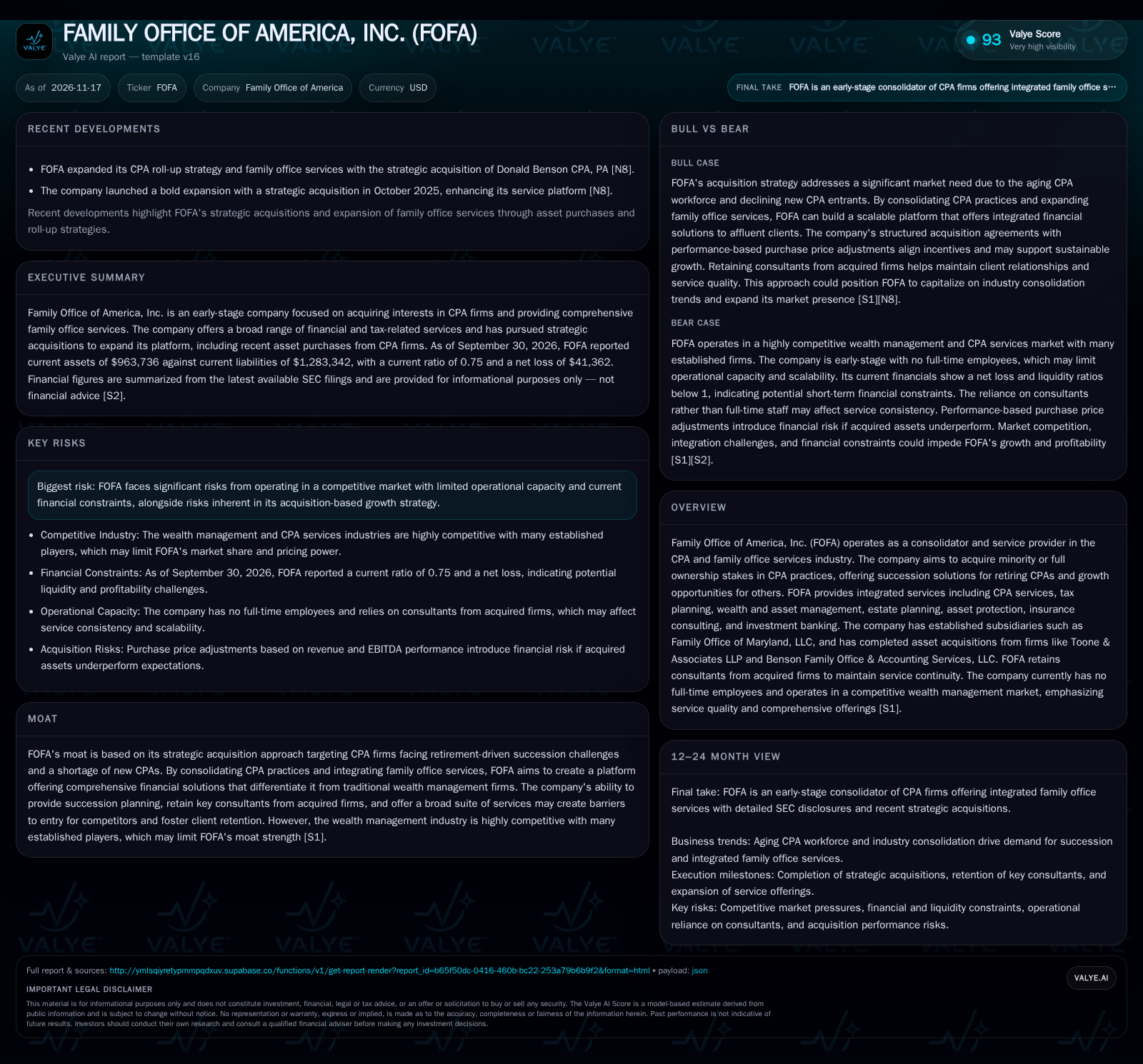
FOFA is an early-stage consolidator acquiring CPA practice assets and offering integrated family office services, targeting succession and growth for CPA firms. The scalability of its consultative approach and the financial performance of acquired assets are pivotal watchpoints as industry consolidation accelerates. [S1] [S2]
Family Office of America, Inc. (FOFA) seeks to capitalize on the growing need for succession solutions among CPA firms by acquiring interests in practices and offering a comprehensive suite of family office services. With recent acquisitions in Maryland and a structure that ties purchase price to post-deal performance, FOFA is positioning itself as a consolidator in a $147.5 billion CPA industry.
Recent Acquisitions and Early-Stage Structure Define FOFA’s Strategic Posture
Family Office of America has executed two notable asset acquisitions since late 2025: one from Toone & Associates LLP for $1.5 million, and another from Benson Family Office & Accounting Services, LLC for $353,750, both with installment payments and adjustments tied to revenue and EBITDA performance. These deals reflect FOFA's focus on acquiring non-attest accounting service assets and retaining the principals of acquired firms as consultants for extended periods—two years for Bruce Toone and four years for Donald Benson. As of September 30, 2026, FOFA's balance sheet shows current assets of $963,736 against current liabilities of $1,283,342 (current ratio 0.75), and a net loss of $41,362. The company currently has no full-time employees, operating instead through consultant arrangements. These facts highlight an early-stage consolidator model with both executional ambition and clear financial and operational constraints. [S1] [S2]
How FOFA’s Acquisition and Service Model Could Generate Value (and Where It May Strain)
FOFA’s business model targets monetization through two primary avenues: acquiring CPA practice assets—potentially up to full ownership—and layering integrated family office services on top of the acquired client base. This approach aims to capture both the recurring revenue streams typical of CPA tax and advisory services and the higher-margin, fee-based income associated with wealth management and estate planning. Performance-based purchase price adjustments tie acquisition outflows to realized post-acquisition revenue and profitability, which could mitigate overpayment risk but also introduce volatility if acquired practices underperform.
In theory, this model can create operating leverage: fixed costs (such as consultant retainers and back-office infrastructure) could be spread over a growing asset base as more practices are acquired. However, the lack of full-time employees and reliance on consultants may limit FOFA’s ability to standardize processes, cross-sell services, or build a unified brand experience—potentially constraining scalability and margin expansion. The capital intensity of acquisitions, alongside cash outlays for consultant agreements and integration, means that FOFA’s funding requirements could be substantial before the business reaches sustainable positive cash flow.
Fragmented Competition and the Challenge of Differentiation in Wealth Management
FOFA operates in one of the most competitive segments of professional services, contending not just with local and regional CPA firms but also with national consolidators, RIA aggregators, and diversified financial advisory platforms. Barriers to entry in traditional CPA services are relatively low, but differentiation in integrated family office offerings hinges on advice quality, breadth of services, fee transparency, and the ability to maintain trusted relationships.
The company’s strategy to provide succession and transition solutions for retiring CPAs addresses a real market need given demographic trends, but larger consolidators and established wealth management firms may have greater resources, brand credibility, and technology platforms to attract both clients and acquisition targets. FOFA’s ability to retain acquired principals as consultants can help preserve client relationships in the near term, but it may struggle to match the service depth, digital experience, or capital backing of leading competitors. The key competitive challenge will be to convert consultant-led relationships into a scalable, branded platform that can compete on more than just local continuity.
If FOFA Executes Efficient Consolidation and Retention, Platform Economics Could Inflect
A favorable trajectory for FOFA would see it successfully acquiring several more CPA practices, efficiently integrating their client bases, and cross-selling higher-margin family office and wealth management services. If the company can demonstrate that its consultant retention model preserves client loyalty and enables seamless service delivery, it could achieve revenue growth and margin uplift as fixed costs are leveraged across a broader base. The performance-based installment structure for acquisitions may allow FOFA to limit downside risk while aligning incentives with acquired principals.
Evidence that would confirm this scenario includes accelerating top-line revenue growth, narrowing or reversing net losses, and positive feedback or retention rates from acquired client bases. A transition from consultant-heavy operations to a hybrid or full-time employee model—if achieved without losing client relationships—would further validate scalability. Announcements of additional acquisitions with favorable terms, evidence of successful integration, and progress toward positive cash flow would all support the upside thesis.
Early-Stage Acquisitions Yield Modest Growth but Expose Operational Growing Pains
The most plausible outcome is a period of modest expansion, where FOFA completes a handful of additional acquisitions but faces delays or challenges integrating disparate practices. The consultant-based model may enable near-term continuity but could struggle to deliver consistent client experience or unlock meaningful cross-sell synergies.
In this scenario, FOFA’s revenue base grows gradually, but operating costs—including consultant fees, acquisition outlays, and integration expenses—keep net margins thin or negative. Evidence confirming this outcome would include slow improvement (or stagnation) in operating losses, ongoing reliance on consultants without movement toward permanent staff, and deal flow that remains limited to small or regional practices. Difficulty in scaling technology, brand, or service consistency would also corroborate this middle path.
Liquidity Pressures and Consultant Reliance Undermine Integration and Client Retention
The absence of full-time employees could lead to service inconsistencies, missed cross-sell opportunities, and client attrition, particularly if consultant agreements expire or are not renewed on favorable terms.
This scenario would be confirmed by rising payables, missed installment payments on acquisitions, further deterioration in current or cash ratios, or disclosures of lost client relationships. An inability to raise capital or secure credit to fund future deals, or the departure of key retained consultants, would also signal downside risk. Prolonged net losses without a clear path to profitability or scale would indicate that the roll-up strategy is not translating into sustainable economics.
Milestones That Will Clarify FOFA’s Platform Ambition and Execution Risk
Acquisition cadence and average deal size: The frequency and financial terms of new CPA practice acquisitions will reveal both FOFA’s access to targets and its capital discipline.
Client retention and satisfaction metrics: If disclosed, data on client retention rates post-acquisition, and qualitative feedback from acquired client bases, would help assess the effectiveness of consultant-led integration.
Revenue and margin trends: Sequential growth in revenue, improvement in gross and operating margins, and progress toward profitability are critical financial signals.
Transition to a more permanent staffing model: Any move to hire full-time employees or build out a core team would test the scalability of the business and reduce reliance on external consultants.
Cash flow from operations: Sustainable positive operating cash flow would demonstrate that the roll-up model is maturing beyond early-stage dependence on external funding.
Integration expenses and synergies: If disclosed, details on integration costs and realized cost or revenue synergies from acquisitions would clarify the economics of consolidation.
Consultant retention and succession transitions: Monitoring the continuity and renewal of consultant agreements is essential, as loss of key relationships could disrupt service delivery and client loyalty.
Disclaimer: This is research-only, informational analysis and not investment advice. It may include AI-generated interpretation and general industry context. Always verify important details using primary sources.

Comments