
FullPAC, Inc.: Severe Liquidity Strain Overshadows Any Potential in Political Engagement Technology
With liabilities vastly outweighing assets and no clear operational milestones, the company’s ability to capitalize on expanding political campaign spending remains highly uncertain.
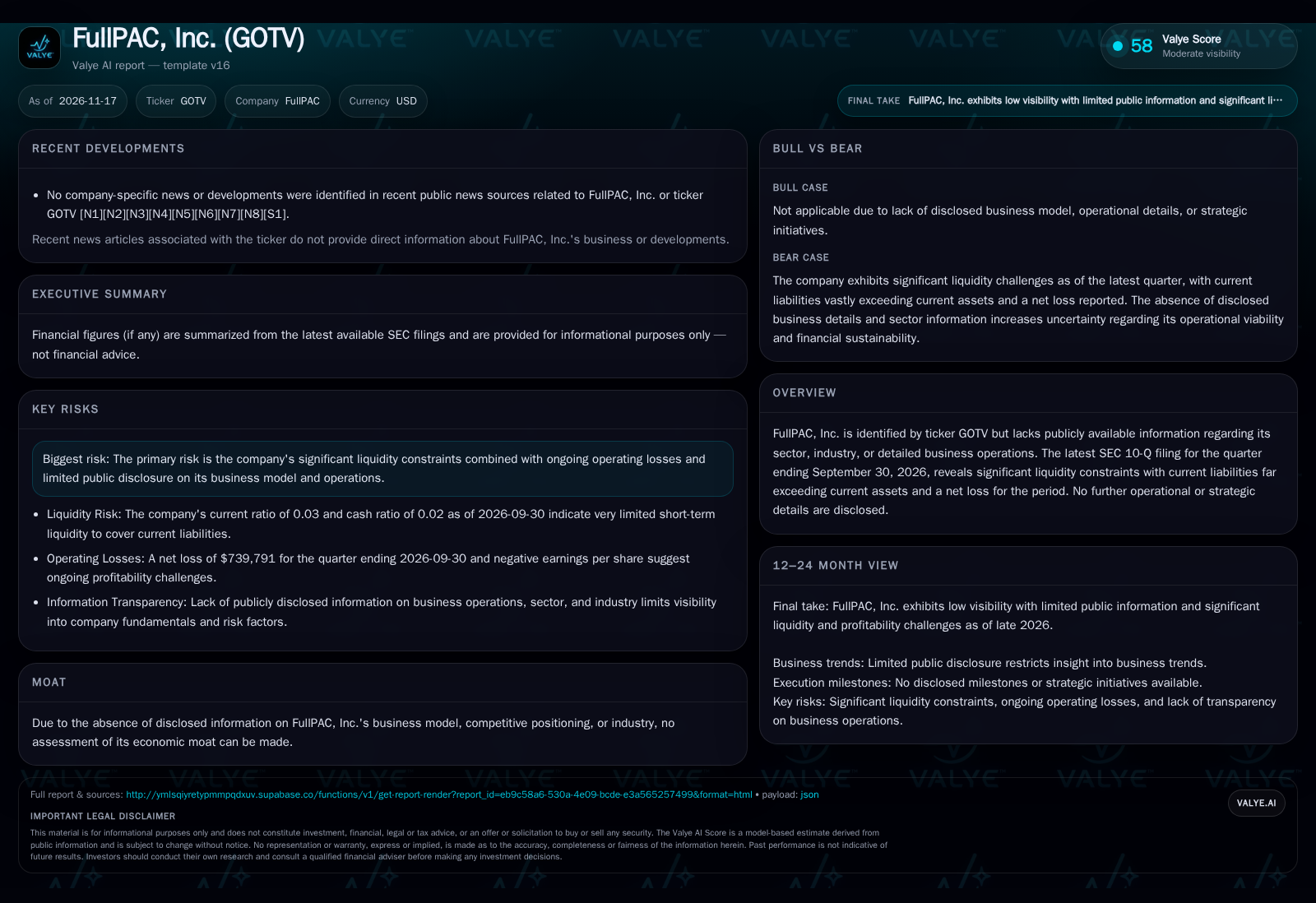
FullPAC, Inc. (GOTV) faces a critical liquidity shortfall, reporting just $59,815 in cash and $88,519 in current assets against $3 million in current liabilities as of September 2026, and a quarterly net loss of $739,791. The absence of clear business disclosures or operational detail compounds significant uncertainty over its future viability or ability to benefit from the growing U.S. political campaign services market. [S1]
FullPAC, Inc. (GOTV) stands at a crossroads defined more by what is unknown than what is disclosed. As of September 2026, the company’s SEC filings reveal a balance sheet under acute pressure: current liabilities exceed assets by a wide margin, while persistent operating losses continue. With no detailed public information about its actual business operations, sector, or customer base, investors are left to speculate about its ability to participate in the expanding political campaign services market. The combination of financial distress and a lack of transparency poses fundamental questions about FullPAC’s operational viability and strategic prospects.
FullPAC’s Financial Distress: The Immediate Challenge
The most pressing fact about FullPAC, Inc. is its acute liquidity crisis. As of September 30, 2026, the company reported only $59,815 in cash and cash equivalents, and $88,519 in current assets, set against $3,022,685 in current liabilities. The company also posted a net loss of $739,791 for the quarter, with negative earnings per share of -$0.03. No material changes to risk factors or new developments have been disclosed, and there is no visible business model or operational detail in public filings. These facts sharply limit visibility and raise fundamental questions about FullPAC’s ability to continue as a going concern. [S1]
Revenue Mechanics and Cost Structure: What Could Matter If FullPAC Is Operational
Without concrete disclosures, FullPAC’s business economics can only be inferred from industry context and the limited clues in its filings. The political engagement technology sector—if that is indeed FullPAC’s focus, as suggested by passing references to campaign engagement—tends to generate revenue through a mix of software subscriptions, campaign-specific service contracts, and data-driven outreach solutions. Pricing is often event-driven (election cycles, ballot initiatives) and may be lumpy, with periods of high campaign activity interspersed with quieter quarters.
On the cost side, such platforms typically incur substantial fixed costs: software development, data center hosting, compliance, and technical support. Variable costs may include carrier messaging fees and campaign-specific services. Capitalized software development appears minimal ($12,141 net as of September 2026), suggesting either a legacy platform or limited ongoing investment. The absence of revenue, customer, or contract disclosures prevents any assessment of gross margins, operating leverage, or capital requirements. With current liabilities so far outstripping assets, FullPAC would likely require either a rapid injection of external capital or a substantial turnaround in underlying operating cash flow to achieve sustainability. [S1]
If FullPAC is indeed operating within the political engagement technology sector, the timing and predictability of revenue recognition could be highly uneven due to the cyclical nature of election cycles. Moreover, the reliance on campaign-specific contracts might lead to client concentration risks, where losing a few key clients could disproportionately impact revenues. The presence or absence of recurring revenue streams, such as multi-year subscription contracts, would materially affect financial stability and valuation prospects. Without visibility into these dynamics, assessing the sustainability of any revenue base remains speculative.
Assessing Competitive Position Without a Playbook
The lack of transparency around FullPAC’s offerings, customer base, or go-to-market strategy makes it impossible to evaluate its competitive position directly. In the broader political campaign technology space, companies compete on data accuracy, platform reliability, compliance with evolving regulations, and integration with campaign management tools. Barriers to entry can be moderate to high for established enterprise-grade providers but are lower for commodity messaging or basic outreach tools.
If FullPAC operates in this arena, it would face competition from both established political technology vendors and generic enterprise communication platforms. Potential advantages—such as proprietary voter data, unique distribution channels, or regulatory compliance features—remain unsubstantiated. In this context, the absence of public information is itself a competitive disadvantage, undermining credibility with potential clients and partners. The question is whether FullPAC has any differentiated position or if it is simply unable (or unwilling) to disclose it.
Competitive differentiation in political technology often hinges on data quality, compliance robustness, and integration capabilities with broader campaign management ecosystems. If FullPAC lacks proprietary data assets or advanced analytics, it may be relegated to competing primarily on price or basic functionality, which is challenging in a market with established players and low switching costs. Additionally, regulatory compliance is a moving target in this sector, requiring ongoing investment in legal and technical safeguards. Failure to adapt could result in reputational damage or legal penalties, further eroding competitive standing. The absence of disclosed compliance frameworks or certifications raises questions about the company’s preparedness to navigate these complexities.
How a Turnaround Could Unfold—If There’s Hidden Value
The best-case scenario for FullPAC would involve previously undisclosed commercial traction or a strategic pivot that leverages the secular growth in U.S. political campaign spending.
Confirmation of this scenario would require new disclosures: evidence of signed contracts, a clear product roadmap, revenue backlog, or a successful funding event. Falsification would be rapid if no such disclosures emerge, or if the company is forced into restructuring, asset sales, or bankruptcy proceedings due to its overwhelming short-term obligations. [S1]
Ongoing Uncertainty and Stagnation in the Absence of Change
The most plausible scenario given current evidence is extended operational stagnation and uncertainty. FullPAC continues to operate with severe liquidity constraints, making only minimal investments in product or business development. Without new capital or a meaningful uptick in revenue, the company is likely to remain in a holding pattern, unable to invest in growth or even maintain current operations at scale.
Signs confirming this scenario would include continued silence on business developments, further net losses, and the absence of new capital raises or strategic partnerships. Any modest improvement—such as a small bridge loan or cost-cutting—might extend runway by a quarter or two but would not fundamentally alter the risk profile. Falsification would require a clear break from this status quo, such as a major contract win, a strategic transaction, or a shift in disclosure practices. [S1]
Liquidity Exhaustion and Potential Forced Restructuring
Given the extreme imbalance between assets and liabilities, the most adverse scenario is that FullPAC exhausts its cash resources and is unable to meet its obligations. Without new funding or a sudden improvement in operating cash flow, the company may default on payables, face legal actions from creditors, or be forced into bankruptcy or liquidation.
Confirmation of this scenario would include disclosures of missed payments, auditor going-concern warnings, or filings for restructuring or bankruptcy protection. The absence of any public evidence of new capital or material business wins would reinforce the risk of imminent financial distress. [S1]
What Would Clarify FullPAC’s Outlook and Test Its Survival Odds
Any disclosure of new revenue-generating contracts, customer wins, or backlog would help clarify whether FullPAC has commercial traction or remains dormant.
Announcements of capital raises, debt restructuring, or strategic partnerships would be critical to assessing whether the company can address its liquidity crisis.
A detailed description of FullPAC’s business model, target market, and competitive differentiation—if disclosed—would allow for a genuine assessment of long-term viability.
Quarterly trends in net income, cash flows from operations, and changes in current assets/liabilities would indicate whether the company’s financial distress is worsening or improving.
Evidence of cost reductions, layoffs, or restructuring efforts would signal management’s response to ongoing losses and liquidity stress.
Auditor comments on going concern or subsequent events in SEC filings could provide early warning of insolvency or strategic inflection points.
Any regulatory, legal, or compliance issues—especially those tied to campaign technology or data privacy—would add further risk or indicate operational headwinds.
A useful metric would be customer concentration or retention rates, if ever disclosed, to understand revenue stability and client dependence.
Disclaimer: This is research-only, informational analysis and not investment advice. It may include AI-generated interpretation and general industry context. Always verify important details using primary sources.

Comments