
Trutankless: Scaling Ambitions Collide with Severe Liquidity and Execution Pressures
The company’s future hinges on its ability to secure external capital, improve operational controls, and carve out a defensible niche in a competitive market.
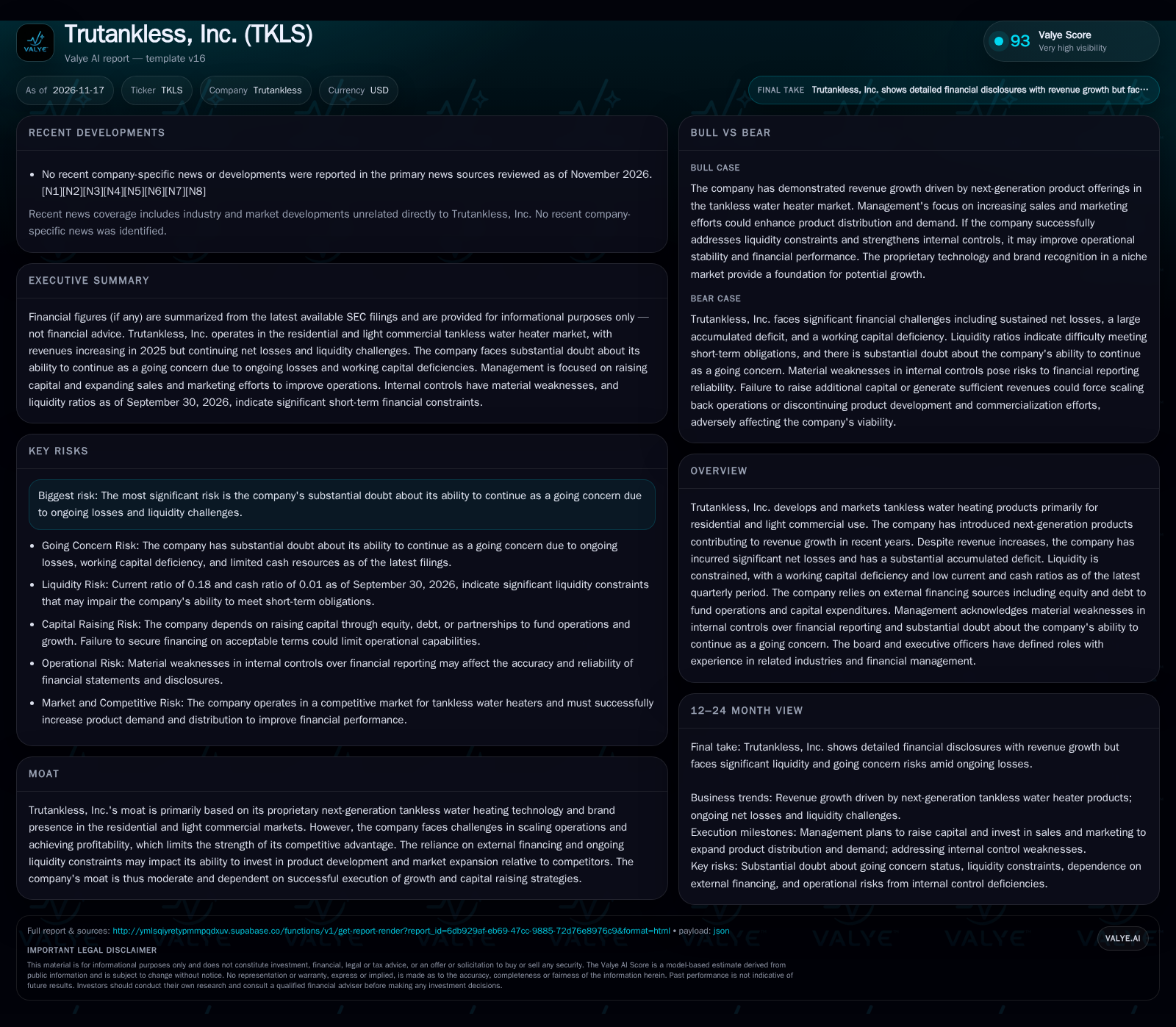
Trutankless, Inc. lifted revenues sharply in 2025 through next-generation products but remains constrained by substantial net losses, a severe working capital deficiency, and persistent going concern risk. The company’s immediate future depends on raising capital and executing on sales and operational discipline amid material internal control weaknesses. Success hinges on converting product innovation into sustainable market traction and financial stability in a crowded competitive landscape. [S1] [S2]
Trutankless, Inc. has managed to deliver substantial top-line growth, driven by its next-generation tankless water heating products for residential and light commercial markets. However, the company’s persistent operating losses, severe liquidity shortfall, and internal control deficiencies have left its future in doubt. With an accumulated deficit exceeding $81 million and a critical reliance on external financing, Trutankless stands at a pivotal juncture: only successful capital raising and operational discipline can convert its technological potential into a viable business. The coming quarters will test whether product innovation can overcome entrenched financial and structural challenges.
Recent Financial Performance Reveals Acute Liquidity Crisis
Trutankless posted $1,082,887 in revenue for 2025—over four times its prior year’s figure—attributed to the introduction of next-generation products. Yet, this growth was accompanied by a net loss of $4,750,710 and a working capital deficiency of $10,612,370 as of year-end 2025. The company’s cash balance dwindled to just $21,619 by December 31, 2025. By September 30, 2026, the current ratio had fallen to 0.18 and the cash ratio to 0.01, underscoring a severe liquidity crunch. Management and auditors have expressed substantial doubt about Trutankless’s ability to continue as a going concern, given the lack of sufficient internally generated cash and persistent losses. [S1] [S2]
Product Innovation Meets Unforgiving Cost Structure
Trutankless’s business model relies on the sale of proprietary tankless water heating units, targeting residential and light commercial customers. While next-generation products have driven revenue growth, the cost of goods sold in 2025 ($1,040,865) nearly matched total sales, implying little to no gross margin expansion. Layered on top are sizable operating expenses—$3.6 million in 2025—including heavy consulting fees and G&A, which dwarf current revenue. This cost structure suggests a business with high fixed overhead relative to scale and limited operating leverage at current volumes.
The company’s ability to achieve profitability depends on rapidly scaling sales to absorb fixed costs and improving gross margins, either through pricing power, supply chain efficiencies, or product mix. The company reported cash and liquidity metrics for the period; these figures do not by themselves establish operating runway, investment capacity, financial flexibility, or financing capacity. This dependence raises capital access and dilution risks, particularly given the company’s weak balance sheet and going concern status. Without a step-change in sales volume or structural cost reduction, ongoing losses—and the need for repeated financing—appear likely.
A critical factor influencing Trutankless’s path to profitability is the scalability of its production processes. Given the high fixed overhead costs, the company’s ability to negotiate favorable supplier contracts or to optimize manufacturing throughput could substantially impact gross margins. Economies of scale typically reduce per-unit costs, but only if production volumes reach thresholds that justify fixed cost absorption. Conversely, if demand fluctuates or supply chain disruptions occur, fixed costs remain burdensome, eroding financial performance. Therefore, operational efficiency improvements and supply chain resilience are essential to underpin sustainable margin expansion.
Moreover, the company’s pricing strategy will play a pivotal role in its economic model. In a commoditized market segment, pricing power is often limited, especially for smaller players without brand recognition or proprietary differentiation. If Trutankless can leverage unique product features to command premium pricing, it may offset some cost pressures. However, this depends on customer willingness to pay and effective communication of value propositions. Should competitive pricing pressures intensify, the company may be forced into discounting, further compressing margins and exacerbating liquidity challenges.
Navigating a Crowded Market with Technology and Brand
The tankless water heater market is mature and highly competitive, populated by established appliance manufacturers and specialized brands. Trutankless’s competitive edge is rooted in its proprietary product technology and focus on next-generation features, which may appeal to tech-savvy homeowners or light commercial buyers seeking energy efficiency and compact design.
However, larger incumbents typically benefit from scale, established distribution networks, and stronger brand recognition. Trutankless’s moderate moat is vulnerable to these larger players’ pricing, marketing, and R&D advantages. The company’s ability to carve out share will depend on its product’s perceived differentiation, the effectiveness of its sales and marketing investments, and its agility in responding to changing building codes and customer preferences. If Trutankless can establish a defensible niche or secure partnership/distribution deals, it may mitigate some competitive pressures, but the risk of technology substitution and commoditization remains high.
Another dimension of competitive positioning is the company’s agility in innovation cycles relative to incumbents. Larger competitors often have more extensive R&D budgets and established product pipelines, enabling them to iterate rapidly and incorporate emerging technologies. Trutankless’s success may hinge on its capacity to innovate faster or more effectively in niche segments, such as integrating smart home compatibility or advanced energy-saving features. However, innovation alone does not guarantee market adoption; the company must also demonstrate reliable product performance and customer support to build trust and brand loyalty.
Additionally, regulatory and environmental trends could influence competitive dynamics. Increasingly stringent energy efficiency standards and environmental regulations may favor advanced tankless water heaters, potentially expanding market opportunities. If Trutankless can align its product development with evolving codes and certification requirements, it may gain a competitive edge. Conversely, failure to anticipate or comply with such standards could limit market access or increase costs. Monitoring regulatory shifts and proactively adapting product design will be critical to sustaining relevance in a tightly contested market.
Capital Infusion and Distribution Expansion Drive Turnaround
The most favorable scenario for Trutankless is one in which it successfully raises sufficient capital to shore up liquidity, invest in targeted sales and marketing campaigns, and address internal control weaknesses. This capital could enable the company to expand its distribution footprint, forge new channel partnerships, and accelerate market penetration, particularly if next-generation products resonate with buyers and deliver tangible performance or efficiency benefits.
Confirmation of this scenario would come from announcements of sizable equity or debt financings, strategic partnerships with distributors or builders, and subsequent sustained revenue growth outpacing increases in operating expenses. Additional evidence would be a measurable improvement in gross margins, reflecting either higher pricing or lower production costs, and a narrowing of net losses quarter-over-quarter. The scenario would be falsified if capital raising efforts fail, liquidity deteriorates further, or if revenue momentum stalls despite increased marketing spend.
Incremental Growth Offset by Persistent Structural Challenges
The most plausible trajectory is one where Trutankless manages to secure short-term funding—perhaps at dilutive terms—allowing it to continue operations and modestly grow revenues. However, the combination of thin gross margins, high fixed overhead, and competitive pressure means that each dollar of sales delivers limited incremental profit, prolonging the company’s path to breakeven.
In this scenario, revenue may grow, but so do costs, and the company remains dependent on external capital. Evidence supporting this path would include ongoing but modest capital raises, gradual sales growth, and net losses that improve only incrementally. Any sustained improvement in internal controls or cost discipline would be a positive sign, but without a structural shift in either revenue scale or cost base, the company’s financial position remains fragile. Conversely, a sharp deterioration in sales or inability to access capital would signal a deviation from this baseline.
Liquidity Exhaustion Forces Restructuring or Business Cessation
The adverse scenario sees Trutankless unable to raise the necessary capital to fund ongoing operations. In this case, the company’s reported cash balance and negative working capital rapidly translate into missed supplier payments, inability to fulfill orders, or breaches of contractual obligations. The company may be forced to curtail product development, lay off staff, or pursue asset sales or bankruptcy protection.
Confirmation would come from failed or delayed financing efforts, rapid depletion of remaining cash, and public disclosures regarding operational cutbacks or formal warnings of potential insolvency. A further weakening of internal controls or loss of key personnel could accelerate this process. This scenario becomes more likely if revenue growth stalls or reverses, or if macro conditions tighten access to capital markets for small, loss-making firms.
Milestones That Will Shape Trutankless’s Next Chapter
The size, timing, and terms of any announced equity or debt financing—especially if sufficient to address near-term obligations.
Quarterly revenue growth rates and whether sales of next-generation products continue to accelerate or plateau.
Gross margin progression: improvements here would signal better pricing discipline or operational efficiency.
Reduction in operating expenses, particularly consulting and G&A, as a share of revenue.
Progress updates on remediation of internal control weaknesses, including external audit commentary if disclosed.
Distribution/channel partnership announcements that could expand market reach or provide validation.
Updates on working capital trends, especially accounts payable and receivable balances if disclosed.
Management turnover or changes in board composition, which could signal confidence or distress.
Disclaimer: This is research-only, informational analysis and not investment advice. It may include AI-generated interpretation and general industry context. Always verify important details using primary sources.

Comments