
Odysight.ai: AI-Driven Predictive Maintenance at an Inflection Point in Aerospace and Industrial Adoption
Recent agreements with Boeing and Elbit Systems signal Odysight.ai’s progress toward commercial validation of its AI-based visual monitoring platform, but early-stage revenues and ongoing net losses highlight the execution risks in transitioning from hardware sales to a scalable, recurring-revenue model. The company’s ability to secure multi-year software contracts and navigate geopolitical headwinds in Israel will determine whether its patented technology becomes a sector standard or faces protracted commercialization.
Odysight.ai is gaining traction in aerospace and defense with its AI-powered visual monitoring solutions, as evidenced by a Boeing pilot and new orders from Elbit Systems. However, its low revenue base and net losses reflect early-stage risks. The transition to recurring software revenue and resilience to geopolitical disruptions are critical to unlocking the company’s long-term potential. Watch for evidence of recurring contracts, expanded deployments, and margin expansion as signals of a sustainable business model.
Odysight.ai sits at a pivotal moment: its AI-powered visual monitoring systems are being tested by industry giants like Boeing and deployed by leading defense contractors, suggesting early validation of its technology in demanding sectors. Yet, the company’s financials reveal the realities of commercialization, with limited revenue and sustained losses as of late 2026. Whether Odysight.ai can transition from hardware-centric pilots to a recurring-revenue software model—while managing geopolitical risks in Israel—will define its trajectory from promising innovator to established industry standard.
Boeing and Elbit Orders Mark Commercial Progress, But Revenue and Losses Highlight Early Stage
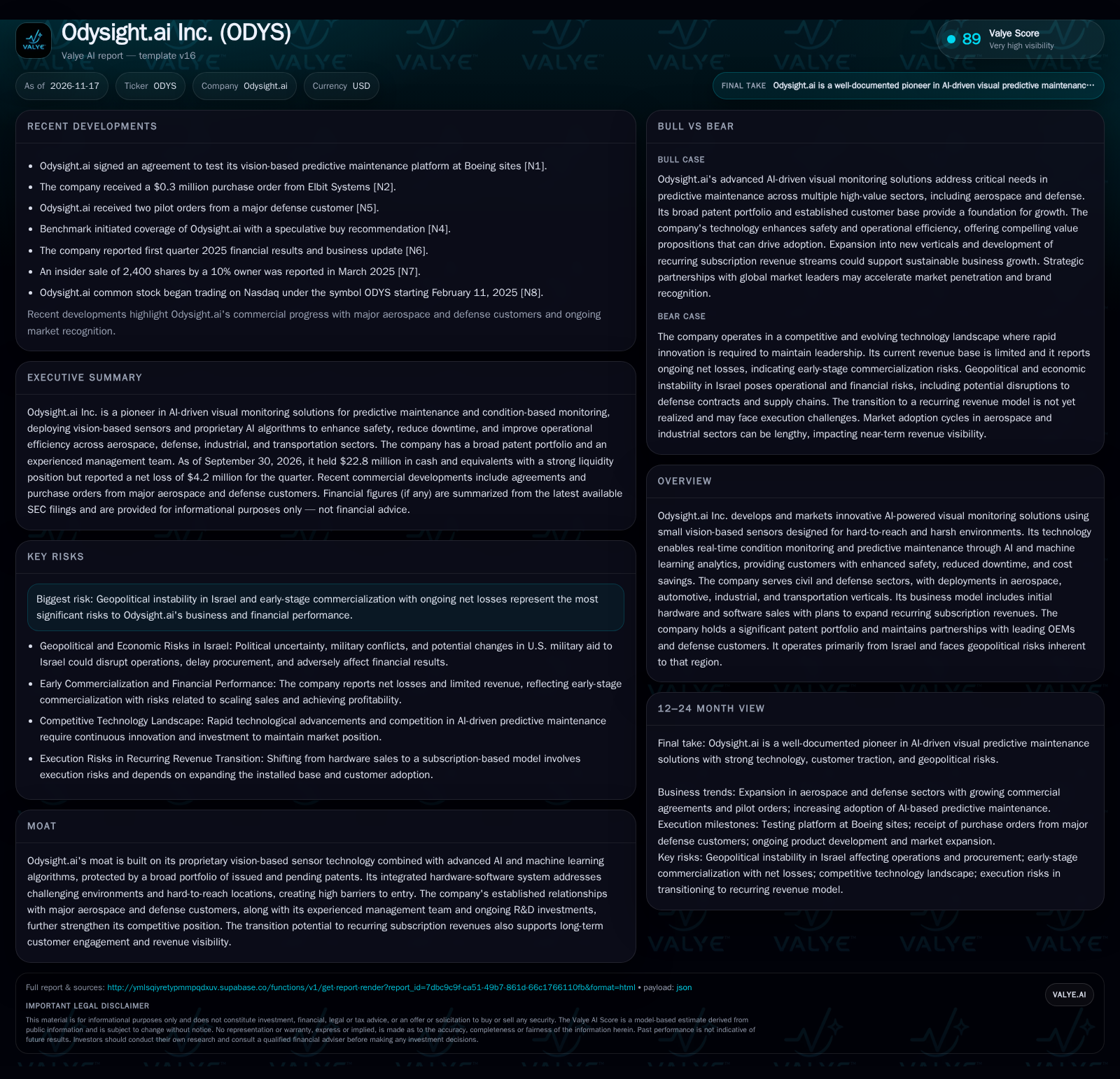
Odysight.ai recently signed an agreement to test its vision-based predictive maintenance platform at Boeing sites, a move that elevates its visibility and validation in the aerospace sector [N1]. Additionally, the company secured a $0.3 million purchase order from Elbit Systems, a major defense player [N2], and received two pilot orders from another large defense customer [N5]. These developments demonstrate the company’s ability to win pilots and initial orders from blue-chip customers, potentially paving the way for broader adoption.
Despite these wins, Odysight.ai remains in early commercialization: as of September 30, 2026, revenue was modest, and the company reported a net loss of $4.2 million for the quarter [S2]. Its cash and equivalents were $22.8 million, resulting in a high current and cash ratio, but this liquidity must be viewed in the context of ongoing losses and the significant investments required to scale [S2]. The company’s Nasdaq listing in early 2025 provides capital markets access but does not itself resolve the challenge of achieving recurring, profitable revenue [N8].
From Hardware Sales to Subscription Ambitions: Economics of the Predictive Maintenance Platform
Odysight.ai’s current business model is anchored in the sale of proprietary sensor kits and embedded software, yielding initial hardware revenue. The company’s strategic goal is to transition customers to multi-year software subscriptions for ongoing AI-driven analytics, which would provide recurring, higher-margin revenue streams post-warranty [S1]. This model is typical of industrial IoT and predictive maintenance, where upfront hardware deployments are often necessary to establish a data pipeline and prove value before software-as-a-service (SaaS) contracts can be secured.
The economics of this transition are compelling if executed: recurring software revenue provides operating leverage, higher gross margins, and revenue visibility. However, the company’s current revenue base is small, and the fixed R&D, sales, and support costs inherent in platform development create operating losses at low scale [S2]. Capital is needed to fund the sales cycle, product development, and customer pilots—especially given long adoption cycles in aerospace and defense. Upsell opportunities include expanded algorithmic functionality, additional vertical applications, and fleet management layers, but these too depend on initial deployments reaching critical mass [S1].
Proprietary Vision Sensors and Patents Offer Barriers—But Integration and Incumbent Counterforces Loom
Odysight.ai positions itself as a technology leader through a combination of proprietary vision-based sensors, advanced AI/ML analytics, and a substantial patent portfolio (19 issued, 63 pending) [S1]. This provides a defensible moat against direct technical imitation and supports differentiation in harsh or hard-to-reach environments where generic IoT solutions may fail.
However, the predictive maintenance market is intensely competitive, with established industrial automation, IoT, and enterprise software vendors deploying a range of sensor, analytics, and cloud-based monitoring solutions. Incumbents often have deeper integration with existing asset management systems, longer customer relationships, and larger sales forces. The challenge for Odysight.ai is to convert its technical edge into sticky deployments amid customer risk aversion and long procurement cycles, especially in aerospace and defense, where reliability and certification requirements are high. Technology substitution risk exists if alternative sensor modalities (e.g., acoustic, thermal) or more generalized AI platforms improve rapidly.
Widespread Adoption and Recurring Revenue Unlock Operating Leverage
The most favorable path for Odysight.ai is that successful pilots with Boeing, Elbit, and other defense customers convert into large-scale deployments and multi-year SaaS contracts. The company’s patented AI-driven visual monitoring becomes the potentially leading standard for predictive maintenance in aerospace and expands into industrial and transportation verticals. Upselling additional analytics, fleet management modules, and cloud services increases average revenue per customer, while the installed base generates sticky, recurring revenue streams.
Evidence that would confirm this scenario includes announcements of multi-year subscription contracts, a sharp increase in recurring software revenue versus hardware sales, expanded deployments across multiple OEMs or operators, and improving gross margins. Falsification would come from stalled pilot conversions, customer churn, or continued reliance on one-time hardware revenue.
Pilots Convert Gradually, Recurring Revenue Ramps Slowly Amid Adoption Friction
The most plausible outcome is that Odysight.ai’s technology sees incremental adoption: some pilots convert to broader deployments, but sales cycles remain long, especially in aerospace and defense. Recurring software revenue grows, but at a measured pace, as customers require extensive validation and integration with existing asset management or maintenance systems. Hardware sales and pilot projects continue to drive a significant portion of revenue in the near term.
Supporting evidence would include gradual growth in the installed base, modest but rising recurring revenue, and continued pilot or demonstration projects with new OEMs and industrial customers. If disclosed, metrics showing rising attach rates of software subscriptions to installed hardware would support this scenario. Falsification would occur if recurring revenue remains negligible or if customer wins are offset by pilot project non-renewals or cancellations.
Commercialization Delays, Geopolitical Shocks, or Competitive Leapfrogging Impede Scale
In a more adverse scenario, Odysight.ai struggles to move beyond pilots, with large customers delaying or declining broader rollouts due to integration complexity, budget constraints, or preference for incumbent providers. Prolonged sales cycles, coupled with ongoing operating losses, erode the company’s cash position before recurring revenue reaches breakeven scale. Geopolitical instability in Israel—such as military conflict or disruptions in U.S. defense aid—could directly impact customer procurement or the company’s operational continuity [S1].
Falsification would require clear signals of accelerating customer conversion and recurring revenue growth, even in the face of external headwinds.
Milestones That Will Reveal Odysight.ai’s Recurring Revenue Trajectory and Market Position
Conversion rate of pilot projects to full-scale deployments—if disclosed, this will show whether blue-chip testing leads to actual revenue growth and installed base expansion.
Proportion of total revenue derived from recurring software subscriptions versus hardware and pilot sales—this metric would indicate progress in the transition to a SaaS model.
Gross margin trends, particularly as the revenue mix shifts—rising margins would confirm operating leverage from software subscriptions.
New or expanded multi-year agreements with OEMs or large operators—announcements here would validate the business model and long-term revenue visibility.
Cash burn rate and updates on the company’s runway, especially if operating losses persist—critical for assessing the need for future capital raises.
Customer concentration and retention data, if disclosed, to assess revenue durability and dependence on a handful of large accounts.
Impact of geopolitical events in Israel on operations, supply chain, or customer procurement—monitoring disclosures around these risks will be important for downside scenario assessment.
Disclaimer: This is research-only, informational analysis and not investment advice. It may include AI-generated interpretation and general industry context. Always verify important details using primary sources.

Comments