
Outdoor Holding Co: Post-Ammunition Sale, Liquidity Strength Meets Strategic and Legal Crossroads
Outdoor Holding Co enters a new phase following the sale of its Ammunition segment, boasting substantial liquidity and ongoing profitability. However, with a redomestication to Texas and an enlarged share repurchase program, the company faces pivotal questions regarding future revenue drivers, legal governance, and capital allocation.
Outdoor Holding Co has completed its exit from the Ammunition business, reported positive net income for the latest quarter, and holds a reported cash position. As it invests in technology and expands its share repurchase program, the company’s future depends on successful platform development, customer adoption, and navigating new Texas governance.
Outdoor Holding Co stands at a strategic inflection point after divesting its Ammunition segment and amassing a reported cash position. The company’s recent financial results show continued profitability and a reported liquidity position cushion, which it is partially deploying through an expanded share buyback program. However, the shift from Delaware to Texas corporate law introduces new legal ambiguities for shareholders, while the company’s future operational focus—especially regarding its marketplace and technology initiatives—remains a key variable. The market will be watching to see if capital discipline, technology investment, and governance changes translate into durable shareholder value.
Recent Transactions and Financial Standing Define Near-Term Outlook
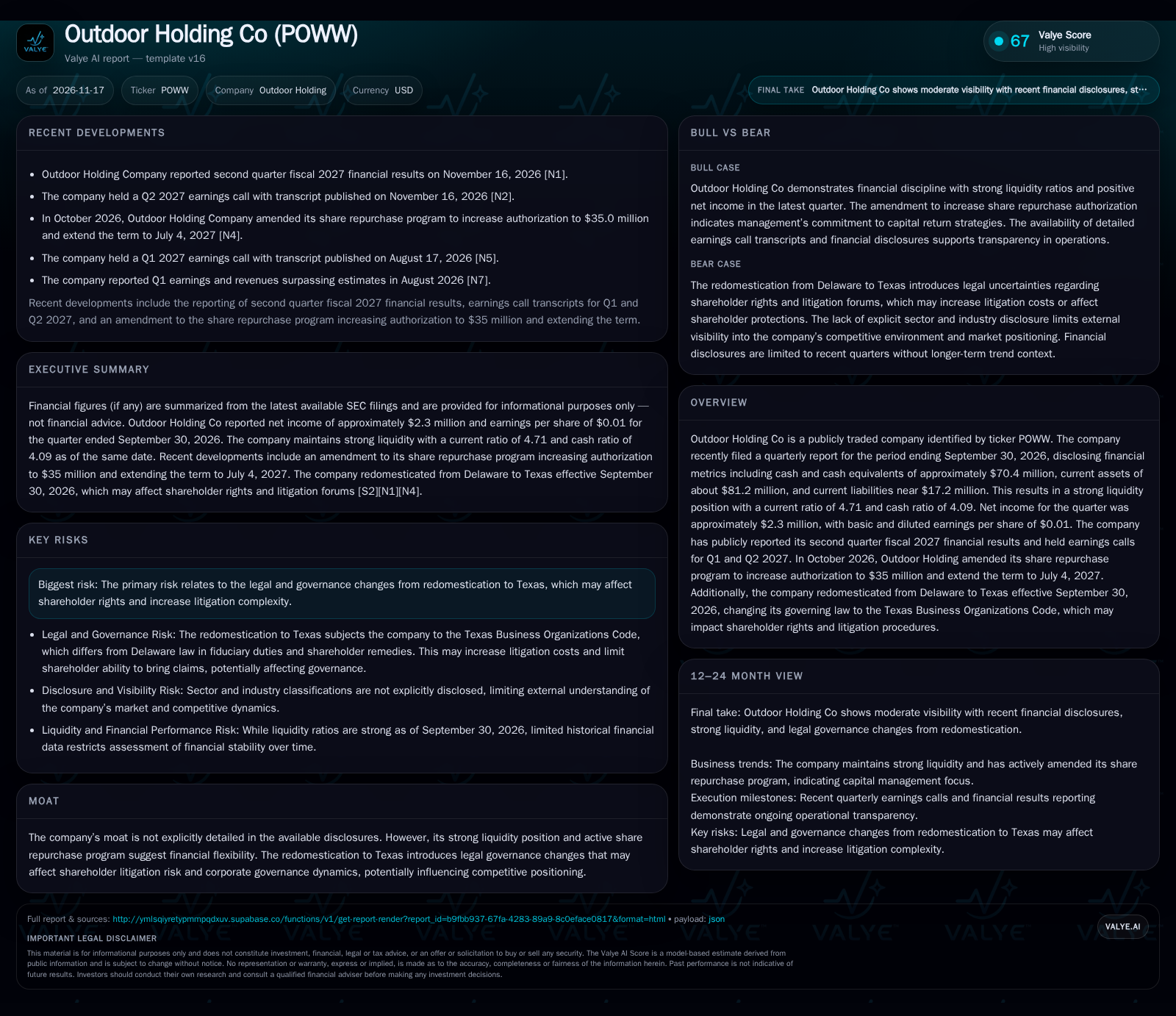
The most material recent developments for Outdoor Holding Co include the completed sale of its Ammunition segment in April 2025, which generated approximately $42.9 million in net proceeds. This divestiture marked a strategic pivot away from manufacturing and toward a platform-centered business model. The company reported cash and liquidity metrics for the period; these figures do not by themselves establish operating runway, investment capacity, financial flexibility, or financing capacity. Net income for the quarter was $2.3 million, translating to $0.01 per share, indicating continued operational profitability even post-divestiture [S2]. In October 2026, Outdoor Holding increased the authorization on its share repurchase program to $35 million and extended it through July 2027 [N4]. The company also redomesticated from Delaware to Texas, a move that changes the legal framework for governance and shareholder rights [S2]. These facts set the stage for a company with considerable potential financial flexibility but heightened uncertainty about its long-term business model and legal risk profile.
Platform Ambitions and Cost Controls: The Shape of Outdoor Holding’s Economic Model
With the sale of its Ammunition segment, Outdoor Holding Co’s core business now appears to center on a digital marketplace and related technology services, though exact commercial mechanics remain undisclosed. In platform businesses, value is typically created through transaction fees, listing charges, premium features, and potentially payment processing. The company has disclosed investments in AI, automation, and enhanced search to improve user experience and operating efficiency—capabilities that, if successfully deployed, could drive operating leverage by scaling revenue faster than costs. However, these investments require upfront capital and may not yield immediate returns, especially if customer adoption or transaction volumes are slower than anticipated.
On the expense side, the company has realized benefits from prior restructuring, but future cost reductions are expected to be modest, with incremental increases likely in technology, compliance, and customer support. This suggests a pivot from aggressive cost-cutting to a growth and technology investment phase. Given the strong current liquidity, Outdoor Holding has some latitude to absorb these expenses, but the sustainability of profitability will depend on its ability to monetize new platform features and maintain or grow transaction volumes. The expanded share repurchase program signals management’s willingness to return capital, but also reduces cash available for organic or inorganic growth if not carefully balanced.
Legal Reshuffling and Market Ambiguity: Where Does Outdoor Holding Stand?
Outdoor Holding Co’s competitive positioning is difficult to assess in detail due to limited public disclosure on its exact sector, customer base, or principal peers. That said, the company’s pivot to a technology-enabled marketplace puts it in competition with other online transaction platforms, potentially including those serving regulated industries. The company’s investments in AI and automation could provide a temporary advantage in user experience or cost structure if implemented ahead of peers, but such technologies are rapidly commoditizing.
The redomestication to Texas alters the legal playing field. While Texas law may reduce certain litigation risks and compliance costs compared to Delaware, it could also make the company less attractive to institutional investors who prefer Delaware’s established shareholder protections. This legal shift may be a double-edged sword: it could deter frivolous lawsuits, but it might also raise the cost of capital or limit appeal to certain investor segments. Furthermore, Outdoor Holding’s ability to attract and retain users, partners, and channel relationships will depend on its ability to demonstrate reliability, regulatory compliance, and product differentiation in a competitive digital marketplace landscape.
If Marketplace Monetization Scales, Shareholder Returns Could Accelerate
A favorable scenario for Outdoor Holding Co would see successful deployment and adoption of its new platform features—such as AI-driven search, automated listing, and integrated payment processing—leading to materially increased transaction volumes and higher monetization per user. If the company can leverage its liquidity to invest in technology and marketing, while keeping incremental costs in check, operating leverage could drive margin expansion and improved cash flow.
Confirmation of this scenario would include evidence of rising transaction volumes, increasing average revenue per user, and growing take rates on platform activity (if disclosed). Accretive deployment of share buyback authorization, without constraining necessary investment, could further amplify per-share earnings. Falsification would come from stagnant or declining platform engagement, higher-than-expected technology costs without commensurate revenue growth, or user attrition due to competitive alternatives.
Stable Profitability, Measured Growth, and Legal Ambiguity Define the Middle Ground
The company may see incremental gains from technology upgrades and operational efficiency, but the impact on top-line growth could be limited if marketplace adoption is slow or if regulatory/payment friction limits transaction throughput.
In this scenario, the share repurchase program helps support EPS, but underlying business growth remains moderate. Confirmation would come from continued quarterly profitability, stable or slightly improving operating margins, and gradual increases in platform activity. This outcome would be falsified by unexpected legal or regulatory setbacks following the move to Texas, or by evidence of customer or partner disengagement.
Legal Uncertainty and Platform Underperformance Could Erode Value
A negative scenario could materialize if the company’s legal shift to Texas results in costly or distracting litigation, or if the market perceives weaker shareholder protections, leading to a lower valuation multiple. Simultaneously, if technology investments fail to drive user adoption or transaction growth, the company could see stagnating or declining revenues while fixed costs rise due to ongoing platform development and compliance burdens.
This scenario would be confirmed by mounting legal expenses, adverse court rulings, or high-profile shareholder disputes, as well as by evidence of flat or declining platform revenue, increased customer churn, or missed milestones in technology deployment. If the company is forced to curtail investments or buybacks to preserve cash, or if profitability turns negative, the investment case would weaken materially.
How to Gauge Outdoor Holding’s Post-Divestiture Transformation
Quarterly revenue and profitability trends—particularly from continuing operations, excluding the discontinued Ammunition segment—would help clarify the sustainability of the new business model.
Transaction volumes, active user counts, and take rates on the company’s digital marketplace (if disclosed) would provide direct evidence of platform adoption and monetization.
Technology deployment milestones such as AI/automation feature launches, payment processing integration, and customer support enhancements—along with their impact on user engagement—would test the effectiveness of ongoing investments.
Operating expense growth versus revenue growth, as a measure of operating leverage and cost discipline, would indicate whether scaling is translating into improved margins.
Share repurchase activity, including actual amounts repurchased and the impact on cash balances, would show the balance between capital return and reinvestment.
Legal expenses and the nature/volume of shareholder litigation or regulatory actions post-redomestication would shed light on the practical impacts of the new governance regime.
Management commentary on strategic priorities, growth investments, and risk management, as provided in future earnings calls or filings, would help interpret evolving execution and governance risk.
Disclaimer: This is research-only, informational analysis and not investment advice. It may include AI-generated interpretation and general industry context. Always verify important details using primary sources.

Comments