
Golden Star Resource Corp.: Exploration Ambitions Under Acute Financial Constraint
Golden Star Resource Corp. holds mining claims in Nevada but remains stalled at the exploration stage, reporting no revenues, minimal cash, and a going concern warning. The company’s future hinges on securing new funding and achieving a commercially viable discovery—a path fraught with uncertainty and operational limitations.
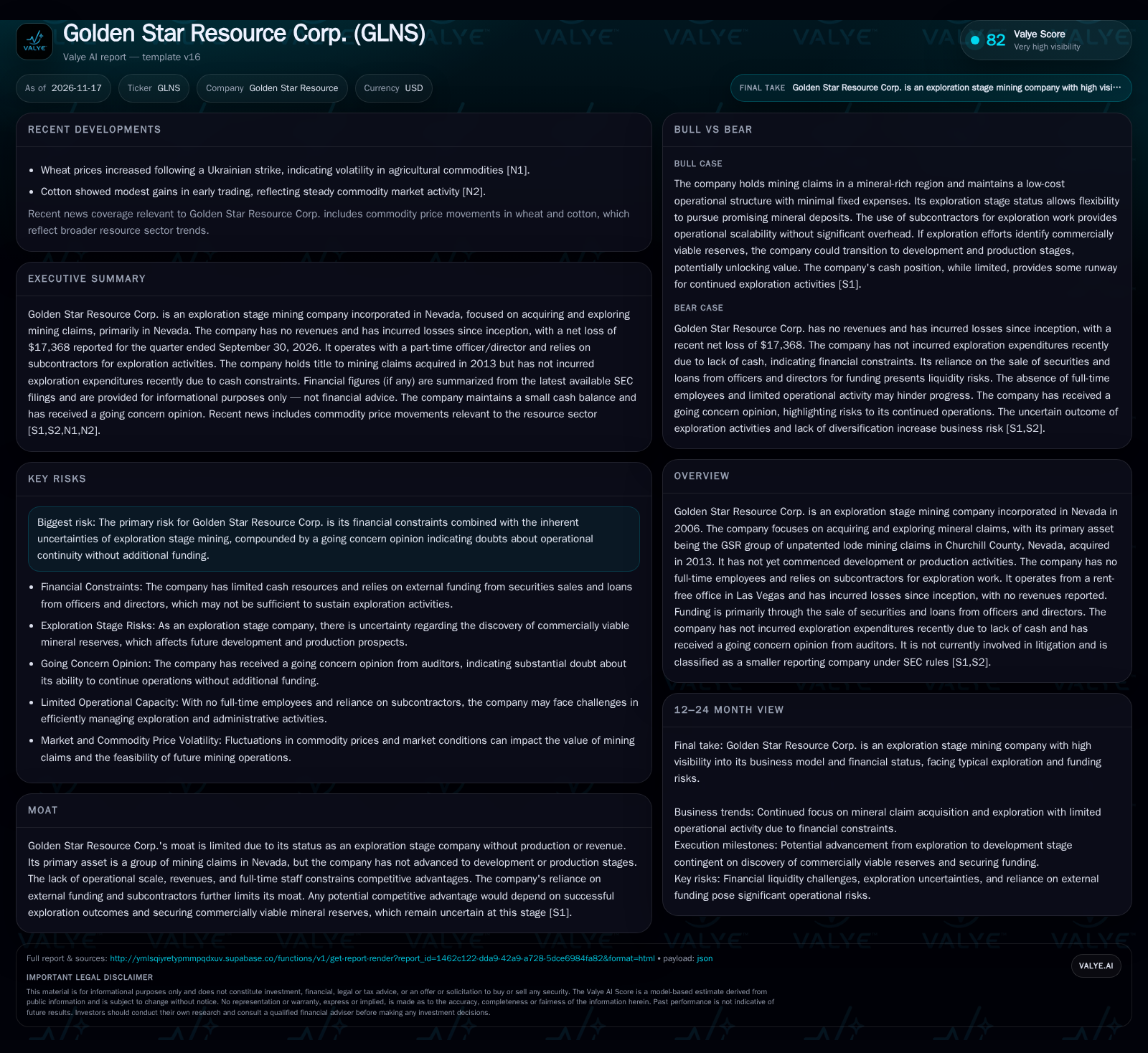
Golden Star Resource Corp. is an exploration-stage mining company with unpatented lode claims in Nevada, no revenues, and a recent net loss. Cash reserves are minimal, and the company has not conducted exploration work recently due to lack of funds. Its sole officer works part-time, and operations depend on external funding. The company faces significant operational and financial risks, with its future dependent on both successful mineral discovery and new capital [S1] [S2].
Golden Star Resource Corp. exemplifies the high-risk, high-uncertainty nature of early-stage mineral exploration. The company’s sole asset—unpatented lode mining claims in Nevada—remains untested, with no exploration expenditures made in the past year due to cash constraints. With only $45,000 in cash as of September 2026 and no operating revenues, Golden Star’s survival depends on its ability to secure external funding and eventually make a commercially viable discovery. The company’s skeletal operational structure, including a part-time officer and reliance on subcontractors, underscores both its financial fragility and its flexibility—but also raises questions about execution capacity and long-term viability [S1] [S2].
Recent Financials and Operations: A Company on Hold
As of September 30, 2026, Golden Star Resource Corp. reported no revenues and a net loss of $17,368 for the quarter, continuing a multiyear pattern of losses. The company reported cash and liquidity metrics for the period; these figures do not by themselves establish operating runway, investment capacity, financial flexibility, or financing capacity. [S2] No exploration expenditures occurred in the year ended June 30, 2026, as cash constraints forced the company to pause field activities. The operational structure remains minimal, with no full-time employees and a sole officer devoting approximately 10% of her time to the company’s affairs. The going concern opinion from auditors highlights the acute risk that Golden Star may not be able to continue operations without additional capital [S1] [S2].
Exploration-Stage Mining Economics: Fixed Costs Low, Funding Needs High
Golden Star Resource Corp.’s business model is typical of micro-cap exploration-stage miners: the company holds mineral claims but generates no cash flow until a commercially viable deposit is discovered and developed. The company’s fixed overhead is minimal—rent-free office space and no full-time staff—allowing it to extend its limited cash. However, the bulk of capital needs are front-loaded in exploration: geological surveys, drilling, permitting, and environmental studies. Without these investments, the value of the claims cannot be established or upgraded. Funding is episodic, typically via equity issuance or loans from insiders, creating dilution risk and dependence on market appetite or insider willingness.
Operating leverage is extremely high if a commercial discovery is made, as the transition from exploration to development can unlock significant asset value, but this outcome is rare. Until then, the business is characterized by recurring cash burn, with capital needs that spike around exploration campaigns and regulatory milestones. The absence of revenues or assets beyond the claims means the company’s survival is binary—either it raises new funds and finds value, or it risks insolvency.
Positioning in a Crowded Junior Mining Landscape
Golden Star’s competitive position is limited by its lack of tangible progress on its mining claims and minimal operating capacity. In the Nevada region, hundreds of junior mining companies compete for investor dollars, exploration talent, and, ultimately, the small number of mineral discoveries that can be advanced to production. The absence of recent exploration activity puts Golden Star at a disadvantage versus peers who are actively drilling, publishing assay results, or advancing permitting. Access to capital is the primary differentiator at this stage—companies that can demonstrate momentum or geological promise attract funding, while those that stall risk becoming ‘zombie’ claims holders.
Switching costs for investors are low, as the value proposition is based almost entirely on the perceived geological potential and management’s ability to advance the project. Without a portfolio of claims, joint ventures, or technical partnerships, Golden Star’s moat is essentially non-existent. The main competitive threat is substitution by more active or better-funded peers in the same mineral district.
What a Breakthrough Could Look Like: Discovery and Funding Catalysts
The most favorable scenario for Golden Star Resource Corp. would involve securing new funding—via equity, debt, or a strategic partner—that enables the company to resume exploration activities. If exploration work on the GSR claims uncovers commercially viable mineralization, the company could attract additional investment, enter joint ventures, or even become a takeover target by a larger miner. A breakthrough drill program yielding high-grade results or a resource estimate would provide tangible value, potentially transforming the company’s prospects.
Evidence that would confirm this scenario includes a disclosed financing event, commencement of fieldwork or drilling, publication of encouraging exploration results, or the announcement of a partnership or farm-in by a larger mining company. Conversely, the scenario would be falsified if the company fails to raise funds, remains inactive, or relinquishes its claims due to non-payment of fees.
Prolonged Stasis: Survival on Minimal Cash and Occasional Fundraising
The most plausible near-term outcome is that Golden Star continues to operate at a minimal level, seeking small amounts of capital to maintain its claims and corporate existence. Periodic fundraising from insiders or microcap investors may allow the company to pay fees and basic administrative expenses, but is unlikely to support meaningful exploration in the absence of a major capital injection. The company’s sole officer may continue part-time oversight, with exploration deferred until market conditions or funding prospects improve.
Evidence supporting this scenario would include continued lack of exploration spending, repeated small financings or loans from related parties, and the absence of material field activity. A falsification would occur if the company either fully ceases operations, loses title to its claims, or unexpectedly secures a large-scale financing for a new exploration program.
Acute Funding Failure and Asset Attrition
The adverse scenario is that Golden Star fails to secure even minimal funding, leading to the inability to pay claim maintenance fees, regulatory filings, or basic administrative costs. This could force the company to forfeit its mining claims, dissolve, or enter bankruptcy. The lack of employees and reliance on one part-time officer increases the risk of operational lapses or missed deadlines, which could accelerate the loss of remaining assets.
Downside confirmation would come from default on claim payments, a notice of claim forfeiture, auditor or regulatory filings citing insolvency, or formal dissolution proceedings. The scenario could be partially falsified if the company manages to raise just enough cash to maintain legal standing and claim ownership for another reporting cycle.
Milestones That Will Determine Golden Star’s Future Trajectory
Any public disclosure of new exploration spending, contracts with geological or drilling subcontractors, or commencement of fieldwork would indicate renewed momentum.
A useful metric would be the amount, timing, and source of any new capital raised—whether from public markets, private placements, or insider loans.
Evidence of claim maintenance fee payments or renewal filings would confirm the company’s ability to hold onto its core asset.
Announcements of partnerships, joint ventures, or farm-in agreements with larger mining or resource companies would signal external validation of the claims’ potential.
Changes in management time allocation, such as the appointment of a full-time officer or additional directors, could indicate a shift in operational ambition.
If disclosed, details of exploration results, resource estimates, or technical reports would provide critical evidence for asset valuation.
Auditor or regulatory filings updating the going concern assessment or flagging new risks would be early warnings for investors.
Any notice of claim forfeiture, legal dissolution, or bankruptcy proceedings would confirm the downside scenario.
Disclaimer: This is research-only, informational analysis and not investment advice. It may include AI-generated interpretation and general industry context. Always verify important details using primary sources.

Comments