
Unicycive Therapeutics: Regulatory Cycles, Manufacturing Hurdles, and the Search for a Kidney Disease Breakthrough
Unicycive Therapeutics faces a pivotal FDA review for its lead phosphate binder, oxylanthanum carbonate, after repeated manufacturing setbacks.
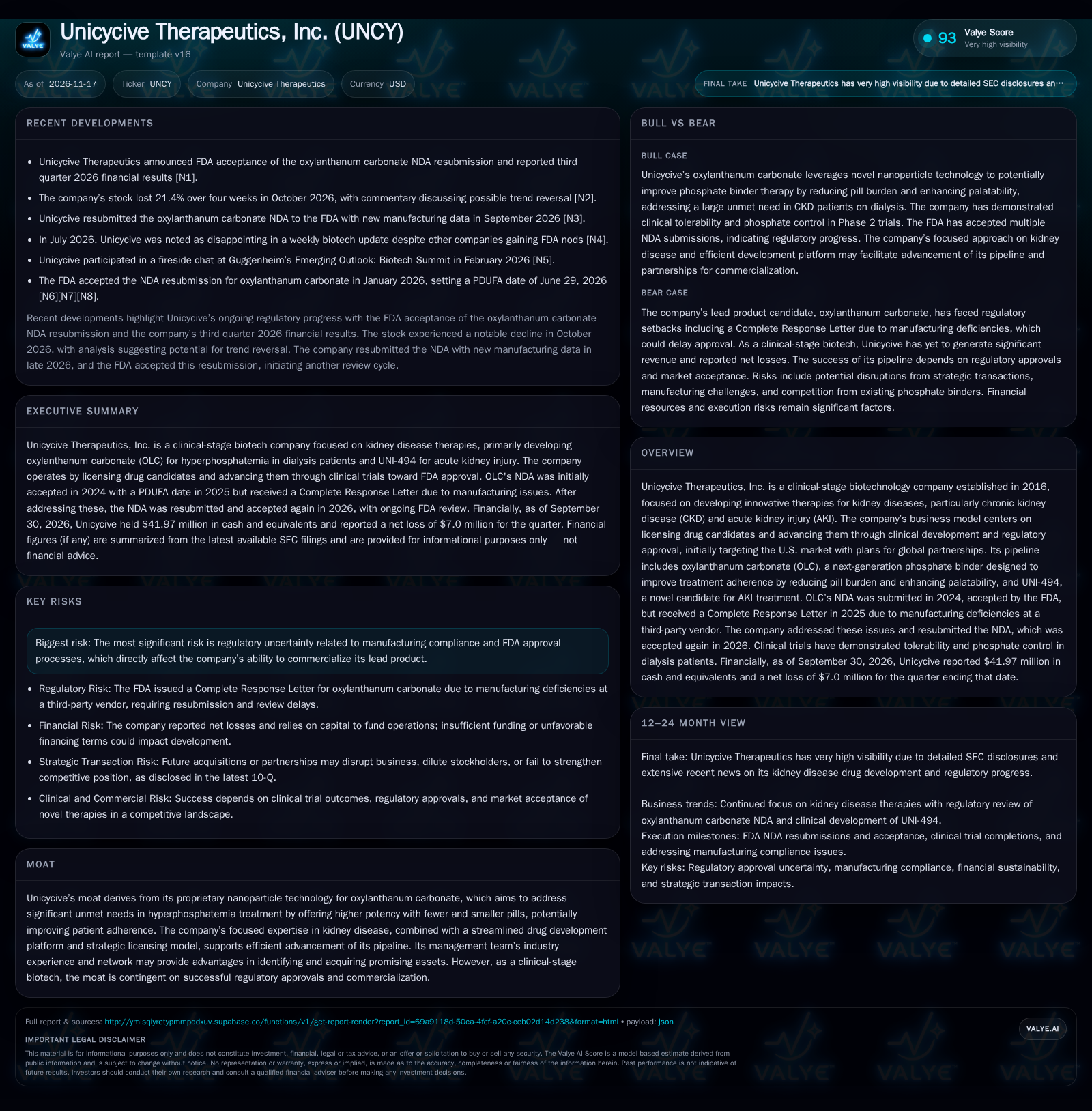
Unicycive Therapeutics is at a critical inflection point as the FDA re-examines its lead drug, oxylanthanum carbonate, following multiple resubmissions centered on manufacturing compliance. The company’s financial position is stable for now, but ongoing net losses and the absence of approved products underscore the urgency of achieving regulatory and commercial milestones. The outcome of the current FDA review, and the company’s ability to address manufacturing and commercialization risks, will determine whether Unicycive can translate clinical promise into business viability. [S2] [N1] [N3]
Unicycive Therapeutics, a clinical-stage biotech focused on kidney disease, is navigating a critical period as its lead drug candidate, oxylanthanum carbonate (OLC), undergoes another round of FDA review following repeated manufacturing setbacks. While the company’s nanoparticle-based phosphate binder has shown promising clinical results and aims to improve patient adherence, Unicycive remains pre-commercial, posting ongoing net losses. With a reported balance sheet position for now but mounting pressure to achieve regulatory and commercial breakthroughs, the next twelve months will be decisive for Unicycive’s ambitions to reshape phosphate binder therapy for chronic kidney disease.
FDA Re-Review and Manufacturing Fixes Dominate Unicycive’s Near-Term Outlook
The most consequential current development for Unicycive is the FDA’s acceptance of the oxylanthanum carbonate NDA resubmission in November 2026, following a prior Complete Response Letter (CRL) in June 2025 that cited manufacturing deficiencies at a third-party vendor. Importantly, no clinical or safety issues were raised with OLC itself. The NDA is now under a new review cycle, with regulatory clarity expected by mid-2027. [N1] [N3]
The company reported cash and liquidity metrics for the period; these figures do not by themselves establish operating runway, investment capacity, financial flexibility, or financing capacity. However, the company remains unprofitable, posting a net loss of $7.0 million for the quarter. [S2]
Clinical data from a pivotal Phase 2 trial showed 90% of dialysis patients achieved target serum phosphate levels after switching to OLC, supporting the drug’s clinical rationale. [S2]
These facts matter because regulatory and manufacturing outcomes will determine whether Unicycive can transition from a development-stage biotech to a commercial enterprise, while the cash balance sets the window for executing on these milestones.
How Unicycive Could Generate Value from Its Kidney Disease Pipeline
Unicycive’s business model is predicated on developing and commercializing therapies for kidney disease, with an initial focus on OLC for hyperphosphatemia in dialysis patients—a large, chronic market with entrenched competitors. Revenue generation would depend first on regulatory approval, followed by market adoption. The company’s economic thesis rests on OLC’s ability to address significant patient pain points: reducing pill burden and improving tolerability, which could drive physician preference and patient adherence if commercialized successfully.
Pricing power for new phosphate binders is typically constrained by reimbursement dynamics and the presence of generics, but true product differentiation (such as improved adherence or reduced side effects) may allow for premium pricing or favorable formulary placement. Volume would be driven by share gains from incumbent therapies, and the mix would depend on payer coverage and patient subsegments (e.g., those most intolerant of current binders).
Fixed costs are substantial—clinical development, regulatory, and manufacturing scale-up—while variable costs are likely to be dominated by COGS and commercialization expenses. Operating leverage could materialize if OLC gains a meaningful share of the dialysis patient population, but this scenario is only plausible if manufacturing can scale reliably and regulatory risks are resolved.
Capital requirements remain significant: Unicycive’s current cash could fund operations through key regulatory milestones, but commercial launch, post-approval studies, and potential global expansion would likely require additional funding or partnership support.
Positioning Against Incumbents in a Crowded Phosphate Binder Market
The phosphate binder segment for CKD patients on dialysis is dominated by established therapies, including calcium-based binders, sevelamer, and lanthanum carbonate. Many are generic, low-cost, and well understood by nephrologists. Unicycive’s OLC leverages proprietary nanoparticle technology, potentially offering improved efficacy at lower pill burden—a key differentiator if validated in real-world use.
However, switching costs are moderate: while patient adherence is a challenge with existing binders, prescribers and payers may be slow to adopt new agents unless there is clear clinical or economic benefit. Competing on pill burden or tolerability could shift share, but only if these advantages are both substantial and supported by post-approval data.
Barriers to entry are high due to regulatory complexity and the need for robust manufacturing quality, as Unicycive has experienced firsthand. Yet, the risk of substitution remains if a rival introduces a similarly differentiated binder or if generic competition intensifies. The company’s moat is thus conditional—dependent on regulatory approval, manufacturing reliability, and proof that its technology delivers a meaningful clinical advantage.
If Manufacturing Issues Are Cleared, OLC Could Unlock Commercial and Strategic Value
The favorable scenario for Unicycive hinges on the FDA accepting the latest manufacturing remediation, leading to OLC approval by mid-2027. With approval in hand, Unicycive could leverage OLC’s clinical profile—demonstrated strong phosphate control and improved adherence potential—to drive rapid uptake among nephrologists and dialysis clinics.
Confirmation of this scenario would require: (1) FDA approval without further manufacturing delays, (2) rapid scaling of compliant manufacturing processes, (3) favorable payer coverage, and (4) evidence that OLC’s lower pill burden translates to superior adherence and outcomes in broader patient populations.
Strategically, a successful approval could attract licensing or co-commercialization partners, accelerating U.S. and ex-U.S. market entry and reducing capital needs. The thesis would be falsified if manufacturing issues persist or if post-approval uptake is limited due to lack of differentiation or payer resistance.
Most Likely: Incremental Progress Amid Execution and Commercialization Uncertainties
The most plausible path for Unicycive is continued regulatory back-and-forth, with eventual approval of OLC after further iterations or minor delays. Manufacturing remediation may succeed, but real-world adoption could be gradual given the conservative nature of the nephrology community and established competition.
In this scenario, Unicycive would need to invest heavily in post-approval studies, physician education, and payer negotiations to demonstrate real-world benefit and achieve preferred formulary status.
Evidence for this scenario would include incremental regulatory progress (e.g., positive FDA communications), steady but slow initial sales, and ongoing need to differentiate OLC via real-world data. The thesis would be challenged if regulatory delays extend further or if early commercial traction is weak.
Extended Regulatory or Manufacturing Setbacks Could Threaten Unicycive’s Viability
If the FDA identifies new or unresolved manufacturing deficiencies in the latest review cycle, approval could be delayed by another year or more. Each delay increases cash burn and raises the risk that Unicycive will need to seek dilutive financings or strategic alternatives before OLC ever reaches the market.
A further adverse outcome would be if OLC, even if approved, fails to gain traction due to insufficient differentiation, payer pushback, or unforeseen safety/tolerability issues in real-world use. In this scenario, Unicycive could struggle to cover its fixed costs, leading to restructuring, asset sales, or a forced search for a buyer.
Confirmation of this scenario would show up as another FDA CRL, negative manufacturing site inspections, or disclosure of a material cash shortfall. The thesis would be partially falsified if the company demonstrates manufacturing compliance and secures a non-dilutive partnership or funding.
Milestones and Data That Will Define Unicycive’s Kidney Disease Ambitions
Outcome of the FDA’s latest review cycle for oxylanthanum carbonate, including any additional CRLs or approval letters.
Evidence of successful remediation and validation at third-party manufacturing sites, as indicated by regulatory filings or site inspection reports, if disclosed.
Announcement or disclosure of commercial partnerships, licensing agreements, or co-promotion deals that could support launch and reduce capital needs.
Updates on payer coverage decisions, formulary placements, or published pricing for OLC, if and when approved.
Clinical or real-world post-marketing data demonstrating improved adherence, pill burden reduction, and patient outcomes versus incumbent binders.
Quarterly cash burn and runway projections relative to disclosed milestones and expected launch timelines.
Any indication of further strategic transactions, including partnerships, asset sales, or equity raises, and their impact on shareholder dilution and business focus.
Progress or setbacks in advancing the UNI-494 program for acute kidney injury, which could diversify pipeline risk if disclosed.
Disclaimer: This is research-only, informational analysis and not investment advice. It may include AI-generated interpretation and general industry context. Always verify important details using primary sources.

Comments