
22nd Century Group: Regulatory Moat Meets Commercial, Financial, and Execution Headwinds
22nd Century Group retains a unique regulatory position in reduced-nicotine combustible cigarettes, but persistent losses, declining revenues, and execution risks challenge the realization of this advantage. The company’s future depends on regulatory outcomes, commercial traction in a slow-changing category, and its ability to convert scientific credibility into sustainable economics.
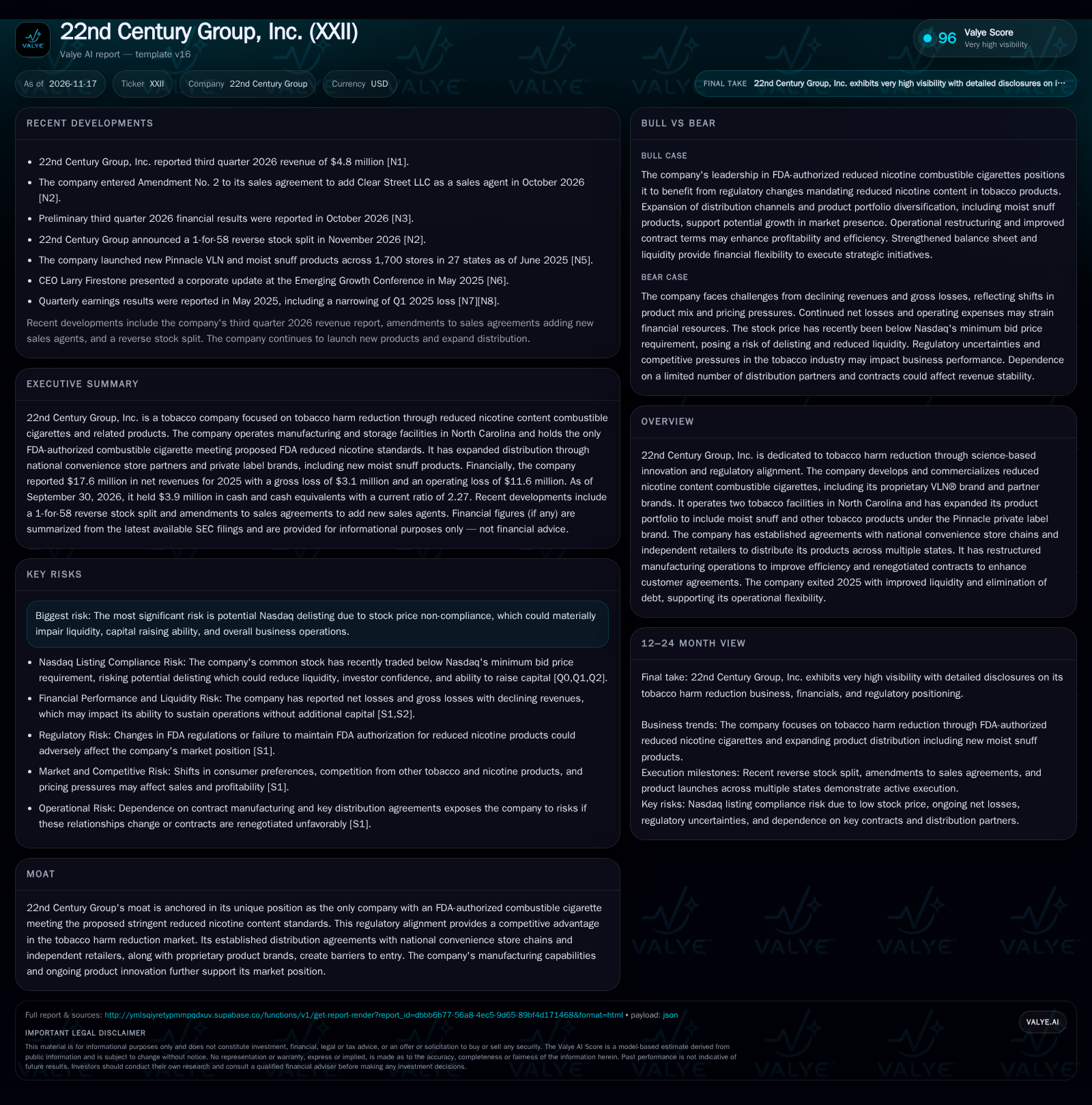
22nd Century Group is the only company with FDA authorization for reduced-nicotine cigarettes, giving it a theoretical edge if regulations tighten. However, 2025 revenues fell 27.9% even as cigarette volumes rose, and gross margins remain negative. Distribution has expanded, but pricing and mix shifts, plus a recent reverse stock split and continued net losses, highlight commercial and financial stress. The central question is whether regulatory momentum and product innovation can overcome entrenched market dynamics and capital constraints. [S1] [S2] [N1] [N2]
22nd Century Group, Inc.’s strategic bet is that regulatory shifts toward nicotine reduction will eventually transform the U.S. tobacco market—and that its exclusive FDA authorization for reduced-nicotine cigarettes will put it in pole position. Yet, despite expanded distribution and new product launches, the company’s top-line has shrunk, gross margins are negative, and persistent net losses continue. With a recent reverse split and reported cash balance, the company is racing against time to turn regulatory privilege into commercial and financial self-sufficiency. The next phase will test whether science and policy can overcome structural headwinds in a mature, price-sensitive category.
Where the Business Stands Now: Regulatory Edge, Shrinking Revenues, and Financial Strain
22nd Century Group remains the only company with an FDA-authorized reduced-nicotine combustible cigarette, a distinction that could be transformative if federal regulations mandate lower nicotine levels industry-wide. However, the company’s financials are deteriorating: net revenues for 2025 declined 27.9% to $17.6 million, with a gross loss of $3.1 million (17.8% of revenue) and an operating loss of $11.6 million. Despite an uptick in cigarette volumes, revenue fell due to less favorable pricing and the absence of one-off orders from the prior year. Filtered cigar revenues also declined sharply. The company ended September 2026 with $3.9 million in cash, a current ratio of 2.27, and no debt, but these reserves are modest relative to ongoing losses. A 1-for-58 reverse stock split in November 2026 and amendments to sales agreements to add new sales agents further underscore the company’s focus on capital structure and channel reach. [S1] [S2] [N1] [N2]
How the Model Could Work: Tobacco Harm Reduction, Pricing, and Margin Dynamics
22nd Century’s business model is built around two pillars: proprietary reduced-nicotine cigarettes (VLN® and partner brands) and private-label tobacco products, including new moist snuff lines. The core economic bet is that regulatory and consumer demand for harm reduction will drive adoption of VLN® products, allowing for premium pricing and volume growth. However, the current reality is less favorable: despite higher volumes, cigarette revenue declined in 2025 due to pricing arrangements and the lack of prior-year bulk orders. Gross margins are negative, suggesting that either cost structures remain too high, pricing power is limited, or early-stage volumes are insufficient to cover fixed costs.
The company has restructured contract manufacturing and renegotiated customer agreements to improve efficiency and economics, but the reported gross loss indicates that variable costs, mix, or pricing are not yet favorable. Expansion into moist snuff and other tobacco products could help diversify revenue streams, though these categories are highly competitive and margin dilutive absent a clear differentiation or scale advantage. Fixed costs from manufacturing facilities and the need to invest in regulatory compliance, product development, and distribution expansion create ongoing capital requirements. Operating leverage could improve with higher volumes if regulatory or consumer adoption accelerates, but the path to sustainable profitability remains uncertain without a step-change in either pricing or scale. [S1]
Regulatory Moat vs. Entrenched Industry and Substitution Threats
22nd Century’s principal advantage is its regulatory lead: it is the only company with an FDA-authorized product that meets proposed reduced-nicotine standards. This creates a potential moat if the FDA moves forward with nicotine reduction mandates, as competitors would need to secure their own authorizations—a time-consuming and costly process. The company has also established distribution through national convenience store chains and private-label partnerships, which could provide shelf space and consumer access.
However, the U.S. tobacco market is mature, highly concentrated, and price-sensitive. Major incumbent manufacturers have deep relationships, marketing muscle, and economies of scale. Consumer inertia is powerful, and reduced-nicotine cigarettes face both skepticism and substitution risk from alternative nicotine products (e-cigarettes, oral nicotine, heated tobacco). The company’s ability to translate regulatory advantage into lasting market share will depend on regulatory momentum, retailer buy-in, and consumer willingness to switch. Distribution agreements help, but dependence on a few large partners introduces counterparty risk if uptake is slow or terms become less favorable. [S1]
What Would Unlock Value: Regulatory Mandate and Rapid Commercial Adoption
The most powerful upside scenario is a decisive FDA mandate requiring reduced nicotine content in all combustible cigarettes, which would instantly elevate 22nd Century’s VLN® products from a niche to a category standard. In this scenario, the company’s first-mover status and sole FDA authorization would create both a supply advantage and potential licensing opportunities with larger manufacturers. Successful scaling of distribution, especially through national convenience chains, would drive volumes and enable operating leverage. Expansion of private-label agreements and new products (like moist snuff) could diversify revenue and improve bargaining power with retailers.
Confirmation of this scenario would come from regulatory announcements moving reduced-nicotine mandates from proposal to implementation, significant sequential revenue and volume growth in VLN® sales, improved gross margins (suggesting better pricing or scale), and evidence of new or expanded licensing deals with other tobacco manufacturers. Additional signals would include a strengthening balance sheet from operating cash flow rather than equity raises or asset sales.
Incremental Progress but Persistent Losses in a Slow-Moving Market
A more plausible middle path is continued gradual expansion of VLN® and private-label products through existing channels, with revenue stabilizing or growing modestly but gross margins remaining under pressure. Regulatory progress is slow, with no immediate mandate but ongoing FDA engagement and public health advocacy keeping the harm-reduction narrative alive. The company may secure incremental wins in distribution or product diversification, but consumer adoption is tepid given price sensitivity and slow behavioral change.
Under this scenario, losses narrow but do not disappear, and the need for periodic capital raises persists. Retailer and partner engagement continues but does not accelerate, and the company remains exposed to shifts in contract terms or competitive responses. Confirmation would be stable or slightly improving revenue trends, modest gross margin improvement, and a stable or slightly improving balance sheet—but without a clear inflection toward profitability or cash self-sufficiency.
Commercial Stagnation, Funding Pressure, and Regulatory Drift
The adverse scenario envisions continued commercial underperformance: VLN® and new product volumes stagnate or decline, pricing remains weak due to lack of differentiation or retailer leverage, and gross losses persist or worsen. Regulatory momentum stalls, with no meaningful progress toward a federal nicotine reduction mandate, leaving 22nd Century’s FDA authorization as a niche advantage without broad market impact. Major partners could reduce or terminate distribution agreements if sell-through disappoints.
Financially, persistent operating losses and reported cash balance force the company to pursue dilutive equity raises or asset sales. The recent reverse stock split is insufficient to address underlying business weakness, and the company risks Nasdaq delisting if the share price remains depressed. Confirmation of this scenario would be further revenue declines, negative gross and operating margins with no improvement, loss of major distribution partners, or an explicit going-concern warning in future filings.
Milestones That Will Determine If 22nd Century’s Regulatory Bet Pays Off
Sequential revenue and gross margin trends for VLN® and partner brands, especially in states and channels with the broadest distribution, would help test if product adoption is accelerating or stalling.
Any FDA action or public announcement regarding national reduced-nicotine mandates or changes in regulatory posture would be a material catalyst or risk.
Expansion or termination of national convenience store and private-label distribution agreements—if disclosed—would signal retailer confidence or concern about commercial traction.
Unit economics and cost structure disclosure for new moist snuff and other tobacco products would clarify whether these lines are margin accretive or dilutive.
Cash flow from operations and the need for additional capital raises would reveal whether the company is approaching self-sufficiency or remains reliant on external funding.
Retention or loss of Nasdaq listing status following the reverse stock split and ongoing share price trends will impact liquidity and access to capital markets.
Material changes in contract manufacturing efficiency or customer terms—if disclosed—would indicate whether operational restructuring is yielding tangible benefits.
Evidence of licensing or partnership deals with large tobacco companies in response to regulatory shifts would confirm the value of the FDA authorization moat.
Disclaimer: This is research-only, informational analysis and not investment advice. It may include AI-generated interpretation and general industry context. Always verify important details using primary sources.

Comments