
Fox Corp’s Earnings Reveal Revenue Growth Amid Profitability Pressures
Fox Corp reports solid revenue gains but faces margin compression amid evolving media industry challenges.
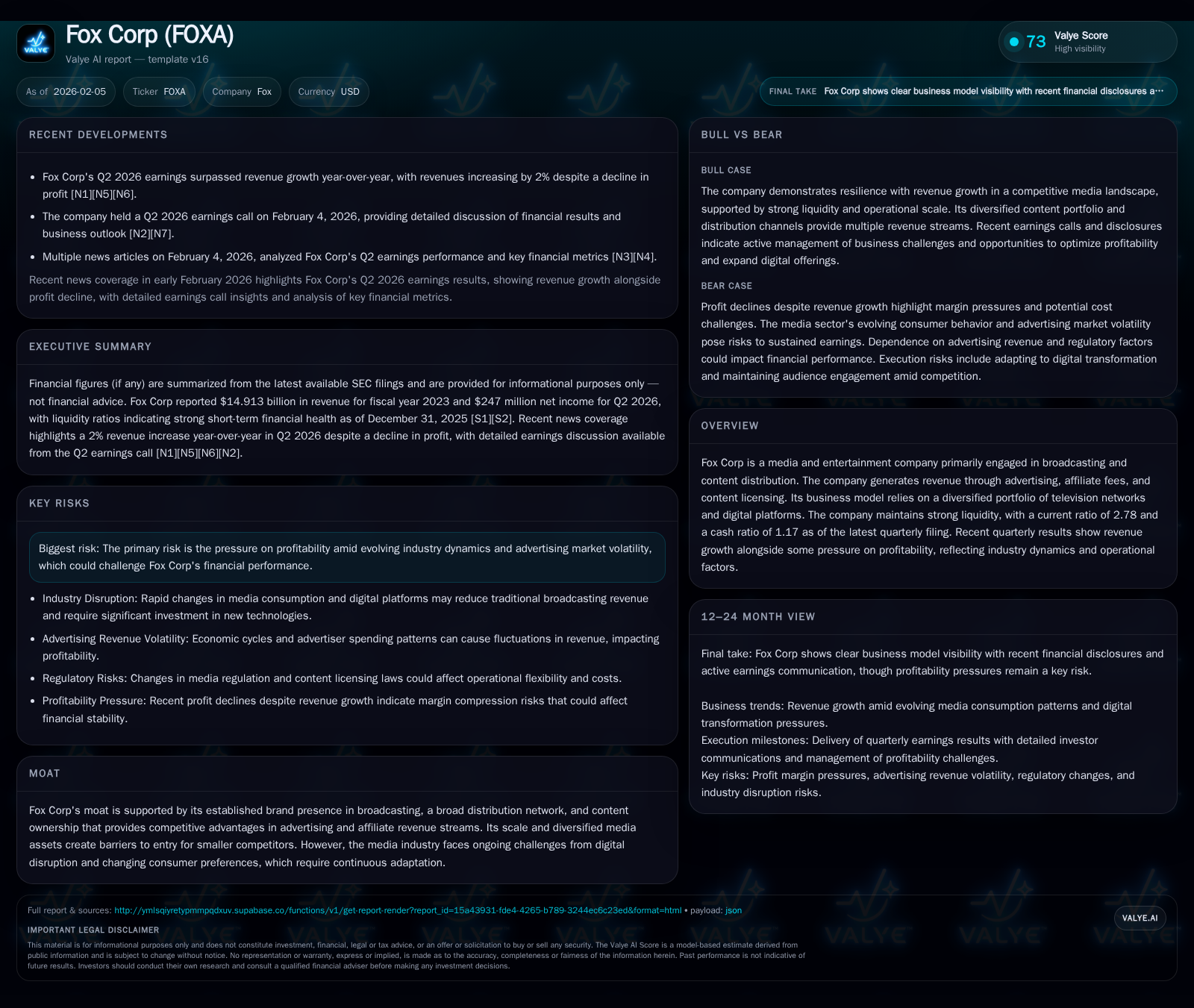
Fox Corp’s recent quarterly report highlights a notable 2% year-over-year revenue increase, surpassing consensus estimates. However, this top-line strength contrasts with declining profit margins, underscoring operational and industry headwinds. The company’s core broadcasting and affiliate fee revenues continue to provide resilience, supported by strong liquidity and a solid balance sheet. Yet, ongoing advertising volatility and digital disruption remain key risks as Fox navigates a rapidly shifting media landscape.
Earnings Snapshot: Revenue Up, Profit Margin Pressure
Fox Corp delivered a mixed financial performance in its latest quarterly release, blending encouraging revenue growth with the sobering reality of shrinking profitability. The company reported a 2% increase in revenues year-over-year, reaching figures above analysts’ expectations—a positive indicator given the pressures facing traditional media players [N1][N4]. Despite this upswing, profitability showed decline as operating margins contracted significantly [N5][N12]. This duality speaks to an underlying complexity where top-line resilience coexists with rising costs. The earnings call further illuminated these tensions, revealing that while demand for Fox’s content remains steady, margin pressure stems from heightened operational expenses and investments needed to adapt to digital transformations [N2].
Core Business Resilience Fueled by Broadcasting and Affiliate Revenues
At the heart of Fox Corp’s relative stability lies its diversified portfolio of broadcasting networks coupled with consistent affiliate fee income streams. These legacy assets generate predictable cash flows that softened the blow of broader industry disruption [valye_report_excerpt][S1]. Broadcasting continues to command substantial advertiser interest due to the scale of live sports and prime-time programming that remains difficult for digital entrants to replicate effectively. Affiliate fees—payments from cable and satellite providers for carriage rights—also provide a robust, recurring revenue foundation insulated somewhat from advertising cyclicality [N2]. This diversity in revenue sources embodies Fox's strategic moat: leveraging established distribution pipelines alongside content ownership ensures enduring relevance despite rapid market shifts.
Profitability Puzzle: Understanding Cost and Margin Dynamics
Though revenues rose, Fox encountered notable margin compression driven primarily by rising content acquisition costs, increased programming expenses related to sports rights, and heightened general operating costs [N5][N12]. These factors are symptomatic of an industry grappling with consumer fragmentation and intense competition for premium content. Fox’s management underscored during the earnings call that investments into digital capabilities—streaming infrastructure and original content development—are necessary but temporarily weigh on profitability [N2][S2]. Moreover, cyclical softness in advertising spend has tightened pricing power. Consequently, cost control remains a critical challenge as fixed expenses scale alongside newly launched initiatives intended to capture future growth opportunities.
Navigating Digital Disruption: Fox's Strategic Moat in Media
Fox Corp’s entrenched brand identity, extensive content library, and wide-reaching broadcast footprint confer meaningful barriers against entrants looking to disrupt traditional television markets [valye_report_excerpt][S1]. Live sports programming, in particular, preserves viewership loyalty resistant to digital substitution due to real-time engagement needs. Additionally, Fox benefits from cross-platform syndication rights that monetize syndicated shows across linear TV and digital outlets alike. That said, consumer behavior is shifting toward on-demand streaming services offering personalized experiences—a trend demanding persistent adaptation from legacy media companies. While Fox's strategic moat is intact today, it must continue investing prudently in technology enhancements, partnerships, and innovative ad products to sustain competitive advantage over time.
Liquidity Position and Financial Health Insights
Despite near-term profitability headwinds, Fox maintains strong liquidity metrics that provide flexibility for operational needs and strategic initiatives [F1][valye_report_excerpt][S2]. As of the latest quarterly filing, current assets stand at approximately $6.7 billion against current liabilities of $2.4 billion, yielding a healthy current ratio of 2.78 [F1]. Meanwhile, the cash ratio sits at 1.17, reflecting solid cash and equivalents coverage relative to short-term obligations. These indicators suggest robust balance sheet strength capable of supporting ongoing capital expenditures or weathering temporary market shocks without urgent financing concerns.
Risk Horizon: Advertising Volatility and Industry Transformation
The primary risks confronting Fox are closely tied to persistent volatility in advertising markets alongside secular shifts reshaping how audiences consume media [valye_report_excerpt][S1][S2]. Changes in advertiser budgets—sometimes abrupt due to economic uncertainties or evolving marketing channels—can quickly erode revenue visibility. At the same time, cord-cutting trends diminish traditional cable audiences that historically underpinned affiliate fee negotiations. The company addresses these challenges explicitly in its risk disclosures emphasizing the need for innovation amid sector-wide transformation [S1][S2]. Strategic agility will be critical to mitigate exposure while capitalizing on emerging digital monetization avenues.
Comparative Performance: How Fox Stacks Up Against Peers
Within the competitive landscape comprising Disney (DIS), Comcast (CMCSA), Charset (CHTR), among others, Fox’s Q2 results display both strengths and areas necessitating caution [N7][N8][N10][N11]. Disney recently posted strong revenue gains led by theme park recoveries and streaming growth; Comcast reported earnings beats supported by Peacock; meanwhile Charter experienced softness with declining revenues [N7][N8][N10][N11]. Relative to these peers, Fox’s reliance on broadcasting anchors steadier revenue growth while operational cost challenges mirror sector-wide trends impacting profitability across the board. The contrast highlights how traditional media conglomerates are reallocating capital between legacy assets and high-growth digital platforms.
Outlook and Wall Street Expectations Ahead of Q3
Looking ahead to Q3 2026 earnings season, market sentiment reflects cautious optimism for continued revenue momentum tempered by questions around margin improvement timelines [N9][N13][N14]. Analysts generally anticipate that sustained advertising demand will support incremental gains yet note cost pressures may persist due to competitive programming bids and integration expenses connected with platform expansions. Valuation narratives also factor in risks alongside opportunities stemming from Fox’s ability to pivot effectively within an industry undergoing accelerated change [N14]. Investor focus will likely center on earnings quality indicators such as free cash flow generation and margins rather than solely topline metrics.
This analysis is for informational purposes only and does not constitute investment advice or recommendations.
Disclaimer: This is research-only, informational analysis and not investment advice. It may include AI-generated interpretation and general industry context. Always verify important details using primary sources.

Comments