
First America Resources: Advanced ITAD Capabilities Meet Financial Strain in a Fragmented Market
First America Resources Corporation leverages machine learning and data-driven pricing in IT asset disposition and electronics recycling, serving enterprise clients and emerging tech segments.
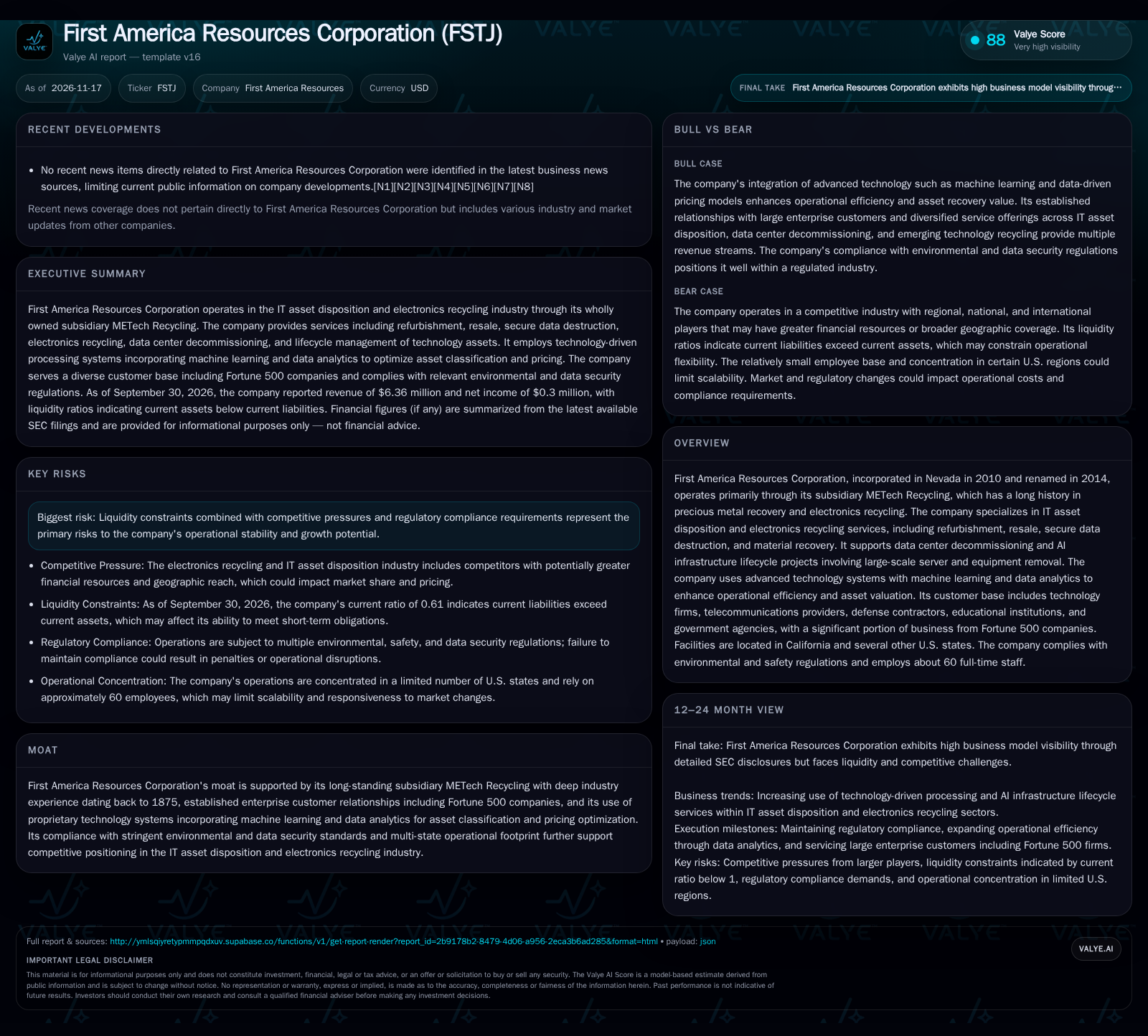
First America Resources Corporation specializes in IT asset disposition and electronics recycling, using proprietary machine learning systems to optimize asset recovery for enterprise clients, including Fortune 500 firms. Strategic execution—particularly in managing cash, expanding customer reach, and maintaining compliance—will be critical over the coming 12-24 months. [S2]
First America Resources Corporation stands at the intersection of technology-driven asset recovery and the practical realities of operating in a capital-intensive, competitive industry. Through its subsidiary METech Recycling, the company has carved out a niche in IT asset disposition (ITAD) and electronics recycling, employing proprietary machine learning and data analytics to maximize asset value and ensure regulatory compliance. Yet, despite its advanced capabilities and enterprise relationships, First America Resources faces acute financial constraints and operational concentration, raising the stakes for execution as the demand for secure, responsible technology asset management continues to evolve.
Liquidity Squeeze and Modest Profitability Define the Present Landscape
As of September 30, 2026, First America Resources reported revenue of $6.36 million and net income of $0.3 million, signaling a modestly profitable operation. Cash and cash equivalents totaled only $97,226 as of the latest quarter. While the company is not embroiled in any material legal proceedings, these financial metrics highlight an immediate need to address short-term obligations and may constrain the company’s operational flexibility and investment capacity. [S2]
How Asset Disposition Economics Are Shaped by Technology and Scale
First America Resources derives revenue primarily from IT asset disposition, electronics recycling, refurbishment, and resale. The economics of this business are inherently a function of volume (number of assets processed), mix (proportion of assets suitable for refurbishment/resale versus scrap), and pricing (determined by secondary market demand and commodity prices for recovered materials). Proprietary machine learning and automated pricing models enable the company to optimize asset identification and valuation, potentially enhancing margins on high-quality, reusable equipment.
Fixed costs include facility leases, compliance programs, and a core workforce of around 60 employees, while variable costs scale with asset intake, logistics, and processing. The company’s ability to capture higher-margin resale opportunities may be limited by customer mix and the quality of inbound assets. Services such as secure data destruction and data center decommissioning add value and may command premium pricing, particularly for enterprise and government clients with stringent compliance needs.
However, operating leverage is constrained by the company’s regional footprint and relatively small scale. The capital intensity of recycling operations, combined with regulatory compliance costs, means that liquidity constraints could limit the company’s capacity to invest in new equipment, expand facilities, or absorb working capital shocks. The economics may become more favorable if the company can increase throughput and secure longer-term enterprise contracts, but this would likely require investment or external financing.
Competitive Pressures, Customer Stickiness, and the Threat of Scale
First America Resources competes in a fragmented market with regional, national, and international ITAD and electronics recycling firms. Its competitive advantages include long-standing industry experience through METech Recycling, proprietary technology for asset classification and pricing, and compliance with rigorous environmental and data security standards. These factors help attract and retain large enterprise clients, including Fortune 500 companies, and government agencies that value reliability, compliance, and data security.
However, larger competitors often benefit from broader geographic coverage, greater financial resources, and the ability to offer integrated logistics and recycling solutions at scale. These rivals may undercut pricing, invest more heavily in automation, or offer more flexible contract terms. Customer relationships in ITAD can be sticky due to data security concerns and compliance requirements, but switching costs are not insurmountable—particularly for price-sensitive or multi-site clients.
The company’s limited workforce and operational concentration in a handful of U.S. states could hinder its ability to respond to large-scale bids, rapidly shifting regulatory demands, or changes in customer needs—especially as enterprises increasingly seek partners with national or global reach.
Unlocking Value Through Enterprise Retention and Expansion in AI Lifecycle Services
The most favorable scenario for First America Resources is predicated on deepening relationships with enterprise and government clients, leveraging its proprietary technology to win larger, higher-margin contracts—especially in emerging areas such as AI infrastructure lifecycle management and data center decommissioning. If the company can demonstrate operational reliability, regulatory compliance, and superior asset recovery value, it could become a preferred partner for organizations upgrading or decommissioning large volumes of IT equipment.
Success in this scenario would likely be confirmed by evidence of multi-year or expanded contracts with Fortune 500 or government clients, increased throughput of high-value assets, and new service offerings tailored to AI and high-performance computing environments. Improved gross margins and a rebound in liquidity metrics would further validate this trajectory. Establishing strategic partnerships or securing external capital could enable facility upgrades or geographic expansion, unlocking scale-driven efficiencies.
Conversely, if the company fails to secure larger contracts, or if enterprise customers migrate to larger, more diversified competitors, the upside scenario would be undermined.
Sustaining Operations Amid Margin Pressure and Selective Growth
The most plausible near-term path is one of continued modest profitability, with the company maintaining its current customer base and service mix while navigating liquidity constraints. Incremental growth could come from gradual increases in asset volumes, targeted wins in AI infrastructure or data center decommissioning, and continued compliance with regulatory standards.
This scenario would be confirmed by stable or slightly increasing revenue and net income, ongoing relationships with enterprise and institutional clients, and no material deterioration in compliance or operational performance. However, persistent liquidity pressure and limited capital for expansion would likely keep the company’s growth and margin profile below that of larger, better-capitalized peers.
If the company is able to improve its current ratio and cash position—perhaps through working capital management, higher-margin service penetration, or selective financing—it could build a foundation for future growth. Deterioration in these metrics, or loss of key customers, would falsify the base-case stability.
Liquidity Stress Forces Retrenchment or Strategic Alternatives
This could force the company to scale back services, delay payments, or seek emergency financing under unfavorable terms. Regulatory non-compliance or service disruptions could result in lost enterprise contracts, reputational harm, and potential legal or environmental liabilities.
Downside signals would include a further decline in the current and cash ratios, negative operating cash flow, reduction in workforce or facility closures, and the loss of major customers. An inability to maintain environmental and data security compliance would amplify these risks. In a severe case, the company might be compelled to seek a strategic sale, enter restructuring, or wind down operations.
Milestones and Metrics That Will Shape First America Resources’ Trajectory
Disclosure of new or expanded multi-year contracts with Fortune 500 or government clients would support the case for enterprise retention and growth.
Trends in asset throughput (volume of IT assets processed and resold/recycled) would clarify whether operational scale is increasing—if disclosed.
Gross margin trends, especially shifts attributable to higher-value refurbishment or resale versus commodity recycling, would help test profitability improvements—if disclosed.
Facility expansion announcements or investments in new processing technologies could indicate capacity for growth and improved competitiveness.
Evidence of successful entry or expansion in AI infrastructure lifecycle services (e.g., large-scale server decommissioning wins) would validate growth in emerging segments.
Compliance incidents, regulatory penalties, or customer losses related to data security or environmental standards would signal operational risk materializing.
Disclaimer: This is research-only, informational analysis and not investment advice. It may include AI-generated interpretation and general industry context. Always verify important details using primary sources.

Comments