
German American Bancorp Expands Regional Footprint with Heartland Acquisition Driving 37.8% Revenue Growth
GABC’s strategic expansion via the Heartland BancCorp merger catalyzed significant revenue and net income growth in 2025, supported by strong capital ratios amid evolving regulatory challenges.
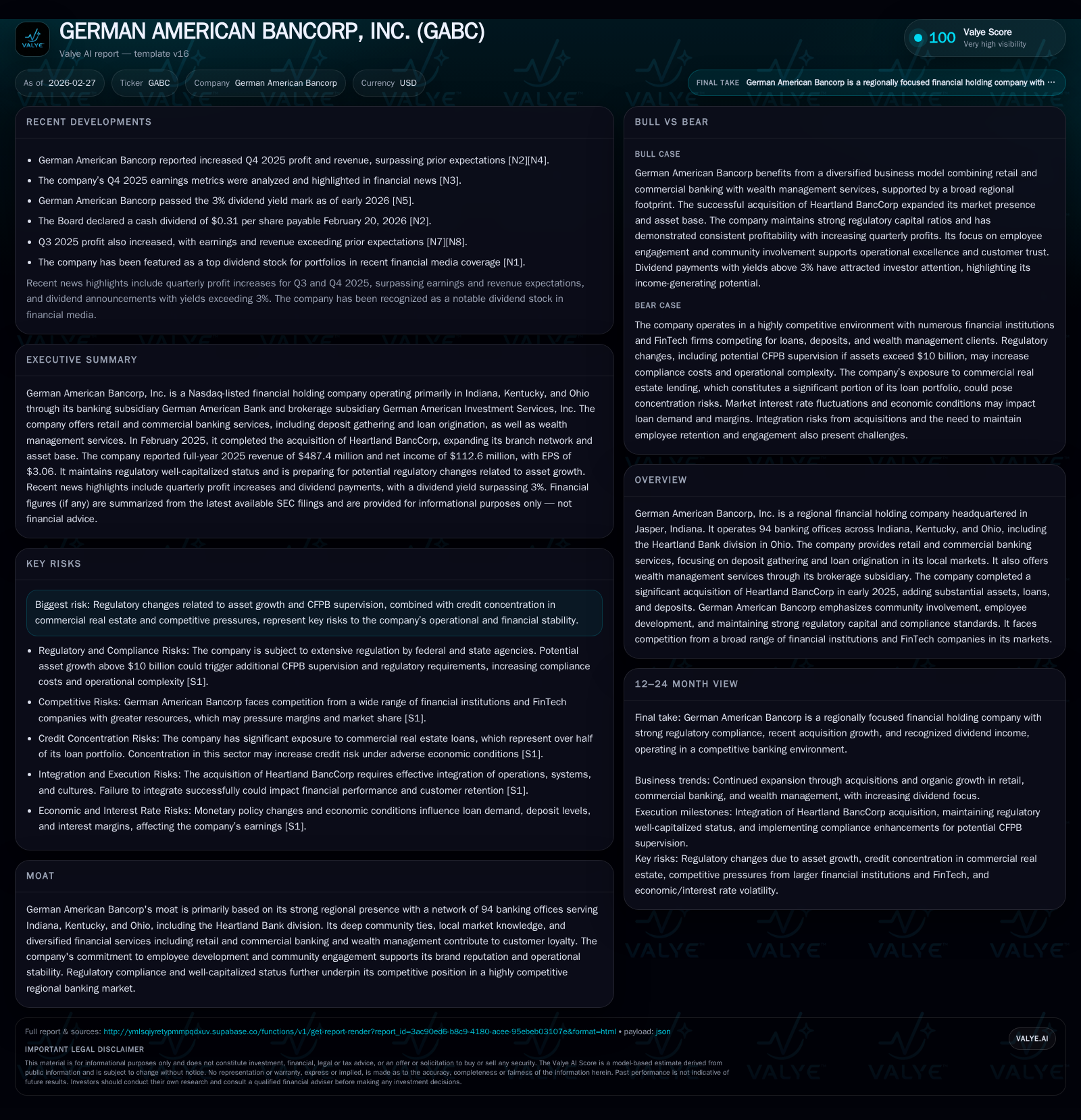
German American Bancorp, Inc. (GABC), a regional financial holding company serving Indiana, Kentucky, and Ohio, delivered a notable acceleration in financial performance in 2025 following its acquisition of Heartland BancCorp. This transaction boosted assets, loans, and deposits substantially, underpinning a 37.8% revenue increase to $487.4 million and a 34.4% net income rise to $112.6 million. The company maintains a disciplined approach toward capital adequacy and regulatory compliance as it prepares for potential CFPB supervision upon asset growth beyond $10 billion. Looking forward, organic growth across retail and commercial banking coupled with prudent integration of acquisitions will be key growth drivers, while credit concentration in commercial real estate and intensified competition from banks and FinTech remain primary risks.
Company Overview
German American Bancorp, Inc. (Nasdaq: GABC) is a regional financial holding company headquartered in Jasper, Indiana. Through its bank subsidiary, German American Bank, the firm operates a network of 94 banking offices across three states—Indiana (central/southern regions), Kentucky (northern/central/western), and Ohio (central/southwest). Notably, since February 1, 2025, it has integrated Heartland BancCorp's operations (20 offices in Ohio), enhancing its footprint notably around Columbus and Greater Cincinnati under the Heartland Bank brand.
The company provides retail and commercial banking services emphasizing deposit gathering and loan origination including consumer, commercial & agricultural real estate loans along with residential mortgages that are often sold into the secondary market. Additionally, wealth management offerings are provided through its brokerage subsidiary German American Investment Services.
Historical Financial Performance
German American Bancorp’s financials saw substantial uplift in FY2025 driven directly by the Heartland acquisition completed early that year:
Historical performance (annual)
| FY | Rev ($mm) | Net ($mm) | CFO ($mm) | Capex ($mm) | Rev YoY | Net YoY |
|---|---|---|---|---|---|---|
| 2025 | 487 | 113 | 159 | 5 | +37.8% | +34.4% |
| 2024 | 354 | 84 | 96 | 5 | -2.4% | |
| 2023 | 86 | 107 | 6 | +5.0% | ||
| 2022 | 82 | 110 | 8 |
Source: SEC companyfacts cache [F1].
Capital returns and efficiency (annual)
| FY | Div ($mm) | FCF ($mm) | ROE% |
|---|---|---|---|
| 2025 | 43 | 154 | 9.7 |
| 2024 | 32 | 91 | 11.7 |
| 2023 | 29 | 101 | 12.9 |
| 2022 | 27 | 102 | 14.7 |
Source: SEC companyfacts cache [F1].
This table encapsulates a rapid top-line growth spurt consistent with the sizable acquisition which contributed nearly $2 billion in assets, $1.58 billion in loans and approximately $1.73 billion in deposits [S23][F1]. The resultant increase in net income reflects efficient integration as well as robust underlying loan performance amidst a generally stable credit environment.
Operating cash flow expanded significantly by over two-thirds year-over-year highlighting improved core earnings quality and liquidity generation capacity which is especially important for community banks managing both organic growth and M&A capital needs.
Capital expenditures have remained modest relative to operating cash flow signaling disciplined reinvestment focused on selective technology upgrades or branch enhancements rather than aggressive expansion capex [F1].
Dividends paid also increased by roughly one-third consistent with a rising earnings base illustrating a commitment to returning capital to shareholders within regulatory constraints.
Strategic Growth Drivers
The completion of the Heartland BancCorp acquisition marks the most prominent recent growth catalyst for GABC [S23]. Integrating Heartland’s branch network significantly boosts scale within Ohio—a key geographic priority—and expands both the deposit franchise and loan originations.
Organic growth prospects remain anchored by:
- Local market penetration: leveraging deep community ties in Indiana, Kentucky, and Ohio to grow retail deposits and commercial lending.
- Wealth management cross-selling: continuing to build advisory relationships via German American Investment Services.
- Technology modernization under new leadership roles such as the Chief Digital & Information Officer appointed January 2026 who brings over two decades of experience implementing AI-driven digital banking solutions [S1].
Future growth also depends on successful navigation of emerging regulatory thresholds since assets are projected to surpass $10 billion around 2027 [S14][S16], triggering direct supervisory oversight from the Consumer Financial Protection Bureau (CFPB). GABC initiated preparatory compliance program reviews during 2025 with ongoing remediation action plans [S16]. This proactive stance aims to mitigate potential growth curbs related to new consumer protection requirements.
Risks and Constraints
While GABC’s conservative lending policies have historically supported credit quality, concentration risk remains elevated due to commercial real estate representing about 53% of the total loan portfolio [S5][S6]. Although current portfolio stress tests indicate sound risk controls amid rising interest rates, sustained CRE market weakness could pressure credit losses above anticipated levels.
The competitive landscape intensifies as GABC competes not only with regional peers but increasingly with large national banks and agile FinTech entrants that offer digital-first experiences backed by deeper resources [S20]. Maintaining customer loyalty requires continuous innovation balanced with personal service—a challenge for midsize regional banks across the U.S.
Compliance complexity also looms large given ongoing regulatory changes around consumer protection laws (Dodd-Frank amendments), cybersecurity mandates including mandatory incident disclosures within four business days if material [S18], as well as data privacy laws at state levels.
Lastly, interest rate volatility influenced by Federal Reserve monetary policy remains a key variable impacting margin compression or expansion given the typical asset sensitivity profile of community banks [S13][S27].
Capital Allocation & Returns
GABC ended FY2025 with common equity approximating $1.16 billion up significantly from prior years reflecting retained earnings accumulation post-acquisition and sound internal capital generation [F1][S4][S11]. The bank comfortably exceeds “well-capitalized” regulatory thresholds prescribed under Basel III standards including CET1 ratios above minimums signifying resilience against economic shocks.
Return on equity is roughly estimated at near 9.7%, consistent with regional banks balancing stable profitability while funding growth initiatives [F1]. Free cash flow metrics stand robust owing to high operating cash flow combined with restrained capital expenditures.
Dividend distributions represent an increasing but sustainable use of capital aligned with earnings growth; however limitations on dividends exist under certain regulatory conditions such as maintaining sufficient retained earnings per bank supervisory review [S15][S28]. On share repurchases, available history is limited precluding current buyback program analysis beyond modest past activity [F1].
Competitive Positioning & Moat Characteristics
German American Bancorp’s moat relies fundamentally on its entrenched regional footprint spanning three adjacent Midwestern states that fosters intimate local knowledge unavailable to larger national competitors . Its commitment to community involvement—financial literacy initiatives, volunteer programs—and employee development supports brand integrity and operational stability.
The combination of retail/commercial banking alongside growing wealth management offerings broadens client relationships reducing revenue concentration risks typical among pure deposit-taking institutions.
Regulatory compliance robustness—including dedicated cybersecurity leadership recently enhanced—and prudent credit risk management preserves long-term franchise value amid industry disruptions from FinTech platforms encroaching into traditional banking domains [S1][S18][S20].
What To Watch / Outlook Analysis
Explicit guidance or forecasts were not disclosed; however key milestones for observers would include:
- Monitoring organic loan/deposit growth post-Heartland integration progression throughout FY2026 as synergy realizations emerge.
- Banking asset size trajectory relative to the $10 billion CFPB supervision threshold expected circa late-2027 or early-2028.
- Trends in CRE portfolio performance amid macroeconomic pressures particularly any increases in non-performing loans or charge-offs.
- Technological modernization progress reflected through digital product adoption rates following CDIO initiatives launched early-2026.
- Regulatory developments around CRA reforms post preliminary injunction continuation could impact compliance programs.
- Employee engagement improvements based on internal surveys which influence service quality outcomes [S26].
In sum, German American Bancorp stands at an inflection point where strategic acquisitions coupled with disciplined organic growth have materially expanded scale while simultaneously imposing greater regulatory complexity requiring effective governance execution going forward.
Disclaimer: This report is prepared solely for informational purposes reflecting publicly available data as of February 27, 2026, without any recommendation or solicitation for investment decisions.
Disclaimer: This is research-only, informational analysis and not investment advice. It may include AI-generated interpretation and general industry context. Always verify important details using primary sources.

Comments