
Galectin Therapeutics: Clinical Progress and Capital Constraints Shape the Road to MASH Cirrhosis Approval
Galectin Therapeutics is pressing forward with belapectin in advanced MASH cirrhosis, buoyed by FDA alignment and promising biomarker data. Yet, with liquidity stretched and Phase 3 trials looming, future progress hinges on successful fundraising and clear clinical differentiation in a crowded fibrosis landscape.
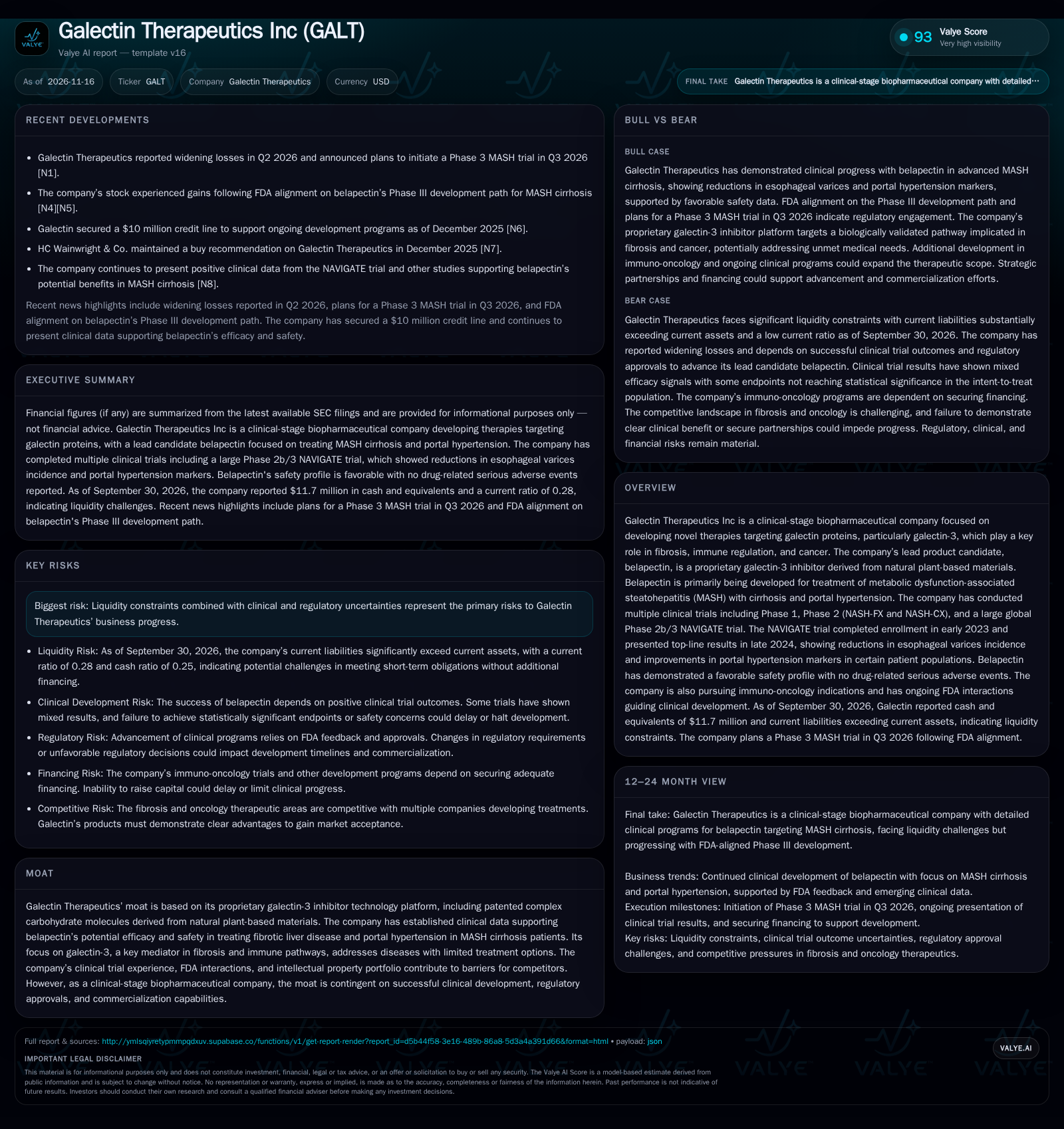
Galectin Therapeutics is advancing belapectin for MASH cirrhosis and portal hypertension, supported by favorable biomarker and safety data and recent FDA alignment for Phase 3. The next phase depends on translating clinical signals into regulatory and commercial success, outpacing both competitive and capital risks. [S2] [N1] [N4] [N6]
Galectin Therapeutics is at a pivotal inflection point as it advances its lead candidate, belapectin, for MASH cirrhosis with portal hypertension. The company has reported encouraging clinical data, including reductions in esophageal varices and improved liver biomarkers, and recently secured FDA alignment for a Phase 3 trial. The next 12 to 24 months will test whether promising science can overcome financial and commercial headwinds. [S2] [N1] [N4] [N6]
Clinical Signals and Capital Gaps Define Galectin’s Present
Galectin Therapeutics has completed the Phase 2b/3 NAVIGATE trial for belapectin in MASH cirrhosis, reporting top-line results in December 2024. These data showed a reduction in esophageal varices incidence in the per-protocol population and statistically significant effects in the U.S. subgroup. Additionally, belapectin improved key biomarkers, including liver stiffness measurement and ELF score, both associated with fibrosis progression and liver function. Importantly, the drug’s safety profile remained comparable to placebo, with no drug-related serious adverse events reported. [S2]
On the financial side, as of September 30, 2026, Galectin reported $11.7 million in cash and equivalents, current assets of $12.9 million, and current liabilities of $46.4 million, resulting in a current ratio of 0.28. This points to acute liquidity constraints. To bridge short-term needs, the company secured a $10 million credit line in late 2025, but with widening losses and an imminent Phase 3 trial, further capital will be essential. [S2] [N1] [N6]
The FDA has aligned with Galectin on the design and path forward for a pivotal Phase 3 trial in MASH cirrhosis, with plans to initiate enrollment in Q3 2026. The company’s clinical value proposition now depends on translating these signals into regulatory approval and, ultimately, commercial adoption. [N4] [N5]
Therapeutic Development Economics: High Stakes, High Burn
Galectin’s business model is typical of clinical-stage biopharma: large upfront R&D and clinical trial expenditures, minimal revenue until product approval, and a ‘binary’ value inflection tied to trial outcomes and regulatory decisions. The commercial opportunity in MASH (formerly NASH) cirrhosis is substantial, as there is currently no FDA-approved therapy for advanced disease with portal hypertension, and the addressable population is large and growing. Pricing for novel, disease-modifying therapies in this space can be premium if clear efficacy and safety are demonstrated.
However, the economics are capital-intensive. A pivotal Phase 3 trial in MASH cirrhosis is likely to require tens of millions in new investment, especially given the complexity of endpoints and regulatory requirements. Without approved products, Galectin must rely on external funding—dilutive equity raises, debt, or partnerships—to sustain operations. The company’s current cash and credit line are insufficient for a full Phase 3 program and subsequent commercial buildout. [S2] [N6]
If belapectin achieves approval, operating leverage could be significant: manufacturing costs for small-molecule or complex carbohydrate drugs are generally moderate relative to price, and sales can scale rapidly in high-unmet-need categories. However, commercial success will depend on payor acceptance, pricing power, and the ability to demonstrate meaningful health-economic benefits over existing standard of care, which is currently limited to supportive management.
Navigating a Crowded Fibrosis Pipeline and Potential Differentiation
The competitive landscape for MASH/NASH and liver fibrosis is dense, featuring both large pharmaceutical companies and smaller biotechs pursuing a variety of mechanisms. Many late-stage candidates have failed to show benefit in advanced fibrosis or have run into safety concerns, leaving an unmet need for therapies that can both arrest disease progression and improve portal hypertension.
Galectin’s core differentiation is its focus on galectin-3 inhibition—a biologically validated target in fibrosis and immune modulation—and its proprietary belapectin molecule. Positive NAVIGATE results in key U.S. subgroups and biomarker improvements provide a potential edge, especially if these findings are replicated in Phase 3. The company also holds a portfolio of patents around its platform, which could create barriers to direct competition.
However, counterforces are significant. Competitor categories include companies developing FXR agonists, THR-beta agonists, anti-fibrotic antibodies, and other small molecules. Some are ahead in development or backed by larger partners with deeper resources. The risk remains that another agent could demonstrate superior efficacy, safety, or commercial execution, eroding belapectin’s potential market share. Additionally, payors and clinicians may require robust, statistically significant data across the full intent-to-treat population, not just select subgroups, to drive adoption and reimbursement.
Pivotal Data and Strategic Partnerships Unlock Value
The most favorable scenario for Galectin is that the planned Phase 3 trial in MASH cirrhosis confirms the positive efficacy signals seen in the NAVIGATE U.S. subgroup and biomarker data, demonstrating statistically significant reductions in varices and improvements in portal hypertension for the broader patient population. If the safety profile remains clean and the FDA grants approval, belapectin could become the first approved therapy targeting this stage of MASH, enabling premium pricing and rapid market uptake.
This upside is amplified if Galectin successfully secures a strategic partnership or non-dilutive funding—either from a large pharma company seeking to enter the MASH space or via out-licensing in non-core geographies. Such a partnership could provide the capital and commercial infrastructure to drive adoption and maximize value.
Confirmation of this scenario would come from: (1) successful capital raises or partnership announcements sufficient to fund the Phase 3 trial; (2) positive, statistically significant Phase 3 results in the full intent-to-treat population; (3) regulatory approval milestones and supportive payor coverage decisions; and (4) early adoption signals from hepatology key opinion leaders and guideline inclusion.
Clinical Progress Continues, but Financing and Execution Remain Central Risks
The most likely outcome is that Galectin initiates its Phase 3 trial as planned, buoyed by FDA alignment and ongoing scientific engagement. The company may secure additional financing, potentially at dilutive terms, to bridge the capital gap. Early enrollment and continued biomarker improvements are plausible, but pivotal efficacy data may remain mixed or fall short of statistical significance in the broader population, reflecting the complexity of MASH trials and historical challenges in this field.
If this scenario unfolds, Galectin could remain a development-stage company for several more years, with value driven by incremental clinical progress, periodic scientific presentations, and partnership speculation. The company may need to prioritize clinical programs or slow spending to conserve cash, increasing execution risk and potentially delaying time to market.
Falsification of this scenario would come from: (1) failure to secure sufficient funding, resulting in halted or delayed trials; (2) adverse safety or efficacy data emerging from ongoing studies; or (3) rapid advancement of a competitor with a more compelling clinical and commercial profile.
Liquidity Crunch or Clinical Setbacks Force Restructuring
The adverse chain begins with Galectin unable to secure the additional funding necessary to initiate or complete the Phase 3 trial. [S2]
Even if the trial is launched, a failure to replicate NAVIGATE’s subgroup efficacy in the broader population or the emergence of safety concerns could halt development or render belapectin commercially unviable. In this scenario, Galectin may be forced to wind down operations, out-license assets at distressed valuations, or pursue a strategic sale.
Downside confirmation would include: (1) missed payroll or vendor payments; (2) public disclosure of strategic alternatives or going-concern risk; (3) trial suspension or termination announcements; and (4) negative regulatory feedback or clinical data releases.
Milestones and Metrics That Will Define Galectin’s Next Chapter
Evidence of successful fundraising—whether via equity, debt, or partnership—sufficient to fully fund the planned Phase 3 MASH trial and sustain operations for at least 18-24 months.
Public disclosure of Phase 3 trial protocol, enrollment pace, and early safety/efficacy signals, if available.
Updates on FDA feedback, regulatory milestones, and any changes to the clinical development path.
Data on the breadth and statistical robustness of belapectin’s efficacy in the full intent-to-treat population, beyond U.S. subgroups.
Commercial partnership announcements, particularly with large pharma or regional players, which would validate platform value and provide funding.
Competitive developments in the MASH/NASH fibrosis space, including major trial readouts or new approvals from peer companies.
A useful metric would be quarterly cash burn and projected runway based on disclosed clinical trial and operational spending.
Disclaimer: This is research-only, informational analysis and not investment advice. It may include AI-generated interpretation and general industry context. Always verify important details using primary sources.

Comments