
GEN Restaurant Group's Q2 Shows Revenue Resilience but Margin Pressure Persists
GENK’s latest quarter reveals revenue beats amid ongoing losses and critical liquidity strains, underscored by leadership changes and capital raising efforts.
In Q2 2026, GEN Restaurant Group reported revenue exceeding expectations driven by improved same-store sales and pricing strategies, yet continued to register net losses. The company faces mounting margin pressure from inflationary labor and commodity costs typical in the restaurant sector. A new CFO appointment and an at-the-market equity offering reveal an urgent need to bolster liquidity and fund growth initiatives. While operational challenges persist, menu innovation and targeted digital engagement offer potential support for future expansion. Investors should closely monitor capital access, margin improvement, and comparable sales performance in upcoming quarters.
Q2 Results Highlight Top-Line Strength but Earnings Pressure Continues
GEN Restaurant Group (NASDAQ: GENK) reported second-quarter results for the period ended June 30, 2026, announcing a revenue figure that surpassed analyst expectations [S2][N1]. This top-line resilience stems primarily from positive same-store sales trends supported by measured menu pricing adjustments—an essential lever in an environment of ongoing inflationary pressures across food service. However, despite the revenue beat, the company continued to post a net loss reflecting persistent margin compression typical in its industry [S2]. The gap between improving topline performance and earnings struggles underscores the delicate balance GENK faces managing cost inflation while driving guest traffic.
The reported results confirm that while the company's revenue model remains intact—selling food and beverages through company-operated restaurants—the operating environment remains harsh. Inflation in commodities such as meat, dairy, and produce combined with rising labor expenses has increased direct operating costs. These cost headwinds have eroded restaurant-level operating margins despite the company’s efforts to manage pricing dynamics and efficiencies.
Unit-Level Economics Under Inflationary Cost Pressures Challenge Margins
Industry-wide labor costs have surged due to wage inflation and heightened competition for frontline workers. GENK’s filings point to elevated labor cost percentages relative to revenue, which alongside commodity inflation has exerted downward pressure on profit margins [S2][F1]. This dynamic is symptomatic of restaurant chains operating primarily through company-owned stores where fixed overheads create operating leverage risks.
The company's inability to shift fully these input cost increases onto customers without risking traffic decline limits margin expansion potential. Compared to faster scaling peers with significant franchise components (where outsized capital costs are borne by franchisees), GENK's reliance on company-operated units intensifies its exposure to these expense pressures. In this context, controlling labor productivity and optimizing throughput become critical operational priorities that will influence margin stability going forward.
Strategic Leadership Adjustments Signal Capital Access Prioritization
Reflective of these operational challenges is GENK’s leadership transition announced earlier in June: appointment of Luke Hewko as Chief Financial Officer [S19][S21]. Mr. Hewko brings experience in building finance organizations under growth and sale conditions, signaling management’s prioritization on financial stabilization.
Concurrently on August 10, 2026, the company filed an at-the-market (ATM) equity offering registration allowing it to raise up to $3.74 million via common stock sales over time [S16][S17]. Proceeds are earmarked for working capital enhancement and funding expansion activities including new restaurant openings. These moves highlight near-term liquidity concerns exacerbated by ongoing operating losses and investment needs typical for restaurant groups aiming for unit growth amid margin pressures.
Industry Context: Benchmarking GENK against Quick-Service and Casual Dining Peers
GEN Restaurant Group operates in a highly fragmented restaurant industry segment characterized by razor-thin margins and intense competition. Compared with quick-service peers like Wendy’s (WEN) which continue to post margin resilience via franchising scale and digital penetration [N2], GENK exhibits more constrained profitability due to its emphasis on company-owned restaurants where labor/commodity costs weigh heavier.
Similarly, casual dining operators such as Darden Restaurants face analogous inflation-related cost challenges that compress margins despite premium pricing capabilities. Unlike some fast casual chains (e.g., Shake Shack), which leverage digital ordering platforms extensively enhancing throughput and customer engagement [N3], GENK’s filings do not detail significant investments or penetration levels in this domain.
This absence suggests operational capabilities or scale limitations relative to digitally advanced peers restraining potential top-line growth avenues—a factor investors must consider when assessing competitive positioning.
Growth Potential Supported by Menu Strategy and Digital Engagement Initiatives
While GENK has not quantified precise digital sales penetration or loyalty program effectiveness in its disclosures, these remain important levers in contemporary restaurant strategies. Menu pricing initiatives mentioned imply a focus on premiumization or value balancing designed to sustain average check growth without depressing traffic.
Successful execution of these strategies could support same-store sales momentum alongside selective unit expansion—critical given the capital-intensive nature of company-owned unit growth compared to franchise-led models. The effectiveness of operational efficiencies deployed will also influence how well increases in input costs translate into bottom-line recovery.
Liquidity Squeeze: Evaluating Debt Burden and Working Capital Needs
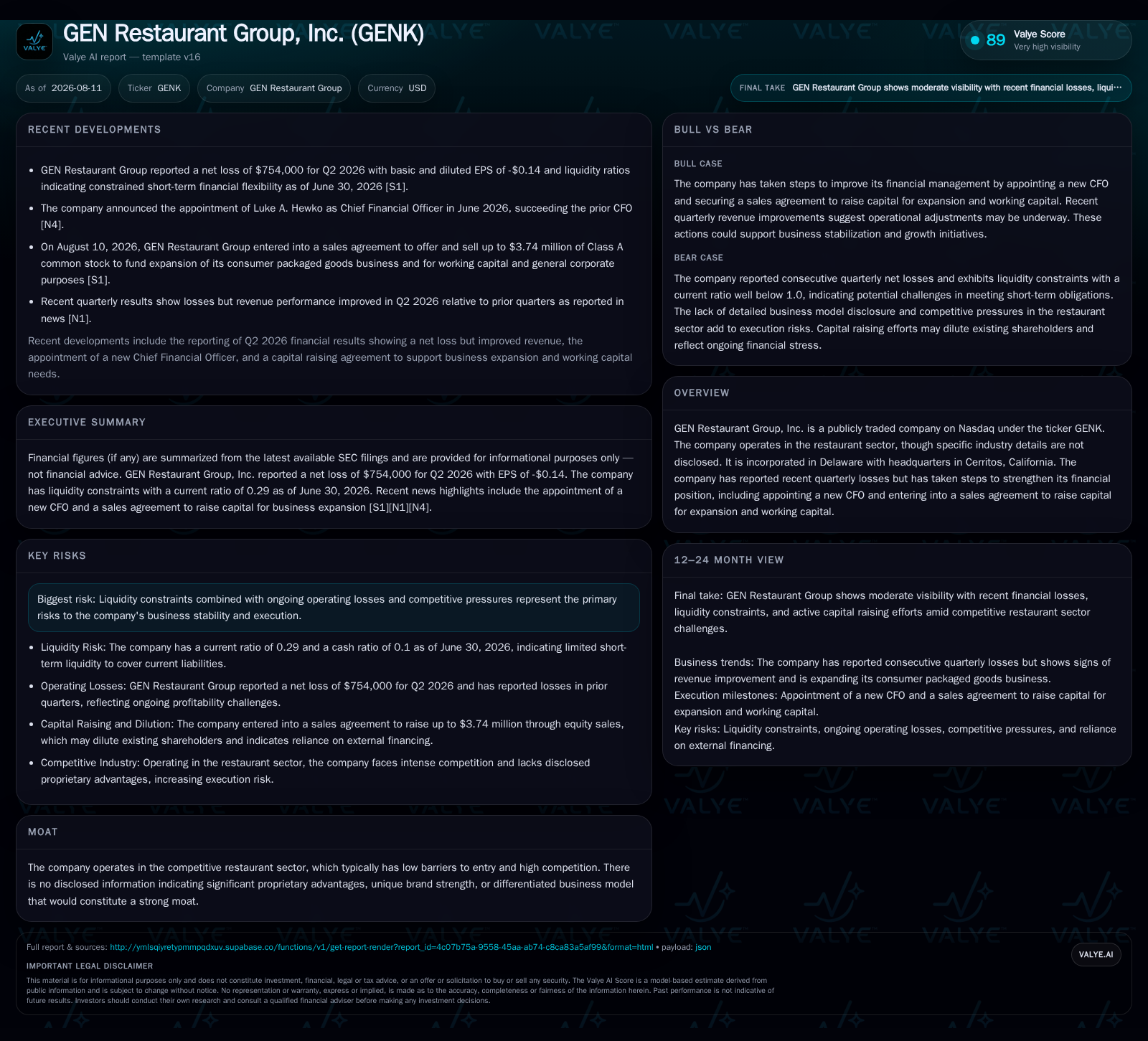
As of June 30, 2026, GENK held approximately $5.93 million in cash against total debt near $11.97 million resulting in net debt around $6.04 million [F1]. Current assets were notably outstripped by current liabilities ($16.80 million vs $58.47 million), rendering a concerning current ratio of approximately 0.29—a signal of significant short-term liquidity stress [F1][S2].
This imbalance underscores the urgency behind the ATM equity offering intended to supplement working capital reserves amid pursuit of planned expansions [S16][S17]. The low liquidity ratio combined with consistent net losses heightens execution risks related to operational continuity without successful capital influx or improved cash flow generation.
Investors should monitor if liquidity management initiatives paired with margin improvements can alleviate solvency concerns given this fragile financial footing.
What Investors Should Monitor Ahead of Next Quarterly Milestones
Key indicators include further updates on sales trajectory—particularly same-store sales growth rates—and prospective shifts in operating margins reflecting either intensified cost control or improved pricing power [S2][S3]. Progress with equity raise execution under the ATM facility will reveal immediate financial health prospects.
Additionally, management commentary on unit count changes or franchise development (if any), along with clarity on digital ordering integration impact will be telling for longer-term scalability.
Watch for announcements on marketing spend efficiency gains or operational restructurings aimed at achieving breakeven points amid high fixed costs associated with company-owned outlets.
Financial Profile Discussion
GEN Restaurant Group's liquidity position is currently stretched; end-of-Q2 cash stands at roughly $5.93 million against total debt close to $11.97 million leading to net debt exceeding six million dollars [F1]. The company exhibits a precarious current ratio near 0.29 due largely to current liabilities substantially surpassing current assets—a structural weakness indicating potential challenges meeting short-term obligations without additional financing or operational turnaround [F1].
These factors contextualize the strategic importance of recent CFO transition aimed at strengthening financial stewardship [S19] coupled with an ATM equity arrangement allowing up to $3.74 million capital raises as critical lifelines for sustaining operations while funding growth plans [S16][S17]. Given typical restaurant industry dynamics involving low single-digit operating margins and need for continual capex investments for unit refreshes or openings, maintaining adequate liquidity is paramount. Continued net losses from operations suggest free cash flow generation remains negative necessitating reliance on external financing or marked improvements in profitability.
This analysis synthesizes information available as of August 2026 from public filings and sector context without projecting specific future outcomes or making investment research views.
Disclaimer: This is research-only, informational analysis and not investment advice. It may include AI-generated interpretation and general industry context. Always verify important details using primary sources.

Comments