
Golden Growers Cooperative Nears Dissolution: The Economics and Endgame of a Value-Added Corn Partnership
Golden Growers Cooperative, a member-owned corn processor with a unique stake in ProGold LLC, is in the final stages of liquidation after decades of channeling value to growers through a joint venture with Cargill. With the sale of its ProGold interest pending and its business model winding down, the focus shifts to how remaining assets are distributed, how execution risks play out, and what the case reveals about the economics and vulnerabilities of value-added agricultural cooperatives.
Golden Growers Cooperative is dissolving after approving a plan to sell its 50% interest in ProGold LLC to Cargill, ending its decades-long model of distributing lease-derived income to member corn growers. The cooperative's final act will test the orderly realization of asset value, expose the risks of concentrated partnerships, and offer insight into the mechanics and limitations of co-op-driven value addition in mature agricultural processing.
Golden Growers Cooperative stands at a pivotal moment: after more than three decades leveraging its unique joint venture with Cargill to deliver value-added returns to over 1,400 Midwest corn growers, the cooperative is in the process of liquidating its assets and winding down operations. With the sale of its 50% interest in ProGold LLC to Cargill now approved, Golden Growers is transitioning from a steady, contract-driven generator of member income to a dissolving entity facing the challenges of executing an orderly asset sale and final distribution. This endgame not only tests the resilience of the cooperative model in mature processing markets but also illuminates the structural trade-offs facing agricultural collectives built on single-asset, concentrated partnerships.
Golden Growers’ Dissolution: Where the Business Stands Today
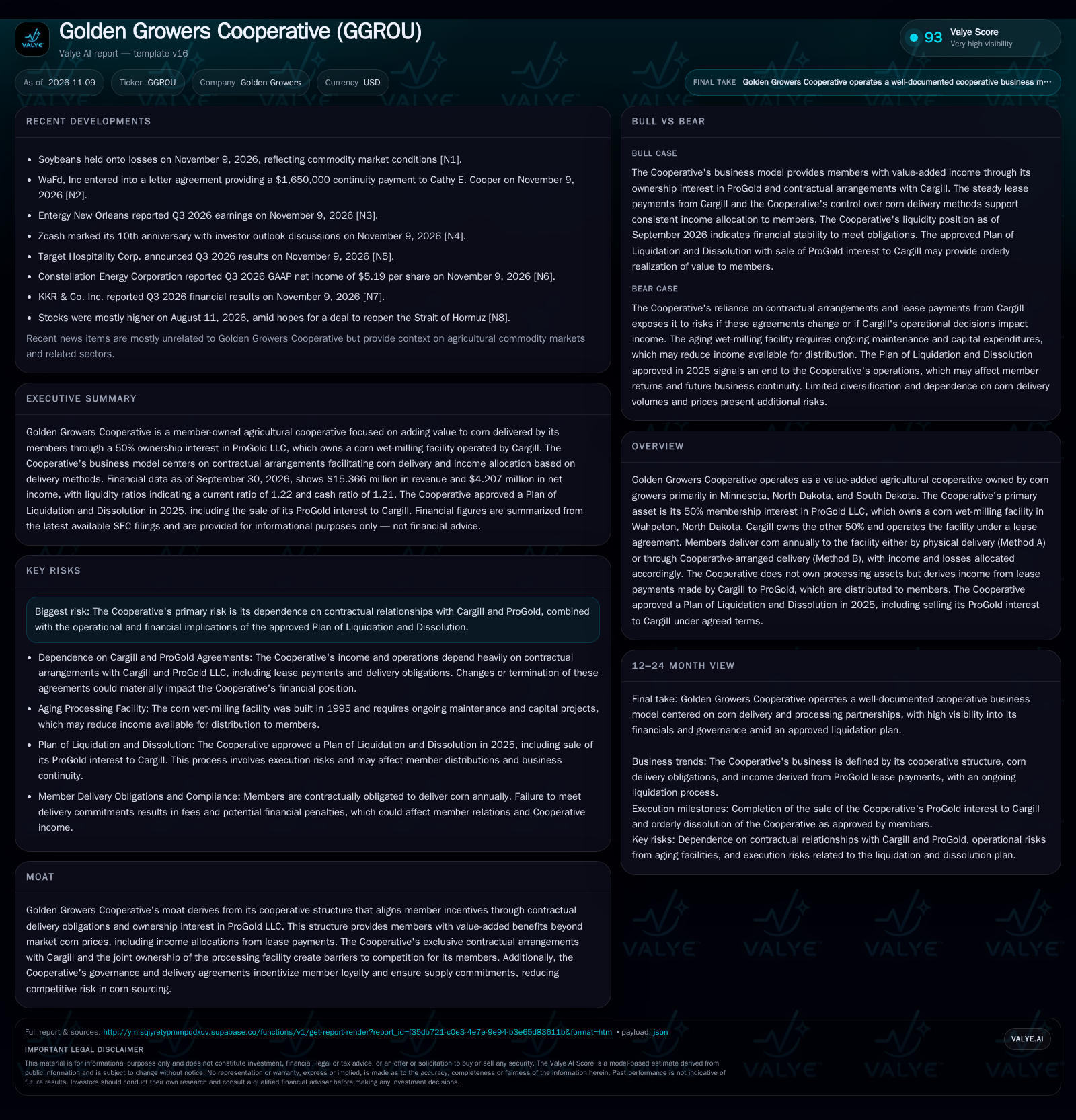
Golden Growers Cooperative is executing a Plan of Liquidation and Dissolution approved in 2025, centered on selling its 50% interest in ProGold LLC to Cargill, the co-owner and facility operator [S1]. The cooperative’s primary income source has been lease payments from Cargill for the use of the Wahpeton, North Dakota wet-milling facility—$16 million annually from 2024 to 2026 [S1]. As of September 30, 2026, Golden Growers reported $15.366 million in revenue and $4.207 million in net income, with cash and equivalents of $1.963 million and a current ratio of 1.22 [S2]. These numbers represent the final phase of operations, as the cooperative prepares to distribute remaining value to its 1,445 grower-members and dissolve.
How Golden Growers Created—and Distributed—Value
The economic model of Golden Growers Cooperative has been shaped by two defining features: its 50% ownership in ProGold LLC (the entity holding the processing facility) and its contractual delivery system for member corn. The cooperative itself does not process corn or own plant assets; instead, it receives lease income from Cargill, which operates the facility, and distributes this income (net of fees and expenses) to members based on corn delivery participation [S1].
Income allocation is sensitive to the delivery method: members can deliver corn physically (Method A) or have the cooperative arrange delivery via Cargill as agent (Method B), each with different incentives and fees. At least 15% of income is reserved for Method A participants, regardless of actual delivery proportions [S1].
The cost structure is unusually lean—Golden Growers had only one full-time employee as of December 2025 [S1]. The largest operating expenses are grain service fees to Cargill and penalties for non-delivery by members. The cooperative’s business model thus features minimal fixed overhead but is highly dependent on the terms and continuity of its lease and delivery agreements.
Operating leverage is limited by the fixed nature of lease income, while member distributions are a direct pass-through of those receipts net of costs. With the impending sale of its ProGold stake and dissolution, the final economic outcome for members will hinge on the sale terms and the efficient unwinding of obligations.
Cooperative Structure as a Double-Edged Sword
Golden Growers’ competitive position has historically been anchored in its cooperative structure, which aligns grower incentives with processing economics. By pooling bargaining power and securing a joint venture interest in ProGold, the cooperative enabled members to capture value beyond commodity corn prices, smoothing income through lease-derived distributions [S1].
However, the model’s moat is fundamentally narrow: the cooperative’s fortunes are tied to a single asset (the Wahpeton plant) and a single counterparty (Cargill). This structure offered high income visibility as long as the partnership endured, but provided little diversification or bargaining leverage in the event of operational or contractual disruptions.
In the broader context, Golden Growers’ model is distinct from commodity marketing co-ops or diversified processors; it offered a specialized, value-added channel for a fixed member base. But the lack of asset diversification or alternative revenue streams left the cooperative exposed to any changes in the economics or ownership of the ProGold facility.
The cooperative’s single-asset concentration not only heightens exposure to counterparty risk but also constrains strategic options in evolving market conditions. For instance, if processing economics at the Wahpeton facility were to deteriorate due to technological shifts or regulatory changes, Golden Growers would have limited recourse to pivot or renegotiate terms. Additionally, the reliance on a single corporate partner reduces competitive tension that might otherwise drive more favorable lease or service arrangements. This structural rigidity suggests that while the cooperative model can effectively capture value in stable environments, it is inherently vulnerable to disruption when asset or partnership conditions change.
Orderly Liquidation Maximizes Member Value
The most favorable outcome for Golden Growers members is a smooth execution of the liquidation plan, with the ProGold stake sold to Cargill at or above book value and minimal transaction friction. In this scenario, the cooperative efficiently settles outstanding obligations, distributes net proceeds to members, and closes its books without litigation or asset impairment.
Confirmation of this scenario would come from disclosures of final sale terms matching or exceeding carrying value, timely distributions, and an absence of post-closing disputes or unexpected liabilities. Additional upside could emerge if the facility is valued above expectations due to favorable processing margins or strategic value to Cargill.
Most Probable: Asset Sale at Book Value, Routine Wind-Down
The most plausible outcome is that Golden Growers sells its ProGold interest to Cargill at a price close to its last reported book value, pays out remaining cash to members, and dissolves with little drama. The fixed nature of lease income and clarity of contractual terms suggest limited room for outperformance or negative surprises, barring unforeseen disputes.
This scenario would be confirmed by member communications announcing final distributions in line with recent financial statements, a lack of litigation or regulatory intervention, and the absence of significant asset write-downs or wind-down costs. Any deviation in final distribution amounts or timing would be a signal to re-examine process risks or asset valuations.
Execution Risks: Delays, Disputes, or Unexpected Liabilities
A less favorable outcome involves execution risks inherent in dissolution: delays in closing the asset sale, disputes over valuation or contract terms with Cargill, or discovery of latent liabilities (e.g., environmental, tax, or pension obligations) that erode distributable value.
Downside would be confirmed by member notifications of delayed payments, litigation between the cooperative and Cargill or other parties, or restatements of asset values. Any unexpected drop in final distributions, material legal costs, or regulatory actions would signal that wind-down risks have materialized.
Testing the Endgame: What Will Determine Member Outcomes
Final sale price and terms of the ProGold interest to Cargill—any premium or discount to book value will directly affect member payouts.
Timing and amount of final member distributions; delays or reductions would indicate execution or valuation issues.
Disclosure of any contingent or off-balance-sheet liabilities (environmental, legal, tax) that could reduce net proceeds.
Transaction costs and wind-down expenses—higher-than-expected costs would erode member value.
Member communications regarding the status of the liquidation and any unresolved disputes or claims.
Confirmation of regulatory or legal approvals required for dissolution and asset transfer.
If disclosed, any post-sale indemnification obligations or escrow requirements imposed by Cargill or regulators.
Disclaimer: This is research-only, informational analysis and not investment advice. It may include AI-generated interpretation and general industry context. Always verify important details using primary sources.

Comments