
Trinseo PLC: Navigating Bankruptcy Restructuring, Margin Recovery, and the Stakes of Demand Volatility
Trinseo’s post-Chapter 11 landscape is defined by pricing-led sales gains, persistent net losses, and the challenge of restoring operating stability amid sector headwinds. The company’s ability to leverage its product diversity and restructuring efforts will determine whether it can achieve sustainable profitability in the face of ongoing demand and trade uncertainties.
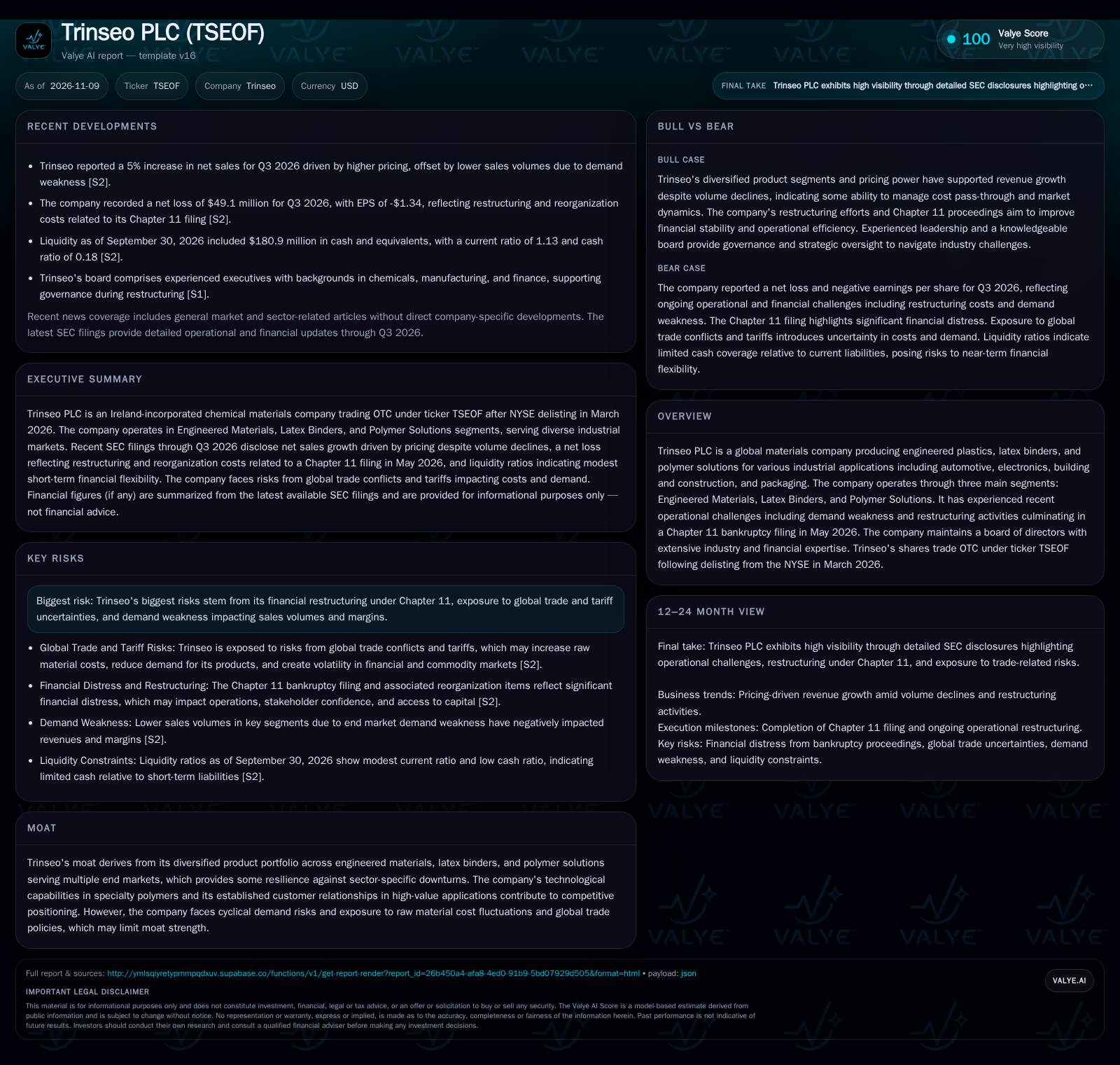
Trinseo PLC, now trading OTC after its NYSE delisting, is restructuring under Chapter 11 following operational and financial distress. Q3 2026 showed higher pricing driving a 5% sales increase, but volumes remain weak and losses persist. The company’s liquidity position is modest, with limited cash relative to current liabilities. The outcome hinges on the effectiveness of restructuring, the ability to reignite demand, and external risks like tariffs and trade disruptions. [S2]
Trinseo PLC, an engineered materials and chemical solutions provider, stands at a pivotal juncture. Following its May 2026 Chapter 11 bankruptcy filing and subsequent OTC transition, the company’s recent results reflect a mix of tentative pricing power and ongoing operating pain. While Q3 2026 saw net sales rise on improved pricing, falling sales volumes and persistent net losses paint a picture of a business still searching for equilibrium. The real test lies ahead: can Trinseo’s restructuring efforts and product diversification overcome sectoral and macroeconomic headwinds, or will trade friction and demand volatility continue to erode its foundation?
Recent Bankruptcy, Pricing Gains, and Persistent Losses: Where Trinseo Stands Now
Trinseo filed for Chapter 11 bankruptcy protection in May 2026, marking a critical inflection point for the company’s capital structure and operational strategy. The company subsequently delisted from the NYSE and now trades OTC under TSEOF. For Q3 2026, Trinseo reported net sales of $778.7 million, a 5% year-over-year increase driven by higher pricing, but this was offset by lower sales volumes as end market demand remained weak. Gross profit increased to $53.1 million (7% margin), yet the company still posted a net loss of $49.1 million for the quarter. Liquidity remains tight: as of September 30, 2026, Trinseo held $180.9 million in cash and equivalents, with a current ratio of 1.13 and a cash ratio of just 0.18. The bankruptcy process triggered a reclassification of nearly all prepetition debt as liabilities subject to compromise, leading to a sharp drop in reported interest expense. These facts set the stage for an uncertain recovery, with operational and financial restructuring underway but not yet proven effective. [S2]
How Trinseo’s Segments Generate (or Lose) Cash: Pricing, Volume, and Margin Dynamics
Trinseo’s core business spans three segments: Engineered Materials, Latex Binders, and Polymer Solutions. The company’s economics are shaped by a mix of commodity and specialty products, with variable input costs (notably for petrochemical feedstocks) and cyclical end-market demand. Recent results highlight a critical tension: while higher pricing has partially offset volume declines, overall gross margins remain slim (7% in Q3 2026), indicating limited ability to pass through all cost increases or to sustain premium pricing in weak markets. Fixed costs—such as plant operations, R&D, and SG&A—create operating leverage, but this can cut both ways: declining volumes quickly erode profitability, as seen in persistent net losses. Capital needs are substantial, covering both maintenance and compliance investments, but are now complicated by bankruptcy-related constraints and limited access to new financing. The company’s ability to improve margin relies on a combination of restructuring-driven cost cuts, selective pricing power in higher-value segments, and eventual recovery in end-market demand. If restructuring succeeds, operating leverage could amplify gains; if not, losses could deepen rapidly.
Resilience or Vulnerability? Trinseo’s Place in the Global Materials Landscape
Trinseo’s competitive position rests on its diversified portfolio across engineered plastics, latex binders, and specialty polymers, serving automotive, electronics, construction, and packaging customers. This breadth provides some defense against sector-specific downturns and allows the company to shift emphasis as markets evolve. However, several counterforces are in play. Commodity chemical producers and specialty materials peers—many with larger scale or stronger balance sheets—may be better positioned to weather prolonged downturns or to invest in innovation and customer relationships. Substitution risk is real: customers can switch to alternative materials, especially if pricing or supply reliability falters. Trinseo’s exposure to global trade and tariffs adds another layer of vulnerability, as raw material sourcing and customer demand can be disrupted by geopolitical shifts. The company’s moat, such as it is, hinges on its technical expertise in specialty polymers and longstanding customer relationships in high-value applications, but these advantages are not immune to broader industry pressures or internal financial constraints.
If Restructuring Delivers: Margin Expansion and Demand Recovery as Catalysts
A favorable outcome for Trinseo would stem from successful execution of its Chapter 11 restructuring, resulting in a leaner cost base, more flexible capital structure, and restored stakeholder confidence. If end-market demand rebounds—particularly in construction, automotive, or electronics—and the company leverages its product diversity to capture share or command premium pricing, gross margins could expand meaningfully. Evidence confirming this upside would include sequential improvements in sales volumes (not just pricing), widening gross and operating margins, and a return to positive net income. Reduced restructuring charges and normalized interest expense post-bankruptcy would further support earnings. A successful emergence from Chapter 11, accompanied by new or renewed customer contracts, and investments in higher-value product lines would all help validate the upside thesis. Falsification would come from continued volume declines, margin stagnation, or an inability to exit bankruptcy with a sustainable capital structure.
Stabilization Without Breakout: Modest Margin Recovery Amid Ongoing Headwinds
The most plausible middle path is one of incremental improvement, not dramatic turnaround. Trinseo may achieve modest gains in gross margin as restructuring efforts yield some cost savings and pricing holds steady in select niches. However, persistent weakness in key end markets (especially if macroeconomic conditions remain soft or trade tensions escalate) would likely keep volumes subdued and limit upside. Net losses could narrow but not fully reverse, as ongoing restructuring and interest costs weigh on the bottom line. Liquidity would remain tight, necessitating disciplined working capital management and possibly further asset sales or facility rationalizations. Confirmation of this scenario would be flat-to-slightly rising volumes, gradual margin expansion, and stabilization in cash flows—without a clear return to robust profitability. A reversal of these trends, such as renewed volume declines or margin compression, would signal downside risk.
When Recovery Falters: Prolonged Demand Weakness and Restructuring Setbacks
The adverse scenario sees Trinseo unable to restore sufficient demand or achieve targeted cost reductions, leaving the company mired in ongoing losses. If global trade frictions intensify, raw material costs spike, or customers accelerate material substitution, sales volumes could fall further and pricing power could erode. Prolonged bankruptcy proceedings or failed negotiations with creditors might restrict access to working capital or impede operational flexibility. In this scenario, liquidity pressures could mount, forcing additional asset sales or even liquidation of business units. Early warning signs would include continued cash burn, negative free cash flow, deteriorating customer relationships, and further declines in sales volumes or margins. Evidence to confirm this scenario would be persistent net losses, shrinking cash balances, and adverse developments in the bankruptcy process.
Milestones That Will Shape Trinseo’s Post-Bankruptcy Trajectory
Monitoring sequential changes in sales volumes across each segment would help assess whether demand is stabilizing or continuing to erode. A useful metric would be segment-specific volume trends if disclosed.
Tracking gross and operating margin evolution in the quarters following restructuring will reveal if cost savings and pricing actions are translating into sustainable profitability.
Updates on the status and terms of the Chapter 11 process—particularly exit financing, creditor agreements, and any asset sales—will be critical to evaluating future capital structure flexibility.
Disclosure of new or renewed customer contracts in higher-value applications would signal customer confidence and potential for improved revenue visibility.
Observation of capital expenditure trends post-bankruptcy will indicate whether Trinseo can resume strategic investments or remains in a cash-conservation mode.
Any significant changes in global trade policy, tariffs, or supply chain disruptions affecting raw materials or end markets must be watched for sudden impacts on cost structure or demand.
Board and executive turnover during or after restructuring could signal shifting strategic priorities or deeper governance challenges.
Disclaimer: This is research-only, informational analysis and not investment advice. It may include AI-generated interpretation and general industry context. Always verify important details using primary sources.

Comments