
Greenland Mines Ltd: Platform Ambitions, Preclinical Stakes, and the Strategic Puzzle of Mining Diversification
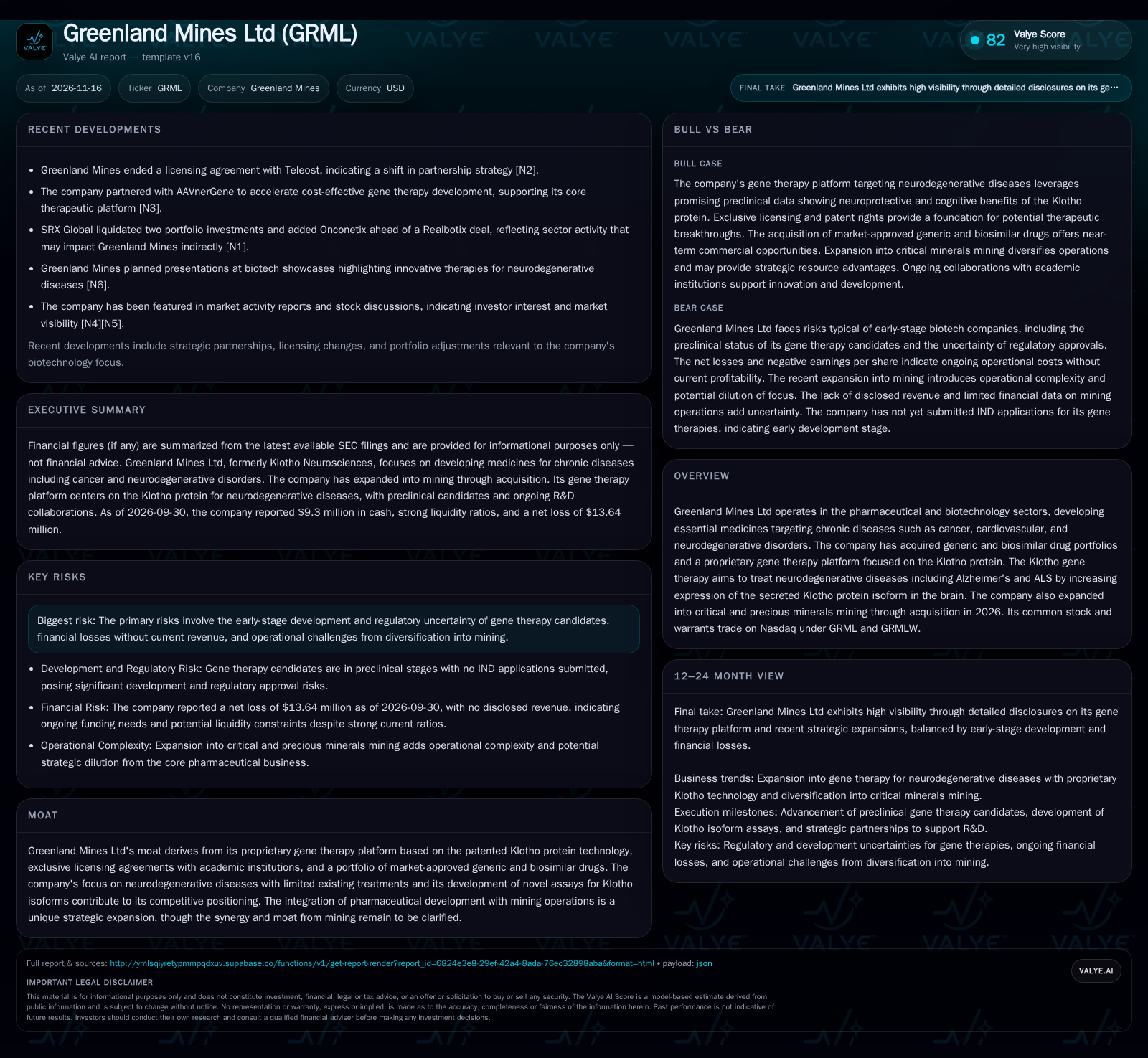
Greenland Mines Ltd merges early-stage biotech ambitions in neurodegenerative disease with a recent foray into critical minerals mining. While proprietary Klotho gene therapy assets and market-approved oncology drugs offer long-term potential, operational losses and the complexity of multiple business lines raise key questions about focus, capital allocation, and the path to commercial proof.
Greenland Mines Ltd is pursuing a dual-track strategy: advancing preclinical gene therapies for neurodegenerative diseases and integrating a newly acquired mining operation. The next 12–24 months hinge on R&D progress, regulatory steps, and clarity on the commercial or strategic rationale for its mining expansion. [S2]
Greenland Mines Ltd stands at a strategic crossroads, blending high-potential but preclinical-stage gene therapy assets for neurodegenerative diseases with a nascent entry into the mining sector. Investors must weigh the promise of Klotho-based therapies and oncology drug assets against the execution risk and capital demands of both biotech and mining, with near-term progress in R&D and commercial clarity on the mining venture serving as critical proof points. [S2]
Liquidity, Losses, and the Reality of a Dual-Sector Strategy
As of September 30, 2026, Greenland Mines Ltd reported $9.3 million in cash and equivalents, with current assets totaling $59.46 million and current liabilities of $0.96 million. Despite this, the company posted a net loss of $13.64 million for the period, translating to a basic and diluted EPS of -$2.51 per share. Notably, there is no disclosed revenue or operating income from either the pharmaceutical or the newly acquired mining operations, and the gene therapy pipeline remains at the preclinical stage with no INDs filed. In March 2026, the company further complicated its profile by acquiring a mining business focused on critical and precious minerals development. These facts set the stage for a business with scientific ambition, ample complexity, and high execution risk. [S2]
How Greenland Mines Could Monetize: Drug Margins, Mining Economics, and the Runway Challenge
Greenland Mines’ economics are not yet proven at the commercial level. In pharmaceuticals, the company’s portfolio includes five market-approved anti-cancer drugs in Germany, which could, if successfully commercialized, generate near-term revenue with typical generic and biosimilar drug margins. These products, particularly if used in standard-of-care regimens like FOLFOX or FOLFIRI, may offer moderate gross margins but face price competition and reimbursement pressures, especially in European markets. The proprietary gene therapy platform targeting neurodegenerative diseases represents a high-risk, high-reward opportunity: if KLTO-101 or KLTO-202 progresses to clinical trials and eventually regulatory approval, such therapies can command premium pricing and strong margins, but require heavy R&D investment, long timelines, and costly clinical trials. No INDs have been filed, so all value here is currently option-like.
The recent mining acquisition adds a fundamentally different economic model. Mining is capital-intensive, cyclical, and typically offers lower gross margins than successful pharmaceuticals, but can generate substantial cash flow if resource extraction is efficient and commodity prices are favorable. The absence of disclosed revenue, production levels, or cost structure from the mining business leaves its contribution highly speculative. Operating leverage exists in both segments, but the risk is that fixed costs and required investment may outpace cash inflows unless one or both business lines demonstrate tangible commercial traction.
Biotech Ambition Meets Mining: Competitive Moats and Counterforces
In pharmaceuticals, Greenland Mines’ moat rests on the proprietary gene therapy platform centered on the Klotho protein, along with exclusive licensing and patent rights developed in academic collaboration. This focus on neurodegenerative diseases, where effective therapies are scarce, could confer first-mover advantage if the science translates into clinical and regulatory milestones. The biosimilar and generic oncology portfolio provides a base of market-approved drugs, but faces intense competition from established generics players, price controls, and payer scrutiny in Europe. The ability to differentiate through pricing, manufacturing, or distribution efficiency is not yet established.
The mining expansion places Greenland Mines in a new competitive arena, where barriers to entry are defined by resource access, extraction technology, regulatory compliance, and commodity market dynamics rather than intellectual property. The rationale for integrating mining with pharmaceuticals is not yet clear: unless mineral resources directly support pharma manufacturing (e.g., rare earths for drug synthesis or delivery systems), synergy is uncertain. Competitors in each segment are typically highly specialized, with diversified mining conglomerates and focused biotech firms rarely overlapping in operations or capital allocation. Greenland Mines’ unique structure could offer risk diversification, but also risks strategic dilution and management distraction.
Therapeutic Breakthroughs and Commercial Synergy: What Would Drive a Rerating
A favorable scenario for Greenland Mines hinges on two reinforcing developments: 1) clinical advancement of its Klotho-based gene therapy candidates, and 2) successful monetization of the oncology drug portfolio or mining assets. If KLTO-101 or KLTO-202 progresses from preclinical to IND filing, followed by positive Phase 1/2 safety and efficacy data, the company could attract strategic partnerships, non-dilutive funding, or premium valuations typical of biotech firms with novel neurodegenerative pipelines. Patents and exclusive licenses would help secure future economics, especially if early clinical data validate the animal model neuroprotection and cognitive improvement results.
On the mining side, efficient development, production, and sale of critical or precious minerals—especially if linked to supply chains relevant for pharmaceuticals or other high-growth sectors—could generate cash flow to fund R&D, providing internal financing and reducing reliance on equity or debt markets. Evidence confirming this scenario would include clinical trial initiations, licensing deals, disclosed revenues from drug or mineral sales, and operating margin expansion. Falsification would come from continued preclinical delays, lack of commercial progress, or cash burn without offsetting inflows.
Operational Complexity and Delayed Validation: The Most Likely Trajectory
Absent near-term clinical or commercial breakthroughs, Greenland Mines is likely to continue incurring net losses as it invests in R&D and mining development. The oncology drug portfolio may generate modest revenue if commercialized effectively, but in the absence of disclosure, it is prudent to assume this contribution remains limited near-term. The gene therapy platform is expected to remain preclinical through at least the next year, with IND submission and early clinical data as key milestones. Mining operations may require substantial capital expenditures before reaching cash-generative status, and integration risk is high given the company’s lack of public track record in the sector.
Confirmation of this scenario would come from continued negative earnings, incremental R&D updates, and slow or undisclosed progress in mining production or sales. Falsification would require a step-change in revenue disclosure, clinical advancement, or external validation via partnerships or licensing.
Execution Drag and Capital Erosion: Where the Model Could Break Down
The primary risk is that Greenland Mines’ dual-sector strategy leads to persistent cash burn without meaningful commercial or clinical validation in either segment. Prolonged preclinical development or regulatory setbacks in gene therapy could erode investor confidence and limit access to new capital. If the mining venture fails to produce marketable output or faces cost overruns, the company could be forced to dilute shareholders or divest assets to raise funds. Operational complexity, management distraction, and lack of clear strategic focus may exacerbate losses and delay any path to profitability.
Confirmation of this downside would include ongoing net losses with no revenue growth, failure to advance gene therapy candidates to clinical stage, lack of disclosed mining output or sales, and potential down rounds or distressed financing. Falsification would require clear evidence of segment-level progress or external validation.
Thesis-Testing Developments for Greenland Mines: What to Track Next
Progression of KLTO-101 or KLTO-202 from preclinical to IND submission and initiation of first-in-human trials.
Disclosure of revenue or margin contributions from the German oncology drug portfolio—if disclosed, trends in market share and pricing would be critical.
Any details on production volumes, sales contracts, or cost structure from the mining business, as well as commodity pricing exposure.
Updates on strategic partnerships, licensing deals, or non-dilutive funding secured for the gene therapy platform.
Cash burn rate and updated liquidity position in subsequent quarters, including any capital raises or debt issuances.
Evidence of synergy or operational integration between mining and pharmaceutical segments, if any is articulated or realized.
Patent issuances, regulatory feedback, or competitive pipeline advancements in the neurodegenerative therapy space.
Disclaimer: This is research-only, informational analysis and not investment advice. It may include AI-generated interpretation and general industry context. Always verify important details using primary sources.

Comments