
Globa Terra Acquisition Corp: Extension Risks, Redemption Pressures, and the Challenge of Closing with Nature’s Ledger
Globa Terra Acquisition, a SPAC targeting agribusiness and water-sector deals, faces acute execution risk as redemptions drain its trust account and Nasdaq delisting looms. Its proposed merger with Nature’s Ledger is now a test of SPAC mechanics, sponsor incentives, and residual deal capacity.
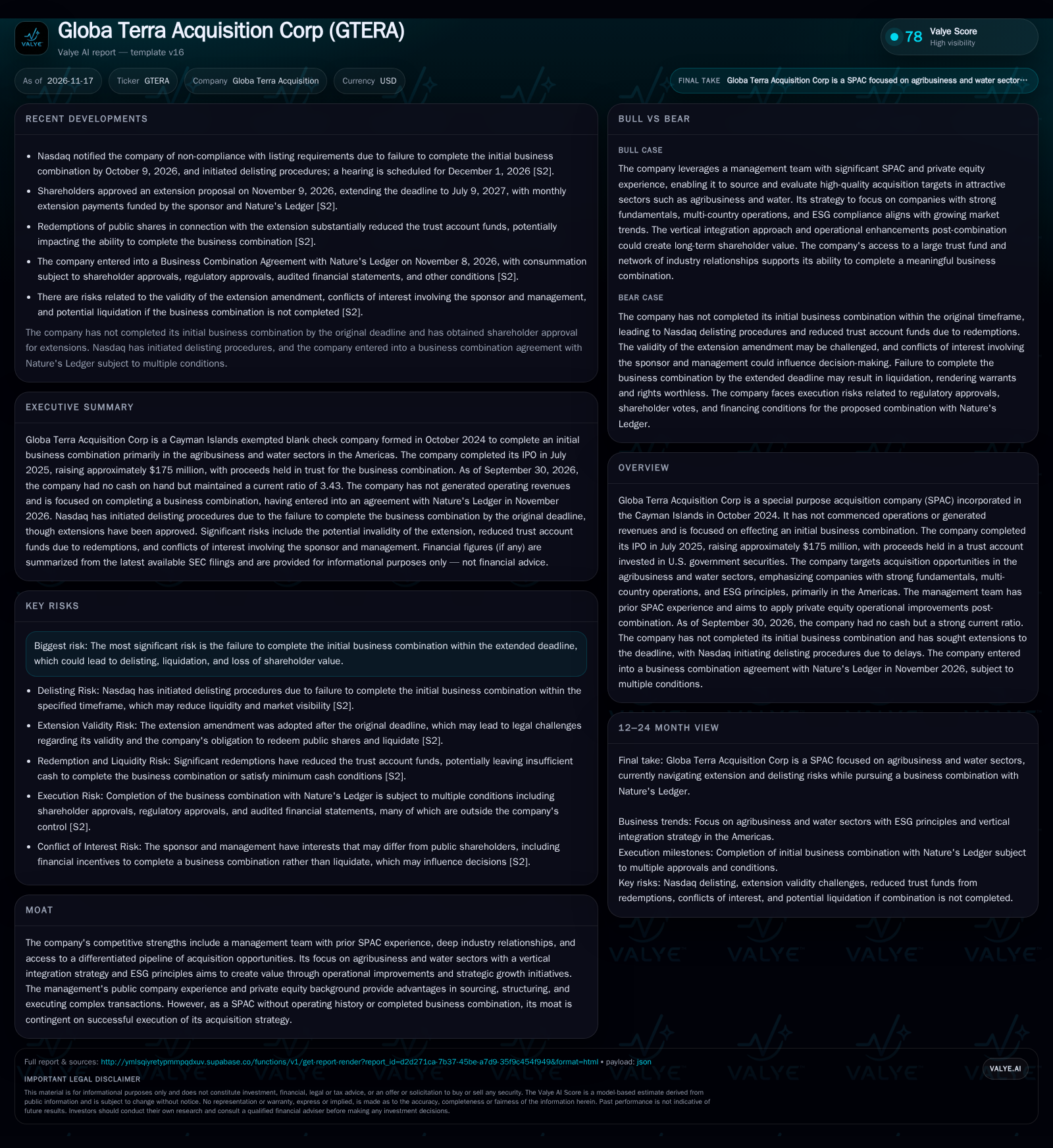
Globa Terra Acquisition Corp, a SPAC focused on food, agriculture, and water assets in the Americas, did not complete its business combination by the original deadline, triggering Nasdaq delisting proceedings. Shareholders approved an extension to July 2027, but steep share redemptions have eroded trust funds, jeopardizing the viability of its pending merger with Nature’s Ledger. Completion now depends on regulatory, shareholder, and financing hurdles amid ongoing sponsor-funded extensions and the risk of forced liquidation if the deal falls through. [S2]
Globa Terra Acquisition Corp exemplifies the high-wire act facing late-stage SPACs in 2026. After missing its original business combination deadline, the company faces Nasdaq delisting and has seen its trust account depleted by substantial redemptions tied to deadline extensions. Its proposed merger with Nature’s Ledger now hinges on overcoming regulatory, legal, and financial hurdles—while sponsor and target-funded extension payments keep the process alive. As the SPAC’s fate is debated in a December delisting hearing, questions about remaining deal capacity, sponsor incentives, and SPAC viability come to the fore.
Redemptions and Delisting Threats Define the Near-Term Outlook
Three developments now dominate Globa Terra Acquisition Corp’s outlook: a) the company’s failure to close a business combination by its original October 9, 2026 deadline, b) a sharp reduction in trust account funds following shareholder redemptions tied to deadline extensions, and c) Nasdaq’s initiation of delisting procedures, with a hearing set for December 1, 2026. [S2] While the company secured shareholder approval to push the deadline to July 9, 2027, this came at the cost of significant redemptions, which have materially reduced the pool of cash available to consummate any merger. [S2]
On November 8, 2026, Globa Terra entered into a business combination agreement with Nature’s Ledger, but the deal’s closing is contingent on multiple conditions, including regulatory and shareholder approvals, and the delivery of audited financials. [S2] The company’s current balance sheet—$0 in cash, $262,099 in current assets, and a current ratio of 3.43—reflects its status as a SPAC with negligible operating liabilities, but the depleted trust account now casts doubt on its ability to fulfill the minimum cash requirements typical of de-SPAC transactions. [S2]
The legal validity of the extension amendment itself is at risk, and if the company cannot close with Nature’s Ledger, it faces liquidation and the potential loss of shareholder value. [S2]
SPAC Economics: Trust Erosion, Sponsor Incentives, and the Narrowing Window for Value Creation
Globa Terra’s business model is the classic SPAC structure: raise capital via IPO, hold funds in trust, and seek a business combination that delivers value to public shareholders and sponsors. The economics are highly sensitive to redemptions, as any reduction in trust account funds directly limits the cash available for the merger and post-closing operations. In this case, substantial redemptions tied to the deadline extension have undermined the original $175 million capital base. [S2]
The sponsor and Nature’s Ledger have funded monthly extension payments, a common practice to keep a SPAC afloat, but this further signals that deal certainty is now heavily dependent on ongoing sponsor support and the willingness of the target to accept a smaller cash component. [S2] If the merger closes, the economics turn on the acquired company’s ability to operate with less cash than anticipated, possibly relying on PIPE (private investment in public equity) financings or alternative capital infusions. If the deal fails, the sponsors lose their at-risk capital, and public shareholders are returned what remains after expenses.
The fixed cost structure of a SPAC—public company compliance, legal, audit, and diligence—becomes increasingly burdensome as the timeline drags on and the trust diminishes. There is little operating leverage until a combination closes, and virtually all pre-combination income is non-operating, derived from interest on trust investments. [S2]
SPAC Landscape Crowds Out Late-Stage Players—Sector Focus May Not Offset Capital Constraints
Globa Terra’s stated targeting of agribusiness, water utilities, and food/ag-tech companies with attractive fundamentals and ESG characteristics offers thematic differentiation. However, the late-stage SPAC market is crowded, and sponsor reputation, capital remaining in trust, and the quality of the proposed target are now the primary differentiators.
The competitive set includes dozens of SPACs still seeking targets or attempting to close combinations under similar time and redemption pressures. Direct competitors are other blank check companies focused on sustainability, infrastructure, or food/water verticals. Indirect competitors are growth equity, private equity, and strategic buyers who can offer more certain, flexible, and possibly less dilutive capital to the same targets.
Globa Terra’s sponsor experience and sector relationships may confer some sourcing advantages, but at this stage, the decisive factor is the ability to deliver sufficient, non-redeemed trust capital and to structure a deal that is both attractive to the target and passing regulatory muster. If the trust is depleted further or if PIPE investors are unwilling to backstop the deal, the company’s negotiating leverage and ability to compete for desirable targets will be diminished.
If Nature’s Ledger Closes—A Path to Public-Company Upside Despite a Smaller Cash Pool
The most favorable outcome is the successful closing of the Nature’s Ledger combination, with sufficient trust or supplemental capital to meet minimum closing conditions. In this scenario, Globa Terra would transition from a shell to a public operating company in the agribusiness/water sector, leveraging the sponsor’s private equity playbook for operational improvements and sector expansion.
For this scenario to materialize, several conditions must be met: regulatory and shareholder approvals must be secured, audited financials must be delivered, and any minimum cash conditions must be satisfied—possibly via new PIPE investment or revised deal terms. Evidence confirming this path would include the announcement of additional capital commitments, regulatory clearance, and definitive proxy materials with a closing timeline.
If the deal closes and the combined entity demonstrates credible growth, margin expansion, or cross-border platform potential, public shareholders could benefit from a re-rating as a differentiated ESG-driven platform. However, with diminished cash, initial execution will likely be scrutinized for capital discipline and early revenue traction.
A Protracted Closing Process with High Execution Risk and Uncertain Deal Economics
The most plausible outcome is a drawn-out closing process, as Globa Terra and Nature’s Ledger attempt to navigate regulatory, legal, and capital hurdles. Ongoing sponsor and target-funded extensions may keep the deal alive, but with the trust account depleted, the final merger terms could be less favorable—potentially requiring significant concessions from the target or additional third-party capital.
This scenario likely features continued uncertainty, with the risk that further redemptions or adverse external conditions (such as a negative delisting determination from Nasdaq) could tip the balance toward liquidation. Evidence confirming this scenario would be continued extension payments, delays in proxy filings or closing-related disclosures, and limited new PIPE or capital raise activity.
Falsifying this scenario would require either a rapid, positive regulatory outcome and capital infusion—accelerating the closing—or a definitive move toward liquidation (e.g., withdrawal of the merger agreement or public acknowledgment that closing conditions cannot be met).
Legal, Regulatory, or Capital Shortfalls Lead to Liquidation and Loss of Sponsor Equity
The adverse scenario is one in which Globa Terra is unable to close the Nature’s Ledger transaction due to failing to meet regulatory, shareholder, or minimum cash conditions. Legal challenges to the extension amendment or an adverse outcome in the Nasdaq delisting process could accelerate a forced liquidation.
In this case, public shareholders would receive a pro rata share of what remains in the trust account after expenses, which may be materially less than the original $10 per share due to cumulative redemptions and costs. Sponsors and warrant holders would likely see their interests rendered worthless, and the proposed combination would collapse.
Evidence supporting this scenario would be: the Nasdaq panel upholding delisting, legal challenges to the extension prevailing, public withdrawal of the merger agreement, or explicit disclosure that trust funds are inadequate to close. Falsification would require the opposite: regulatory and legal clearance, and a confirmed closing timetable.
Milestones That Will Determine Whether Globa Terra Survives as a Public Company
Redemption levels at each extension and proxy event—if disclosed—will directly determine the trust capital available for closing.
Nasdaq delisting panel outcome at the December 1, 2026 hearing will affect market access and deal feasibility.
Progress on securing PIPE or alternative capital to offset trust account depletion would help test the ability to close the Nature’s Ledger deal.
Shareholder and regulatory approval timelines, including proxy filing and vote scheduling, are critical for deal momentum.
Legal challenges to the validity of the extension amendment and any resulting court rulings could force early liquidation.
Announcement or withdrawal of the business combination agreement with Nature’s Ledger will provide a real-time signal of deal viability.
Any changes to minimum cash or other closing conditions in the merger agreement would indicate deal renegotiation and capital structure flexibility.
If disclosed, the specific terms of sponsor and Nature’s Ledger extension funding arrangements may reveal alignment or stress among key stakeholders.
Disclaimer: This is research-only, informational analysis and not investment advice. It may include AI-generated interpretation and general industry context. Always verify important details using primary sources.

Comments