
Hancock Whitney's Multistate Growth Through Relationship Banking and Credit Discipline
This analysis examines Hancock Whitney’s resilient financial performance, expansive regional footprint, disciplined credit practices, and capital allocation strategies to assess future growth prospects.
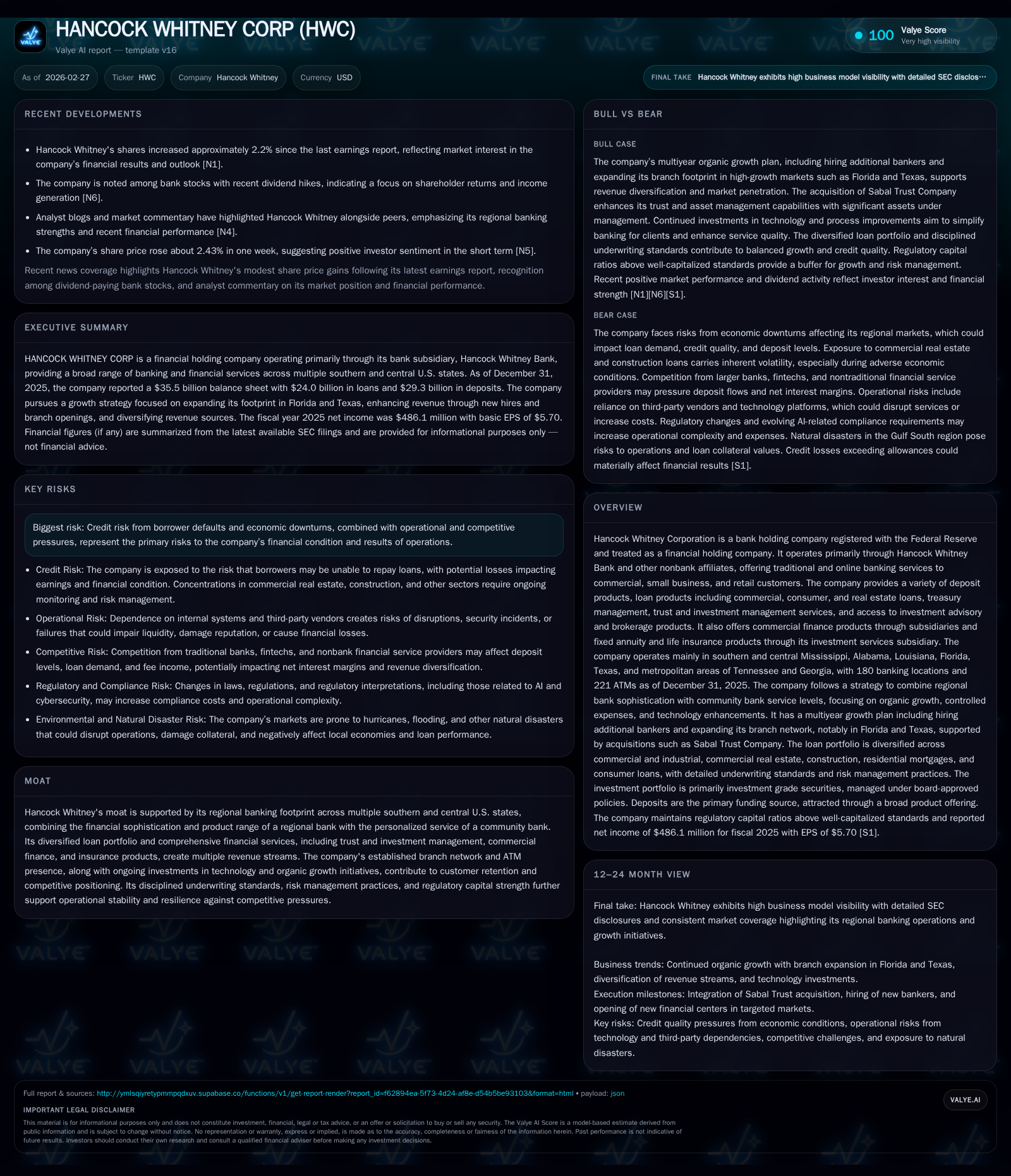
Hancock Whitney Corporation demonstrates durable profitability supported by a multistate regional banking model that blends personalized community service with broad financial offerings. Its ten-year track record shows stable revenue and substantial net income growth driven by diversified loan portfolios and efficient operations. The company’s ongoing organic growth plan focuses on expanding its presence in Florida and Texas through banker hiring and branch openings, supported by robust underwriting standards that manage credit risk effectively. Capital returns have strengthened with notable dividend increases and share repurchases alongside strong regulatory capital ratios sustaining operational resilience. Future growth hinges on continued geographic expansion, technological investments enhancing customer experience, vigilant credit quality management amid macro risks, and consistent execution of its multiyear expansion strategy.
Evolution of Hancock Whitney’s Revenue and Earnings: A Decade of Resilient Growth
Hancock Whitney Corporation has demonstrated sustained financial resilience over the past decade. According to SEC companyfacts data, total revenue remained steady around $979 million from FY2012 through FY2025 [F1], illustrating stability amid fluctuating banking industry environments. More notably, net income soared from $131 million in FY2015 to approximately $486 million by FY2025—a nearly 270% increase over the decade—reflecting enhanced operational efficiency and favorable market conditions for its core businesses [F1]. Operating cash flow exhibited variability with a peak of $842 million in FY2022 before moderating to $542 million in FY2025; meanwhile, capital expenditures shifted upward recently with an 83% year-over-year increase introduced in FY2025 as the bank ramped technology investments and branch infrastructure enhancements [F1]. These trends indicate Hancock Whitney's ability to balance efficiency gains with strategic reinvestment into growth enablers.
Historical performance (annual)
| FY | CFO ($mm) | Capex ($mm) |
|---|---|---|
| 2025 | 542 | 19 |
| 2024 | 626 | 10 |
| 2023 | 495 | 25 |
| 2022 | 842 | 29 |
Source: SEC companyfacts cache [F1].
Capital returns and efficiency (annual)
| FY | Buybacks ($mm) | FCF ($mm) |
|---|---|---|
| 2025 | 247 | 523 |
| 2024 | 38 | 616 |
| 2023 | 0 | 470 |
| 2022 | 59 | 813 |
Source: SEC companyfacts cache [F1].
The significant net income growth during this period suggests Hancock Whitney successfully leveraged its diversified financial product lines and operational efficiencies despite flat revenue figures. This underscores effective margin management where net interest income likely played a central role given sector norms.
Geographic Expansion and Impact on Commercial and Consumer Lending Mix
Hancock Whitney operates predominantly across southern states including Mississippi, Alabama, Louisiana, Florida, Texas, Tennessee, and Georgia with a strategic emphasis on expanding commercial banking relationships in high-growth markets. As detailed in the company's February 2026 SEC filing, the ongoing multiyear organic growth plan initiated in late 2024 centers on hiring additional revenue-generating bankers primarily focused on Florida and Texas markets—a pivot designed to capture emerging commercial opportunities therein [S1][S18]. This hiring initiative has so far yielded a net addition of approximately 22 bankers with plans for about 50 more in the upcoming year.
This workforce expansion is accompanied by physical branch growth; after opening one new financial center in 2025, Hancock Whitney aims to establish four more centers concentrated around North Dallas—underscoring penetration efforts designed to deepen market footprint via relationship banking principles supported by proximity advantages [S1][S18]. Such tactics are classic regional bank strategies aimed at increasing commercial loan volumes while diversifying client exposures across multiple states.
A multi-state footprint underpins not only geographical risk mitigation but also loan portfolio diversification vital for balancing credit concentration risks common in commercial lending-heavy institutions. By targeting both metropolitan hubs and broader southern geographies, Hancock Whitney aligns itself well against competitors who specialize either narrowly or lack scale across these fast-growing corridors.
Loan Portfolio Diversification and Underwriting Standards Driving Credit Quality
The company's loan portfolio comprises a measured mix of commercial and industrial loans, owner-occupied commercial real estate loans, income-producing commercial real estate loans, construction loans—including residential—and consumer loans secured by various collateral types [S4][S6][S7][S9]. The underwriting process adheres stringently to industry-standard metrics such as loan-to-value (LTV) limits tailored per asset class; debt service coverage ratio minimums ensuring borrowers’ timely payment capacity; amortization requirements; global debt-to-income ratios; credit scoring thresholds; and formalized lending limits accompanied by hierarchical credit approval processes [S7].
Internal risk rating frameworks supplement these quantitative boundaries by enabling ongoing portfolio surveillance which calibrates pricing models, monitors concentration tolerances across industries and property types—including shared national credits and healthcare sectors—and assists early identification of credit deterioration through scheduled reviews overseen by dedicated centralized credit officers [S6][S7][S8]. Independent credit review teams provide an additional layer of governance facilitating corrective actions where exposure anomalies arise before they escalate into losses [S8]. This conservative stance reflects an awareness that geographical focus areas entail localized macroeconomic vulnerabilities—including weather events prone to the Gulf Coast region—that could impact borrower cash flows or collateral values materially.
Technological Enhancements and Customer-Focused Innovation as Growth Enablers
Recognizing shifting customer preferences toward digital engagement while maintaining six layers of five-star personalized service remains crucial in their operating strategy [S1]. Investments have been directed at technology platforms designed not simply as channels but as enablers simplifying banking processes for clients—thus improving retention rates while facilitating deposit gathering. In highly competitive southern U.S. markets where customers often weigh convenience heavily against pricing structures offered by well-capitalized rivals or fintech providers, these technology deployments underscore Hancock Whitney’s dual commitment toward enhancing both customer experience fidelity and operational efficiency without speculative future claims [S1].
Dividend Policy and Share Repurchases: Assessing Capital Return Effectiveness
Reflecting growing profitability translated into shareholder distributions, Hancock Whitney announced an 11.1% increase in its quarterly dividend during Q1 2026—the first such hike since late FY2024—signifying confidence in recurrent earnings cash flow generation capacity [N7][F1]. Over the same timeframe, share repurchases surged markedly: from roughly $37 million in buybacks during FY2024 to nearly $247 million repurchased in FY2025—a concerted acceleration endorsing capital discipline intelligently calibrated between dividend yield enhancement and capital structure optimization [F1].
Relative to equity levels near $4.46 billion at end-FY25 versus net income approximating $486 million that year yields an indicative return on equity near 10.9%, highlighting systemic profitability adequate for sustained shareholder returns amidst growing regulatory scrutiny favoring balance sheet fortification [F1].[N7]
Liquidity Management and Regulatory Capital Position Supporting Operational Stability
Effective liquidity management lies at the heart of Hancock Whitney’s operational framework given its deposit-heavy funding model sourced largely through retail branches spanning multiple states—underscored by the importance placed on maintaining access to deposits even under stress scenarios noted within SEC disclosures [S4][S5][S6][S14][S18][S21]. The securities portfolio primarily comprises investment-grade municipal bonds plus U.S agency debt aimed at liquidity support as well as collateralization obligations limiting pledge concentration ratios carefully monitored under asset/liability committee oversight [S10][S14].
Capital adequacy metrics remain comfortably above both minimum regulatory thresholds for well-capitalized status as defined under Basel III standards enforced by federal agencies including Federal Reserve review encompassing CET1 ratios above prescribed levels alongside leverage ratios exceeding required minimums of approximately 5% versus mandated baseline of 4%, thus enabling flexibility for dividends/share buybacks without compromising safety buffers or triggering prompt corrective action constraints [S15].
Depositor confidence remains a core consideration particularly post recent broader regional bank sector volatility since early-2023 failures elsewhere heightened sensitivity around uninsured deposits prompting rigorous contingency planning internally supported by transparent risk disclosures regarding liquidity risk factors related both to macroeconomic conditions impacting deposit flows as well as securities valuation risks should liquidation become necessary under adverse mark-to-market realizations[S11].[S14]
Future Outlook: Expansion Plans, Market Risks, and Credit Environment Considerations
Looking ahead, Hancock Whitney’s articulated strategy projects sustained multiyear organic growth through recruiting up to approximately fifty bankers in FY2026 emphasizing Florida and Texas markets alongside several branch openings focusing on North Dallas expansion signaling continued investment in relationship banking footprints capable of supporting diversified loan origination pipelines aligned with community-bank style client intimacy combined with regional-banking product sophistication [N7][S1].[S18]
Nevertheless, recognized risks persist broadly consistent with those beleaguering regional bank cohorts; specifically elevated credit risk tied to economic downturn effects remain paramount—particularly within concentrated real estate segments exposed to volatile market pricing or construction financing where repayment depends on successful project completion or refinancing availability illustrating sensitivity balanced against strict underwriting guardrails [N10][N11][S12][S16].[N7]
Operationally though competition intensifies from non-bank financial providers along with constrained funding cost dynamics fueled partially by deposit rate competition may pressure net interest margins necessitating close attention towards fee income diversification trajectories highlighted by recent earnings beats pointing towards adaptive business models emphasizing ancillary revenue drivers outside pure interest spread reliance[N1].[N7]
Key Metrics to Watch in Upcoming Earnings Reports for Validation of Growth Trajectory
Analysis points towards monitoring trends within fee income streams which complement core net interest income growth rates historically demonstrated as crucial profitability components for banks like Hancock Whitney experiencing modest top-line variation but amplified bottom-line expansion[N1],[N7]. Loan loss provisions warrant continuous scrutiny given their direct linkage to portfolio quality maintenance amid potentially shifting macroeconomic signals impacting borrower repayment profiles particularly within commercial real estate loan clusters.
Further scrutiny on dividend payment sustainability paired with buyback cadence will shed light on evolving capital allocation priorities providing clear signals regarding management’s outlook on earnings stability relative to balance sheet strength commanded.[N7]
Disclaimers: This analysis is based exclusively on publicly available data as cited from SEC filings and specified news sources up to February 27, 2026. It does not constitute any form of investment advice or recommendation but rather aims to provide an informed overview grounded strictly on disclosed company facts.
Disclaimer: This is research-only, informational analysis and not investment advice. It may include AI-generated interpretation and general industry context. Always verify important details using primary sources.

Comments