
ITT Inc.'s Operational Resilience Amid Tariff Headwinds: Financial Strength and Strategic Navigation
ITT Inc. demonstrates robust financial health and strategic agility to surpass earnings expectations despite ongoing global trade challenges.
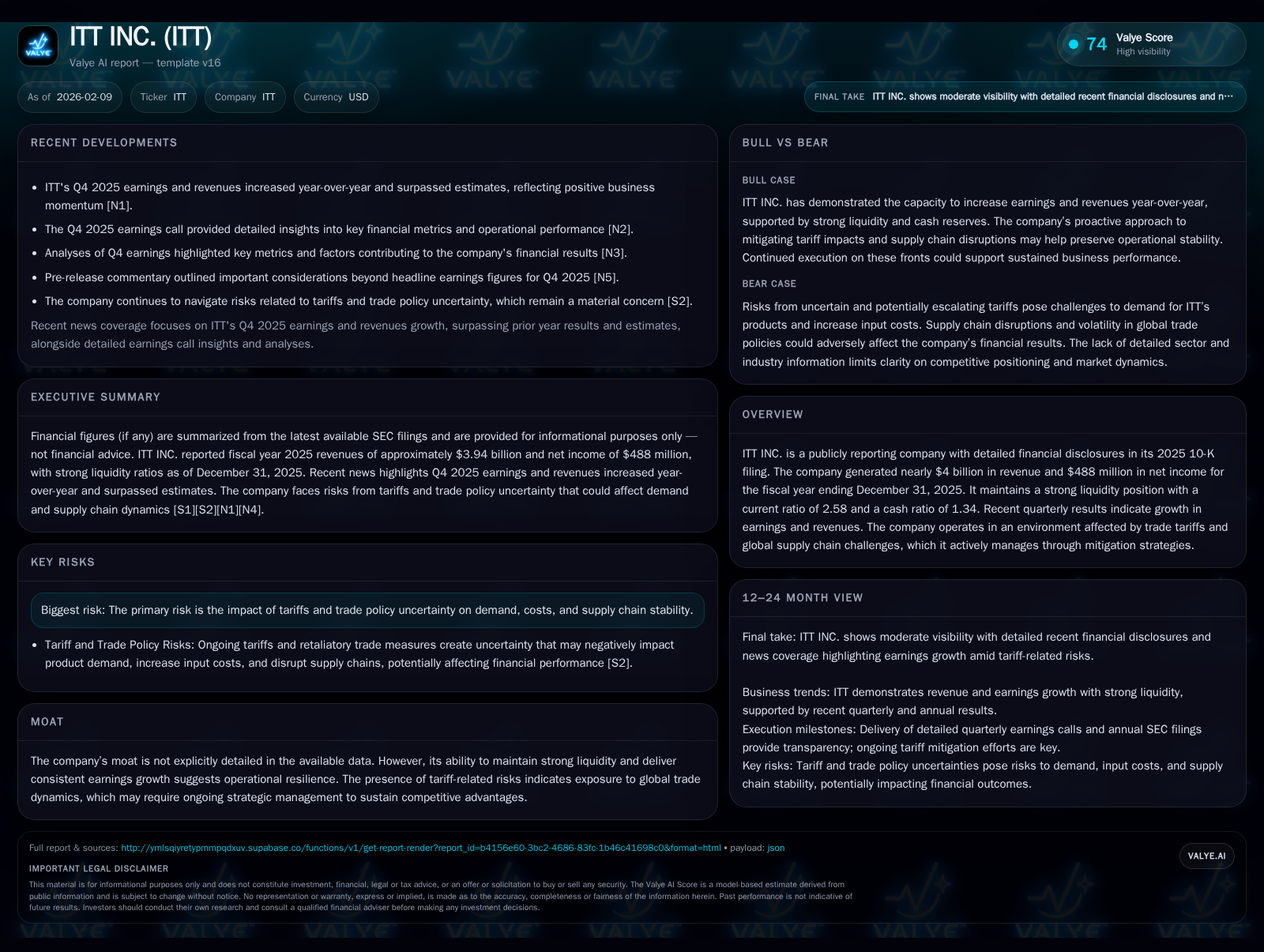
For the fiscal year ending in 2025, ITT Inc. posted nearly $4 billion in revenue and $488 million in net income, marking continued growth driven by strong operational execution. The company’s liquidity ratios of 2.58 (current) and 1.34 (cash) underpin its capacity to absorb external shocks, notably rising trade tariffs that have complicated supply chain dynamics. Through diversified sourcing, pricing strategies, and proactive supplier/customer negotiation, ITT is managing tariff-related risks with measured optimism, while maintaining growth engines across its product lines. Comparatively, ITT offers a resilient profile among diversified industrials, balancing near-term risks with solid financial footing.
Surpassing Expectations: The Latest Quarterly Snapshot
ITT Inc.'s Q4 2025 performance showcased an encouraging earnings beat relative to analyst projections, defying broader headwinds from escalating global trade tensions. Reported revenues increased year-over-year, surpassing estimates comfortably [N1][N4], while net income growth aligned with improved operational leverage indicators highlighted during the earnings call [N2]. This quarterly momentum underscores an ability to sustain top-line expansion even as key competitors face more volatile outcomes amid supply chain disruptions.
The earnings call provided nuanced insight into drivers behind this outperformance: selective pricing initiatives have held firm despite inflationary pressures on inputs, and targeted operational efficiencies within manufacturing have helped offset rising raw material costs. Additionally, ITT made clear that customer demand in certain industrial end markets remained stable or modestly expanded, cushioning tariff-related impacts.
Financial Fortitude: Liquidity and Profitability Deep Dive
A particularly compelling aspect of ITT’s financial profile is its pronounced liquidity strength as disclosed in the 2025 10-K filing [S1]. With current assets totaling approximately $3.35 billion against current liabilities near $1.3 billion, the resulting current ratio of 2.58 signifies ample short-term solvency—a cushion not always evident among industrial peers navigating similar pressures.
Moreover, the cash ratio close to 1.34—reflecting about $1.74 billion in cash and equivalents—affirms immediate liquidity accessibility to fund operational needs or strategic initiatives without reliance on external financing amid uncertain credit markets.
Profitability metrics reveal a net income margin roughly at 12.4% ($488 million net income on $3.94 billion revenue), indicating effective absorption of incremental costs related to tariffs and supply chain adjustments without significant margin erosion [F1]. This margin resilience enhances confidence in management's ability to preserve earnings quality under duress.
Navigating Tariff Turbulence: Mitigation Strategies in Action
ITT faces persistent headwinds stemming from U.S. government tariffs imposed primarily on imports from China and retaliatory measures by trading partners [S2]. The company explicitly acknowledges ongoing risks that may adversely impact demand, increase input costs, or disrupt supply chains—risks further amplified by unpredictable policy shifts.
In response, ITT has executed several mitigation tactics aimed at preserving operational continuity and financial outcomes:
- Supplier diversification reduces overreliance on any single geography vulnerable to tariffs.
- Strategic negotiations with both suppliers and customers aim to share or absorb cost impacts pragmatically.
- Targeted pricing actions help offset cost inflation, maintaining margins without severely dampening demand.
While these initiatives provide meaningful risk dampening today, ITT cautions that the evolving geopolitical landscape may still introduce unforeseen challenges requiring ongoing management agility.
Growth Engines and Operational Resilience
Despite tariff-driven macro uncertainties, ITT’s fundamental business units—diversified technology-driven operations catering to critical infrastructure and industrial markets—continue powering growth trajectories [N7][N12][S1].
Though the company’s moat is not formally delineated in disclosures, its operational resilience manifests through sustained revenue gains alongside stable profitability amid complexity. This suggests embedded capabilities in engineering innovation, customer relationships, and supply chain management that collectively foster durability.
Industry commentary highlights ITT alongside peer diversified operations firms managing similar external shocks while capitalizing on niche market segments less prone to cyclicality or commoditization — factors supporting continuing top-line momentum even if headline market conditions remain challenging.
Weighing the Risk Landscape: Trade Policies and Market Volatility
Trade policy uncertainty remains the foremost risk contour shaping ITT’s near-term outlook [S2]. As tariff regimes evolve unpredictably—with both extensions of existing levies and potential new protectionist measures—the resultant variability can impact:
- Demand patterns for affected industrial components given price sensitivities.
- Cost structures especially for imported raw materials or intermediate goods subject to duties.
- Supply chain reliability tied to logistical complexities or regulatory constraints.
Such volatility introduces potential fluctuations in quarterly results beyond typical industrial cyclicality norms. Investors considering exposure must reflect upon these downside scenarios balanced against demonstrated corporate mitigation efforts and financial buffers articulated earlier.
Comparative Context: ITT within Its Industry and Peer Universe
When situated among comparable value-focused candidates such as CIB (Cibus), ITT presents a blend of stable fundamentals with managed risk exposures that differentiate its risk-reward complexion [N8][N9][N13].
Analysts note that while both stocks face macro headwinds—from transportation cyclicality to input cost inflation—ITT's stronger liquidity profile combined with relatively consistent earnings trends may offer a more attractive defensive posture amid sector uncertainties [N11].
Moreover, industry outlooks emphasizing diversification advantages position ITT well relative to peers heavily concentrated in singular end markets or geographies vulnerable to acute trade disruptions [N12]. This situates ITT favorably within the broader industrial landscape for investors prioritizing resilience alongside reasonable value metrics.
Valuation Verdict: Is ITT a Compelling Value Play?
From a valuation standpoint anchored on fundamental financial data, ITT’s recent growth beats reinforce a narrative of operational strength yet invite cautious interpretation given latent tariff risks [N8][valye_report_excerpt][F1].
High liquidity ratios reduce default risk concerns; meanwhile sustained profit margins support intrinsic earning power that may justify premiums relative to historical trading multiples.
Nonetheless, unresolved tariff uncertainties impose a ceiling on valuation expansion until clarity emerges around durable trade peace or demonstrable long-term cost optimization success. Hence valuation attractiveness depends squarely on investor risk appetite calibrated against the company’s proven ability to navigate complexity without sacrificing core competitiveness.
Forward-Looking: Strategic Considerations and Investor Takeaways
Looking ahead, management commentary from the latest earnings call reinforces commitment to strategic discipline amidst fluid external conditions [N2]. Key takeaways include:
- Continued emphasis on leveraging supplier diversity and customer collaboration as frontline defenses against tariff-driven interruptions.
- Ongoing investments in efficiency improvements designed to safeguard margins irrespective of input cost fluctuations.
- A cautiously optimistic stance regarding organic growth prospects fueled by stable demand segments resistant to broader economic weakness.
While risks remain material—with trade policy volatility chief among them—the company’s combination of strong balance sheet positioning and proactive adaptation frameworks bodes well for sustaining financial health through at least the medium term horizons currently visible.[S2][valye_report_excerpt]
In sum, ITT stands as a notable example of how an industrial firm can convert near-term headwinds into validated resilience through focused execution — an instructive case for value-conscious observers tracking global trade ramifications closely.
The analysis presented here synthesizes publicly available data sources including recent SEC filings and market reports but does not constitute investment advice or recommendations. Readers should consider independent professional consultation tailored to their individual circumstances before forming any opinion regarding investment decisions.
Disclaimer: This is research-only, informational analysis and not investment advice. It may include AI-generated interpretation and general industry context. Always verify important details using primary sources.

Comments