
iWallet’s Push Toward Luxury Biometric Security: Prototype Progress, Capital Constraints, and the Stakes of Market Entry
iWallet has completed working prototypes of its next-generation biometric wallets and is preparing for pre-sales and manufacturing, targeting luxury consumers with co-branding ambitions.
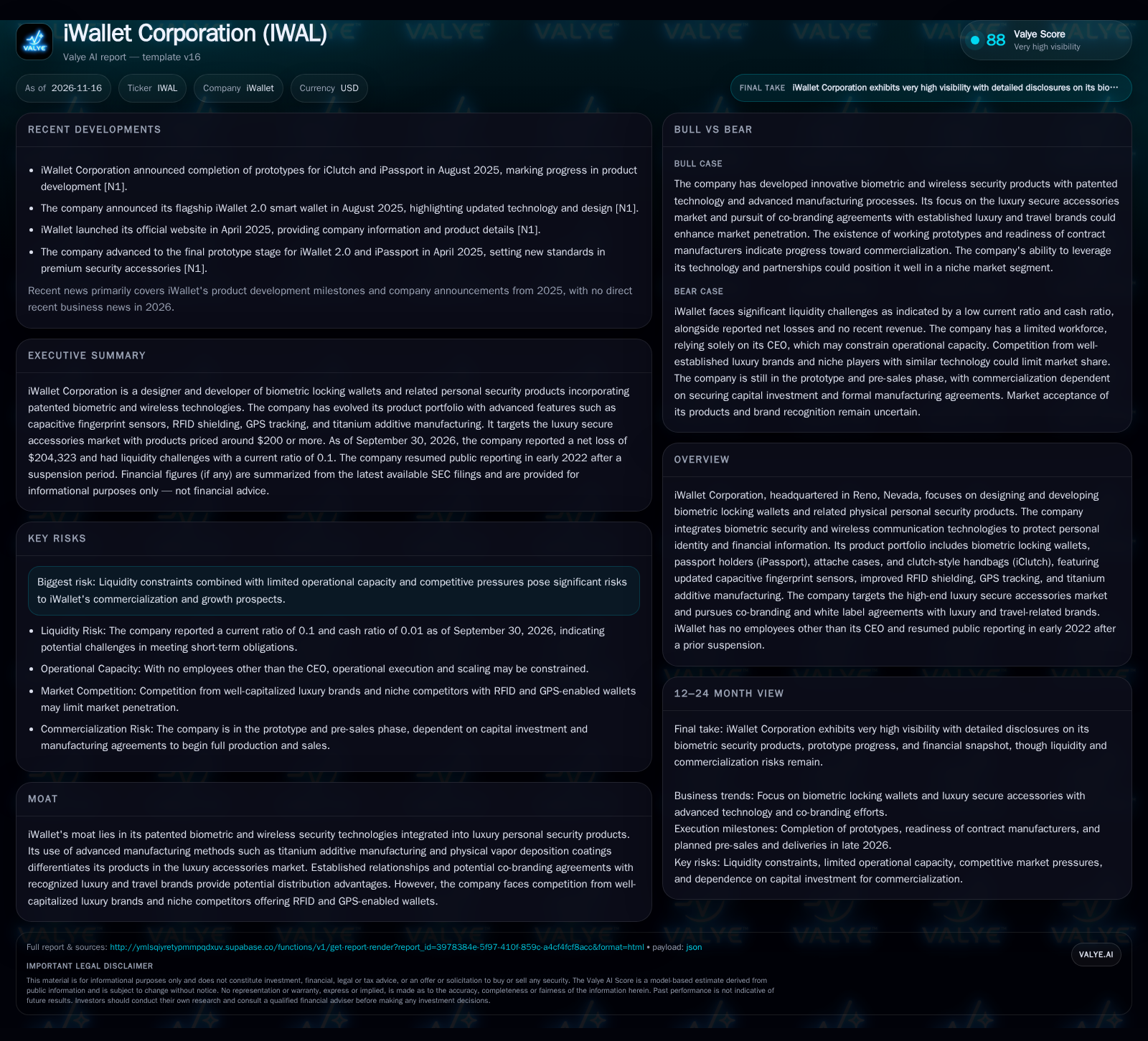
iWallet has completed working prototypes of its next-generation biometric wallets and is preparing for pre-sales and manufacturing, targeting luxury consumers with co-branding ambitions. However, the company’s cash position is extremely limited, with a current ratio of 0.1 and no revenues reported in 2026. Execution now hinges on securing capital, fulfilling pre-sales, and differentiating in a market crowded with established luxury and tech-forward niche competitors. [S2]
iWallet Corporation is poised at a critical inflection point, with advanced prototypes of biometric security wallets and accessories ready for pre-sales and production—provided it can secure the necessary capital. The business is targeting a high-end consumer niche through technology-driven differentiation and co-branding ambitions. Success will now depend on iWallet’s ability to translate technical progress and luxury positioning into sustainable commercial traction against formidable competition. [S2]
Prototype Readiness and Liquidity Crunch Shape iWallet’s Near-Term Outlook
As of November 2026, iWallet Corporation has completed working prototypes of its next-generation biometric wallets, passport holders, and clutch accessories, integrating features such as capacitive fingerprint authentication, RFID shielding, and GPS tracking. The company has identified contract manufacturers and component suppliers ready to commence production, contingent on capital investment and sales forecasts. However, the company’s financial position is precarious: as of September 30, 2026, iWallet reported just $8,923 in cash, $91,604 in current assets, and $872,557 in current liabilities, resulting in a current ratio of 0.1 and a cash ratio of 0.01. No revenue was reported for the first half of 2026, and the net loss for the nine months ended September 30 was $204,323. Plans are in place to begin pre-sales in Q3 2026 and direct deliveries in Q4, but these milestones hinge on overcoming near-term liquidity and operational execution hurdles. [S2]
Monetizing Biometric Security in Luxury Accessories: Pricing, Margins, and Fixed-Cost Dilemmas
iWallet’s business model aims to capture value from the convergence of luxury branding and biometric security, targeting consumers willing to pay $200 or more for secure wallets, passport holders, and personal accessories. In theory, this positioning enables premium pricing and higher per-unit contribution margins than mass-market competitors, especially if the company can leverage co-branding or white label agreements with luxury and travel brands. However, the economics of hardware-driven consumer products are typically capital-intensive, with significant upfront costs tied to tooling, manufacturing scale, inventory, and channel relationships.
The company’s reliance on external contract manufacturers could provide some operational flexibility and reduce fixed cost commitments compared to vertically integrated peers. However, without scale, unit economics may be challenged by high minimum order quantities, component costs, and the need to invest in marketing and brand-building. With only one employee (the CEO), iWallet’s fixed operating expenses may be low, but this also limits capacity for business development, customer support, and scaling partnerships. Ultimately, gross margins and cash flow will depend on the company’s ability to achieve sufficient sales volume and maintain premium pricing amid luxury and tech-driven competition.
Differentiation Versus Established Luxury Brands and Agile Tech Entrants
iWallet is positioning itself at the intersection of luxury accessories and personal security technology. Its core differentiation lies in patented biometric authentication, advanced RFID/GPS features, and the use of premium materials and manufacturing techniques. The company is seeking to amplify this edge through co-branding with luxury and travel brands, potentially gaining distribution and brand halo effects.
However, iWallet faces formidable competition on two fronts. First, established luxury brands such as Louis Vuitton, Cartier, Gucci, and others command entrenched distribution, marketing muscle, and consumer trust. These brands can rapidly incorporate incremental technology features (RFID, GPS) and leverage their global scale. Second, niche tech-forward competitors—such as Ekster, Nomad, and Zitahli—offer innovative wallets with similar features, often at lower price points and with digital-native marketing strategies. The question is whether iWallet can carve out a defensible niche with its technology, patents, and potential partnerships, or whether it will be squeezed by better-capitalized luxury incumbents and nimble startups.
If Co-Branding and Pre-Sales Gain Traction, iWallet Could Carve Out a Profitable Niche
The most favorable outcome for iWallet would involve successfully securing capital to commence production, followed by strong pre-sales and early adoption from luxury consumers and travel enthusiasts. If the company can finalize co-branding or white-label agreements with recognized luxury or travel brands, this could provide both sales volume and critical brand credibility. Early customer testimonials, positive reviews, and visible placement with luxury partners would support premium pricing and help offset marketing and distribution costs.
Confirmation of this scenario would come from disclosed pre-sales volumes meeting or exceeding internal targets, announcements of formal co-branding agreements with major partners, and evidence of repeat orders or expanded product lines. If iWallet can demonstrate positive gross margins and early revenue traction within the first two quarters of commercial sales, the business could achieve operating leverage and attract further capital for scaling.
Commercial Launch Proceeds, but Sales Ramp and Brand Penetration Remain Unproven
The most plausible near-term trajectory is that iWallet secures just enough capital—either through pre-sales, bridge financing, or small-scale investment—to initiate limited production and fulfill initial orders. The company enters the market with its next-generation products, but faces a slow ramp as it competes for consumer attention and luxury channel acceptance. Margins may be pressured by small batch manufacturing and promotional expenses needed to generate early traction.
Under this scenario, iWallet’s revenue growth is modest, with sporadic sales and ongoing cash burn. The company gradually builds relationships with potential co-branding partners and may secure one or two small-scale collaborations, but does not immediately achieve broad distribution or strong brand recognition. Confirmation would come from initial sales figures in late 2026 and early 2027, evidence of manufacturing execution, and incremental progress on partnership discussions. Failure to show material revenue or partnership advances by mid-2027 would suggest the company is struggling to break through.
Liquidity Shortfall and Competitive Pressures Threaten Commercial Viability
The primary risk is that iWallet’s acute liquidity constraints prevent it from moving beyond the prototype stage. If capital is not secured promptly, contract manufacturers may not commence production, and pre-sales may falter due to long lead times or lack of consumer trust. Even if limited production begins, the company could struggle to fulfill orders at scale or absorb operational setbacks.
In this scenario, established luxury brands accelerate their own tech-infused accessories, while niche competitors capture the early-adopter segment with aggressive marketing and lower prices. iWallet may be forced to discount products, deplete remaining cash, and ultimately face insolvency or asset sale. Confirmation would come from missed pre-sales and delivery milestones, further deterioration in working capital, undisclosed delays in manufacturing, or the absence of new partnership announcements.
Milestones That Will Define iWallet’s Commercialization and Brand Trajectory
Announcement and volume of pre-sales orders for iWallet 2.0 and related products; disclosed figures would provide a direct test of early market demand.
Formal confirmation of co-branding or white-label agreements with major luxury or travel brands, with details on scale, exclusivity, and distribution channels.
Evidence of initial deliveries and fulfillment execution in Q4 2026 and early 2027, including customer satisfaction or product reviews (if disclosed).
Updates on capital raised, whether through equity, debt, or bridge financing, and the company’s ability to improve its working capital position.
Gross margin and per-unit economics upon ramping production—a useful metric would be disclosed COGS and ASPs for early sales batches.
Progress on expanding the product portfolio or securing follow-on orders from distribution partners.
Competitive responses from established luxury brands and niche tech competitors, especially new product launches or aggressive pricing moves.
Any change in the company’s operational capacity, such as additions to the management team or new hires, which would test scalability.
Disclaimer: This is research-only, informational analysis and not investment advice. It may include AI-generated interpretation and general industry context. Always verify important details using primary sources.

Comments